
😥“A FINAL FAREWELL.” Ann Widdecombe’s loved ones will gather first for a private funeral shared only with family and close friends, before a public memorial gives admirers the chance to celebrate her remarkable life and legacy.
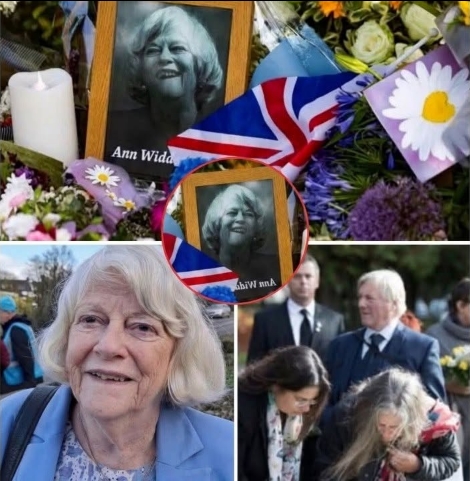
A Final Farewell: Ann Widdecombe’s Family Prepares Private Funeral Before Public Memorial
Ann Widdecombe’s family is preparing for a private final farewell, as Britain continues to reflect on the life, legacy and sudden death of one of the country’s most recognisable political figures.
The former Conservative minister, Brexit campaigner, Reform UK spokeswoman and television personality died at the age of 78 after being found at her home in Haytor, on Dartmoor, Devon, on 9 July 2026. Her death shocked Westminster and the wider public, not only because of her decades in politics, but because of the serious criminal case that has since followed.
In a statement released after widespread public interest, her family confirmed that a private service for family and close friends would be held first, with invitations already distributed. A more public memorial will follow later in the year, allowing admirers, former colleagues and supporters to pay tribute to a public life that spanned Parliament, television, European politics and national debate. The family said they were “very grateful” for the wide expression of condolences, but asked that the initial service remain limited to those closest to her.
The announcement captures the difficult balance now facing those who loved her. Ann Widdecombe was a public figure whose career belonged, in many ways, to the country. But her funeral is first and foremost a private act of grief. For family and close friends, the first farewell will not be about politics, headlines or public argument. It will be about saying goodbye to someone they knew personally-beyond the speeches, controversies and television cameras.
A Private Funeral Before a Public Memorial
The family’s decision to hold a private funeral before a public memorial is both practical and deeply human. Widdecombe’s death generated intense national attention. Tributes came from across political life, but so did questions about the circumstances of her death, the ongoing police investigation and the court proceedings that have followed. A private funeral allows those closest to her to grieve without the pressure of cameras, public commentary or political theatre. It protects the emotional space that families often need most after a sudden and traumatic loss.
The later public memorial will serve a different purpose. It will give the wider country a chance to remember Widdecombe as a political figure, a broadcaster, a campaigner, a woman of faith and one of the most distinctive personalities in modern British public life.
That separation matters.
A funeral belongs to the family.
A memorial belongs partly to history.
The Legal Case Continues
The funeral arrangements are taking place while the criminal case linked to Widdecombe’s death continues through the courts. Joshua Kerry, 28, from Rotherham, South Yorkshire, has been charged with her murder. He has been remanded in custody, and court proceedings are ongoing. Sky News reported that prosecutors alleged in court that Widdecombe was attacked while eating lunch at her home, but those details remain allegations at this stage and have not been tested at trial.
That distinction is essential. A charge is not a conviction. A court allegation is not yet a legal finding. The accused remains entitled to due process and the presumption of innocence unless and until a jury reaches a verdict. Authorities have also continued to investigate possible motive. AP reported that police were examining whether there may have been any political or terrorist connection because of Widdecombe’s public profile, but no final motive has been established in court.
For the family, that means grief and justice are moving on different timelines. The funeral will come long before the full legal process reaches its conclusion. The public memorial may also take place before all the evidence has been heard. That is often the painful reality in high- profille criminal cases: loved ones must mourn while the courts continue slowly and carefully.
A Death That Shocked Westminster
Ann Widdecombe’s death struck a powerful emotional chord because she had been part of British public life for almost four decades.
She first entered Parliament in 1987 as a Conservative MP and later served in ministerial roles under John Major, including as prisons minister. She was known for her strong views on law and order, social issues, religion, Europe and public morality. After leaving the House of Commons, she remained active in politics, later serving as a Brexit Party MEP and becoming associated with Reform UK. At the time of her death, she was a Reform UK spokeswoman on immigration and justice. But Widdecombe was not only a politician.
She became a familiar figure to millions through television. Her appearances on Strictly Come Dancing and Celebrity Big Brother brought her to audiences who may never have followed
parliamentary debates. She became a rare kind of public figure: part politician, part commentator, part national character. To her supporters, she represented courage, conviction and plain-speaking conservatism.
To her critics, she represented a politics that was too rigid, too socially conservative and too unwilling to move with the times. But even many who disagreed with her acknowledged that she was unmistakably herself. In an era of carefully managed political messaging, Widdecombe was difficult to package. She was direct, often severe, sometimes funny, frequently controversial and rarely vague. That made her admired, disliked, quoted, mocked and remembered.
A Woman of Faith
Any serious account of Ann Widdecombe’s life must include her faith.
She converted to Roman Catholicism in 1993, a decision that reflected deep convictions rather than political calculation. Her religious beliefs shaped much of her public identity and influenced her views on moral questions, conscience and public duty. Reports after her death described Buckfast Abbey as a place of spiritual importance to her, close to her Dartmoor home and closely linked to her Catholic life. The Times reported that a Mass at Buckfast Abbey was redirected to honour her memory, with tributes focusing on her faith, fearlessness and public service.
For Widdecombe, faith was not a decorative part of her personality. It was central.
It gave structure to her life. It helped explain her political positions. It also helped explain why she remained so unmoved by criticism. She often appeared to believe that public approval mattered less than conscience. That could make her difficult in debate. It could also make her unusually resilient. Whether people agreed with her or not, her faith gave her public life a seriousness that supporters respected and critics often challenged.
A Divisive but Unforgettable Public Figure
Ann Widdecombe’s legacy cannot be described in simple terms. She was admired by many and strongly opposed by many others. Her views on abortion, LGBTQ+ rights, immigration, crime, Europe and religion made her a symbol of conviction for some and intolerance for others. She was often at the centre of cultural arguments long before the phrase “culture war” became common in British politics.
Yet part of her staying power came from the fact that she never seemed desperate to be liked.
She accepted controversy as the cost of saying what she believed. She did not chase modernity. She did not soften easily. She did not disappear when her parliamentary career ended.
Instead, she found new platforms.
She wrote. She broadcast. She campaigned. She performed. She argued. She reinvented herself without appearing to become someone else. That is rare in politics. Many politicians fade when office ends. Widdecombe did not.
The Public Reaction
The announcement of a private service followed by a public memorial has prompted renewed reflection on how Widdecombe should be remembered. For those who admired her, the memorial will be a chance to honour a woman they saw as principled, patriotic and unafraid to speak plainly. For those who disagreed with her, it may be a moment to recognise the scale of her public life without rewriting the controversies that accompanied it. That is the difficult task of remembering any major political figure honestly. Tribute should not require erasing disagreement. Criticism should not require denying humanity. A fair assessment of Ann Widdecombe must hold both truths together: she was a deeply consequential figure to many people, and she was also a deeply contested one.
A Career Built on Certainty
Widdecombe’s political style was built on certainty.
In Parliament, she was known for discipline, seriousness and a willingness to take unpopular positions. As prisons minister, she became associated with a tough approach to criminal justice. As a social conservative, she often spoke from a moral framework that placed her at odds with social change.
In later years, her support for Brexit brought her back into frontline political debate. She became one of the public faces of a movement that reshaped British politics and eventually helped take the UK out of the European Union.
For supporters, that made her a democratic fighter.
For critics, it placed her on the wrong side of a national rupture.
But either way, she was not peripheral.
She was part of the story.
The Television Reinvention
One reason Widdecombe remained so widely recognised was her unexpected second life in entertainment.
Her appearance on Strictly Come Dancing was not remembered for technical excellence, but it was remembered. She became part of the show’s history because she leaned into the absurdity of it with a kind of stern self-awareness that audiences found compelling.
It softened her image for some viewers.
It made her seem less like a Westminster scold and more like a public character willing to laugh at herself.
But it did not erase her politics.
That mixture-stem moralism and unexpected theatricality-became part of the Widdecombe brand. She could appear in a sequined costume on television and still return to a political interview with uncompromising views.
Few public figures have managed that combination.
The Private Person Behind the Public Voice
The funeral announcement also reminds the public that there was a private person behind the voice.
Public figures are often flattened by debate. They become positions, quotes, memes, villains or heroes. In Widdecombe’s case, her strong personality made that even more likely.
But those preparing for her private funeral will not be saying goodbye to a headline.
They will be remembering a friend, relative, colleague and woman of faith.
That is why the family’s request for privacy matters.
The public may feel a connection to a figure who appeared on their screens for decades. But grief belongs first to those who knew her when the cameras were gone.
Why the Memorial Matters
The later public memorial will likely become an important moment for political reflection.
It will give former colleagues and admirers space to speak about her life in the broader sense: her parliamentary service, her faith, her contribution to Brexit politics, her role in television and her impact on public debate.
It may also become a moment to consider the dangers faced by public figures in Britain.
AP noted that Widdecombe’s death revived concerns about violence against politicians, following the murders of Labour MP Jo Cox in 2016 and Conservative MP David Amess in 2021.
That concern is not abstract.
British public life has become increasingly tense, and politicians across parties have warned of rising abuse, threats and intimidation. Widdecombe was no longer a sitting MP, but she remained a prominent political figure. That has made the question of motive especially sensitive.
Still, any discussion of motive must remain cautious until the courts establish the facts.
The Importance of Legal Restraint
In the age of social media, high-profile deaths are often followed by speculation, rumours and political claims before evidence is fully known.
This case is no exception.
Because Widdecombe was a controversial political figure, some have rushed to frame her death through political narratives. But the responsible position is to wait for the legal process.
The court will decide whether the accused is guilty.
Investigators will continue examining motive.
The public should avoid treating allegations as proven fact.
That restraint is not weakness. It is the foundation of justice.
A society cannot demand law and order while ignoring due process.
Remembering Without Simplifying
When the public memorial eventually takes place, there will likely be many versions of Ann Widdecombe on display.
There will be Ann Widdecombe the Conservative MP.
Ann Widdecombe the minister.
Ann Widdecombe the Catholic convert.
Ann Widdecombe the Brexit campaigner.
Ann Widdecombe the Reform UK spokeswoman.
Ann Widdecombe the television personality.
Ann Widdecombe the controversial culture-war figure.
Ann Widdecombe the private woman mourned by friends and family.
All of them are real.
That is why her legacy cannot be reduced to one sentence.
She was not simply “beloved.” She was not simply “controversial.” She was both admired and criticised, celebrated and challenged, familiar and unknowable.
Her public life created strong reactions because she had strong beliefs.
A Final Goodbye in Two Stages
The phrase “final goodbye” carries different meanings here.
For the family, the private funeral will be the true goodbye-intimate, emotional and shielded from public attention.
For the country, the later memorial will be a public act of remembrance.
The two should not be confused.
The private service is about love and grief.
The public memorial is about legacy and history.
Together, they reflect the two lives Ann Widdecombe lived: the private life of faith, friendship and personal routine, and the public life of argument, conviction and national attention.
Conclusion: A Life That Will Continue to Be Debated
Ann Widdecombe’s loved ones will gather first in private, away from the cameras and commentary, to mourn a woman whose life meant far more to them than politics.
Later, a public memorial will allow supporters and admirers to celebrate her remarkable and often controversial legacy.
The criminal case connected to her death remains before the courts. A man has been charged, but no verdict has been reached. Investigators have examined possible motive, but the public must wait for the legal process before drawing conclusions.
For now, the focus returns to her family’s request: privacy for the first farewell, and time for the wider public to pay tribute later.
Ann Widdecombe leaves behind a legacy that will not be remembered in only one way.
Some will remember her as a fearless conservative.
Some will remember her as a divisive political voice.
Some will remember her faith.
Some will remember the television moments that made her unexpectedly familiar to a new generation.
But perhaps most will remember that she was never vague, never easily ignored and never afraid to stand apart.
Her final farewell will begin quietly, among those who knew her best.
Her public legacy will continue to be debated for years to come.