
Street Prayer Debate in Montreal and Quebec Rekindles National Discussion on Public Space, Religious Freedom and Social Cohesion
A public gathering involving street prayer in Montreal has renewed debate across Canada over religious expression, the use of public space and the responsibilities of governments in maintaining public order. Videos circulating on social media have attracted significant attention, with users offering sharply different interpretations of what occurred. While some posts characterize the incident as evidence of growing tensions between religious communities, others caution that short clips often lack important context and should not be treated as a complete record of events.
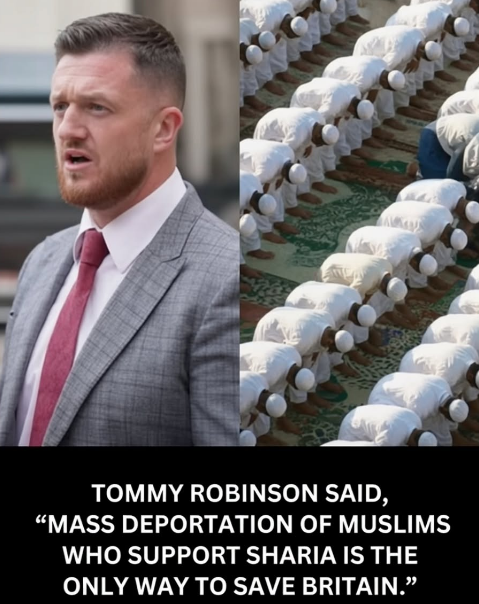
The discussion has intensified following renewed attention to Quebec’s approach to public religious demonstrations. Provincial authorities have previously expressed concern about organized public prayer in certain settings, arguing that activities taking place in streets or other shared public spaces can create practical challenges and, in some circumstances, contribute to tensions. Supporters of tighter rules say governments have a responsibility to ensure that public areas remain accessible to everyone while preventing unnecessary confrontation between different groups.
Critics, however, argue that restrictions affecting religious gatherings must be carefully balanced against constitutional protections for freedom of religion, freedom of peaceful assembly and freedom of expression. Civil liberties organizations have emphasized that any limitations imposed by governments should be justified by legitimate public-order concerns, applied equally to all groups and remain proportionate to the circumstances. They caution against measures that could be interpreted as targeting a particular faith community.
The viral footage itself has become a subject of debate. Different social media accounts have attached conflicting descriptions to the same video, with some claiming it shows an organized confrontation while others argue it depicts only a brief disagreement that was later resolved. At the time of writing, the available clips alone do not establish the full sequence of events before recording began or after it ended. Journalists and fact-checkers therefore recommend relying on verified reporting and official statements rather than isolated excerpts.
Questions surrounding religious gatherings in public spaces have become increasingly prominent in several Western democracies. Municipal authorities frequently balance competing interests, including freedom of worship, traffic management, public safety, noise regulations and the rights of nearby residents and businesses. Similar discussions have taken place in cities across Europe and North America involving a variety of religious and non-religious public events.
Quebec has long maintained a distinctive approach to secularism in public life. Provincial legislation concerning state secularism and religious neutrality has generated significant public discussion in recent years, reflecting Quebec’s historical emphasis on the separation of religion and state institutions.
Supporters argue that these policies reinforce equality and common civic values, while critics contend that some measures disproportionately affect religious minorities.
Legal experts note that Canada’s Charter of Rights and Freedoms protects freedom of religion, but like other constitutional rights, those protections are not absolute. Governments may impose reasonable limits that can be demonstrably justified in a free and democratic society. Whether a particular restriction satisfies that legal test depends on its purpose, scope and practical application, and may ultimately be determined by the courts if challenged.
Community leaders from various religious backgrounds have urged restraint in public discussion of the Montreal incident. Christian representatives have emphasized the importance of respectful coexistence and the peaceful resolution of disagreements. Muslim organizations have likewise called for dialogue and rejected attempts to portray the actions of individuals as representative of an entire faith community. Many interfaith groups have encouraged Canadians to avoid escalating tensions through inflammatory rhetoric on social media
Public safety specialists observe that emotionally charged videos frequently spread faster than verified information. Dramatic captions, selective editing and missing context can influence public opinion before investigators or journalists have established what occurred. As a result, responsible reporting distinguishes between confirmed facts, eyewitness accounts, official statements and claims circulating online.
The controversy has also highlighted broader questions about how democratic societies accommodate increasing religious diversity while preserving shared public spaces. Supporters of stricter regulation argue that governments should establish clear, content-neutral rules governing all public demonstrations regardless of the beliefs involved. Others believe existing laws already provide sufficient authority to address disruptions without introducing additional restrictions.
Political reactions have reflected wider debates over integration, secularism and social cohesion. Some elected officials have argued that clearer rules are needed to prevent future disputes, while others have warned against allowing isolated incidents to shape policy affecting entire communities. Analysts note that such debates often become symbolic discussions about national identity as much as about the specific events themselves.
Constitutional scholars stress that policies regulating public assemblies must generally be applied consistently regardless of religion or viewpoint. If governments regulate street activities because of public safety, traffic or access concerns, those rules ordinarily apply across comparable events rather than to one faith alone. Equal application is widely regarded as an essential safeguard for both public confidence and constitutional legitimacy.
Social media has amplified every stage of the discussion. Millions of users have viewed short clips, while political commentators from across the ideological spectrum have offered competing interpretations. The speed with which these narratives develop illustrates how viral content increasingly shapes public debate before complete factual records become available.
Whatever the final assessment of the Montreal incident, it has underscored the continuing challenge of balancing freedom of religion, freedom of assembly, public order and mutual respect within diverse democratic societies. As officials, community leaders and legal experts continue examining these questions, many observers argue that lasting solutions will depend less on viral moments than on transparent institutions, equal application of the law and constructive dialogue among Canada’s many religious and cultural communities.
The debate is therefore likely to continue well beyond the viral videos themselves. While public opinion remains divided, the issues raised-constitutional rights, secularism, community relations and the management of shared public spaces will remain central to Canada’s ongoing
conversation about how a diverse society accommodates different beliefs while maintaining social cohesion and respect for the rule of law.