
Florida Legislation on Foreign Law and Security Sparks National Debate Over Religious Freedom, Public Safety, and Constitutional Rights
Florida has once again become the center of a national political debate after Governor Ron DeSantis signed legislation expanding the state’s approach to domestic security while reinforcing existing restrictions concerning the application of certain foreign laws in Florida’s courts. Supporters describe the measures as necessary steps to strengthen public safety, protect constitutional governance, and ensure that American law remains the exclusive legal framework in the state. Critics, however, argue that aspects of the legislation could contribute to misunderstanding, stigmatization, or unnecessary concern among Muslim communities, despite repeated statements from state officials that the measures are not directed at any particular religion.
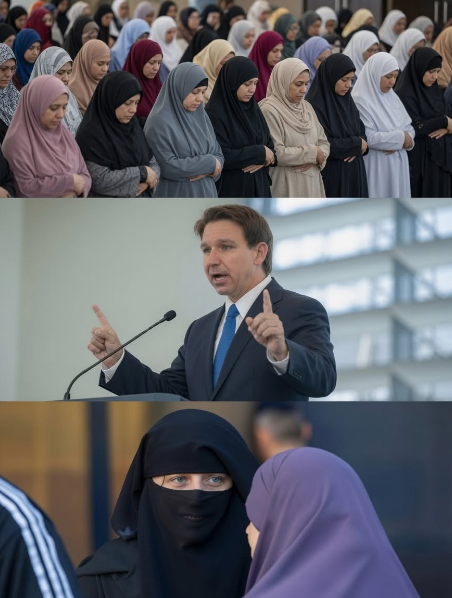
Governor DeSantis has long positioned Florida as a state willing to adopt policies that differ from those pursued in many other parts of the United States. Throughout his administration, he has argued that state government should take an assertive approach to issues involving public safety, border security, constitutional rights, and what he describes as threats posed by extremist ideologies. Supporters view this philosophy as a commitment to proactive governance, while opponents contend that it often relies on highly polarized political messaging.
The legislation builds upon Florida’s existing legal framework regarding foreign law. Previous state law already limited the application of foreign legal principles in Florida courts whenever they would conflict with the rights guaranteed by the United States Constitution or the Florida Constitution. State officials have argued that these protections ensure that judicial decisions remain grounded in American constitutional law rather than legal systems that may not recognize equivalent civil liberties or due process protections.
Supporters of the legislation emphasize that the measures are written in religion-neutral language. They argue that the objective is not to regulate religious belief or peaceful religious practice but rather to ensure that public institutions, courts, and government agencies operate exclusively under American constitutional principles. From this perspective, the legislation applies equally regardless of whether questions arise involving religious law, customary law, or any other foreign legal system that conflicts with constitutional protections.
Another component of the legislation focuses on organizations involved in criminal or terrorist activity. State officials have said the law strengthens Florida’s ability to respond to entities that provide material support for terrorism or engage in activities threatening public safety. Supporters argue that governments have a responsibility to prevent public resources from benefiting organizations connected to unlawful or violent conduct and maintain that these provisions are intended to reinforce existing national security efforts rather than create new restrictions on lawful religious organizations.
Governor DeSantis stated that Florida’s policies are designed to protect constitutional government, individual liberty, and public safety. Administration officials have repeatedly argued that American law must remain the supreme legal authority within the state’s judicial system. They also emphasize that peaceful religious practice-including Islam, Christianity, Judaism, Hinduism, Buddhism, and other faiths continues to enjoy constitutional protection under both federal and state law.
Civil rights organizations, including the Council on American-Islamic Relations (CAIR), have criticized aspects of the legislation. They argue that although the statutory language may be facially neutral, political rhetoric surrounding such measures can lead some Muslim residents to believe they are being singled out because of their faith. Representatives of these organizations contend that American Muslims overwhelmingly reject violent extremism and that legislation should avoid creating the perception that ordinary religious observance is associated with security concerns.
Other legal advocacy groups have expressed similar concerns regarding the broader social impact of legislation addressing foreign law or extremism. They caution that public debate can sometimes blur the distinction between violent organizations and peaceful religious communities. These organizations argue that governments should continue pursuing individuals and groups involved in criminal conduct while ensuring that constitutional protections for freedom of religion, expression, and association remain fully respected.
Constitutional scholars note that the United States legal system already provides significant safeguards regarding the application of foreign law. American courts generally cannot enforce any foreign legal principle that conflicts with constitutional rights or established public policy. For that reason, some legal experts argue that legislation specifically addressing foreign law may be largely symbolic, while others believe such statutes provide additional clarity and public reassurance regarding constitutional supremacy.
The debate also reflects broader political disagreements over national security and immigration. Supporters of stronger legislative measures argue that governments should act before potential threats develop rather than waiting until criminal activity occurs. They contend that maintaining clear legal standards strengthens public confidence and reinforces the constitutional framework upon which American government is based.
Critics respond that effective counterterrorism depends primarily on intelligence gathering, law enforcement cooperation, and criminal prosecution rather than broad political messaging. They argue that successful security policy requires strong partnerships with communities, including Muslim Americans, who have frequently cooperated with authorities in preventing violent extremism and identifying potential security threats.
Religious freedom remains a central constitutional issue throughout the discussion. The First Amendment protects the free exercise of religion while prohibiting government establishment of religion. Courts have consistently held that individuals are generally free to practice their faith unless specific conduct violates otherwise applicable laws. Consequently, peaceful observance of Islam, Christianity, Judaism, or any other religion remains constitutionally protected regardless of ongoing political debates concerning public policy.
Political analysts observe that legislation involving security, immigration, and constitutional identity often resonates strongly with voters because it touches upon fundamental questions regarding national values and the role of government. As a result, debates surrounding such measures frequently extend well beyond the legal text itself, becoming part of broader discussions about identity, public confidence, and competing visions for the country’s future.
The Florida legislation is therefore likely to remain the subject of continued legal, political, and public discussion. Advocacy organizations may continue evaluating whether any provisions raise constitutional concerns, while state officials are expected to defend the law as consistent with both federal and state constitutional principles. If future litigation arises, courts will ultimately determine how the legislation should be interpreted and applied.
Ultimately, the controversy illustrates the challenge democratic societies face in balancing multiple constitutional principles at once. Governments have a legitimate responsibility to protect public safety and combat violent extremism. At the same time, they must safeguard religious liberty, equal treatment under the law, and the constitutional rights enjoyed by every resident. Supporters believe Florida’s approach strengthens constitutional governance and national security. Critics contend that policymakers should ensure security measures are implemented in ways that avoid stigmatizing peaceful religious communities. As debate continues, the law is likely to remain an important part of the wider national conversation about security, civil liberties, religious freedom, and the enduring role of the Constitution in American public life.