
Tensions Rise at Poland’s Eastern Border: New Incident Renews Debate Over Security, Migration, and Europe’s Response
A renewed incident along the Poland-Belarus border has once again drawn public attention to one of Europe’s most closely watched frontiers. According to statements from Polish authorities, border personnel recently intercepted a large group of people attempting to enter Poland from Belarus without authorization. While such incidents have occurred repeatedly in recent years, each new development continues to fuel political discussion across Europe about border management, migration policy, humanitarian responsibilities, and regional security.
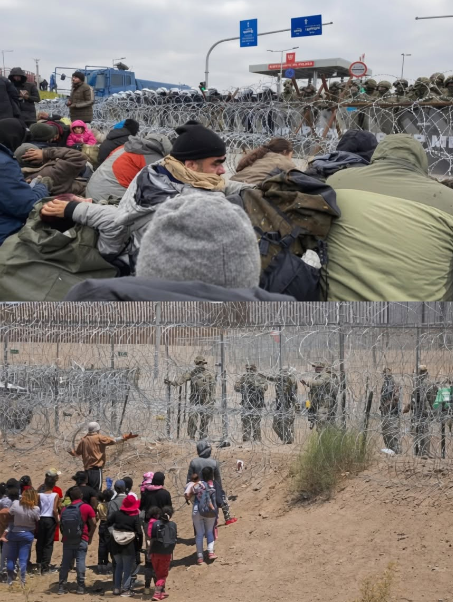
The latest reports have emerged against the backdrop of an ongoing migration dispute that has shaped relations between Poland, Belarus, the European Union, and neighboring countries for several years. Officials in Warsaw have argued that the pressure at the eastern border is not solely a matter of irregular migration but forms part of a broader geopolitical challenge. Belarus, meanwhile, has rejected accusations that it deliberately facilitates migration toward the European
Union. As with previous incidents, differing interpretations of events have contributed to continued debate among governments, analysts, humanitarian organizations, and the public.
According to information released by Polish border authorities, officers detected a sizable group attempting to cross into Polish territory from Belarus. Border personnel reportedly responded by preventing the crossing and maintaining control of the area. Authorities stated that surveillance systems, physical barriers, and patrol units played an important role in identifying the attempted crossing before individuals were able to travel further into Polish territory. Independent verification of every detail surrounding the incident remains limited, and official investigations or additional reporting may provide further clarification.
Poland has significantly expanded its border infrastructure since the migration crisis intensified in 2021. The country has constructed fencing, installed electronic surveillance systems, increased patrols, and deployed additional personnel along large sections of its eastern frontier. Officials say these measures are intended to reduce unauthorized crossings while improving the ability of border guards to respond quickly to developing situations. Supporters argue that the investments have strengthened national security, while critics continue to question whether physical barriers alone can address the broader causes of migration.
The Poland-Belarus border has become one of Europe’s most politically significant external borders. Unlike migration routes across the Mediterranean Sea, where maritime rescue operations often receive international attention, crossings along the eastern frontier involve forests, wetlands, and remote terrain. These conditions create unique operational challenges for both border authorities and humanitarian organizations. Weather conditions, difficult landscapes, and limited accessibility can complicate rescue efforts when migrants become stranded between border zones.
European Union officials have repeatedly emphasized that protecting the Union’s external borders is an essential responsibility of member states. At the same time, EU institutions have consistently stressed that border protection should remain consistent with international law, including obligations related to asylum procedures and the treatment of vulnerable individuals. Balancing these two objectives has proven to be one of the most complex aspects of European migration policy, particularly when governments face increasing political pressure from domestic audiences concerned about security.
Polish leaders have frequently described the situation at the Belarusian border as more than a conventional migration challenge. Government officials have argued that Belarus has encouraged or facilitated the movement of migrants toward the EU’s eastern frontier in an effort to place political pressure on neighboring countries. Belarusian authorities have denied these allegations, maintaining that they are not responsible for migration decisions made by individuals seeking entry into the European Union. The disagreement remains a central element of broader tensions between Belarus and Western governments.
Migration has become one of Europe’s most divisive political issues over the past decade. Different governments have adopted varying approaches depending on domestic political priorities, legal interpretations, economic conditions, and geographic location. Some countries have favored stronger border enforcement combined with stricter asylum procedures, while others have emphasized expanded humanitarian assistance and increased cooperation among EU member states. The diversity of these approaches often complicates efforts to establish a unified European migration strategy.
Supporters of Poland’s border policies argue that effective border control is essential for maintaining national sovereignty and public confidence in immigration systems. They contend that governments must know who enters their territory and under what legal circumstances. According to this
perspective, preventing unauthorized crossings discourages organized smuggling networks and helps ensure that legitimate asylum applications are processed through established legal channels rather than through irregular entry.
Others, including humanitarian organizations and refugee advocacy groups, have expressed concerns about the conditions faced by migrants attempting to cross the border. Human rights organizations have documented instances in previous years where individuals became trapped between border areas for extended periods while lacking adequate access to food, medical care, shelter, or legal assistance. These organizations have called for continued monitoring of border operations and greater transparency regarding the treatment of migrants encountered during enforcement activities.
The latest incident also highlights the growing importance of technology in modern border management. Poland has invested in surveillance cameras, thermal imaging equipment, motion sensors, drones, and integrated monitoring systems designed to detect movement along difficult terrain. Security experts note that technological improvements have increased authorities’ ability to identify unauthorized crossings more quickly than was possible in previous years. Nevertheless, experts also caution that no technological system is capable of eliminating irregular migration entirely, particularly across extensive land borders.
Beyond the immediate operational response, incidents at the Poland-Belarus border often influence political debates throughout Europe. Migration remains a prominent issue in national elections across several EU member states, where political parties frequently differ on questions concerning asylum, deportation, labor migration, border enforcement, and humanitarian obligations. News reports involving large attempted crossings can quickly become part of broader discussions about immigration policy, national security, and European integration.
Security analysts also point to the broader geopolitical environment surrounding the region.
Relations between Belarus, the European Union, NATO members, and neighboring countries remain strained due to multiple diplomatic and security issues extending beyond migration alone. Consequently, developments at the border are often interpreted within a wider strategic context rather than solely as isolated migration events. This broader perspective influences how governments assess risks and determine appropriate policy responses.
Public opinion regarding migration varies considerably across Europe. Surveys conducted over recent years have shown that many citizens support stronger border controls while also expressing support for humanitarian assistance to individuals genuinely fleeing conflict or persecution. These views are not necessarily contradictory; rather, they reflect the complexity of balancing national security concerns with commitments under international refugee law. Policymakers therefore face the difficult task of addressing multiple public expectations simultaneously.
Legal experts note that international refugee law distinguishes between unauthorized border crossings and the right to seek asylum. Individuals may request asylum even after entering or attempting to enter a country’s territory, provided legal procedures are followed. Governments, however, retain authority to regulate border entry and determine whether applicants meet the legal criteria for international protection. The interaction between these principles often becomes the subject of judicial review and policy debate across Europe.
The situation has also prompted discussions about the role of international cooperation. Many analysts argue that migration pressures cannot be addressed solely through national measures because migration routes frequently span multiple countries and regions. Cooperation involving origin countries, transit states, destination governments, international organizations, and humanitarian agencies is often viewed as an essential component of long-term migration management. At the same time, political disagreements can make coordinated responses difficult to achieve.
Economic factors remain another important dimension of migration. Many migrants attempting to reach Europe are motivated by a combination of conflict, political instability, economic hardship, climate-related challenges, or limited employment opportunities in their countries of origin. Addressing these underlying drivers generally requires long-term international development efforts in addition to immediate border management policies. While border enforcement may influence migration routes, researchers often emphasize that it does not eliminate the broader conditions encouraging migration.
Within Poland itself, public discussion reflects a range of opinions. Some citizens emphasize the importance of maintaining secure borders in light of regional security concerns, while others advocate ensuring that humanitarian standards remain central to all border operations. Civil society organizations, academic researchers, religious groups, and local communities have all contributed perspectives on how Poland should balance security with international obligations. These discussions continue alongside parliamentary debates and evolving government policy.
The European Union has repeatedly stated that protecting external borders remains essential to maintaining the integrity of the Schengen Area, where internal border controls are generally minimized. Effective management of external borders is viewed by many policymakers as necessary to preserve freedom of movement within much of Europe. Consequently, developments at the Poland-Belarus frontier often attract attention beyond Poland itself because they relate to broader questions affecting the EU as a whole.
As investigations and official reporting continue regarding the latest attempted crossing, additional information may further clarify exactly what occurred during the incident and whether any subsequent legal or humanitarian actions were taken. For now, the reports have once again highlighted the ongoing challenges facing governments attempting to balance border security. international law, humanitarian considerations, and regional stability. With migration expected to remain a defining political issue across Europe in the years ahead, developments along Poland’s eastern border are likely to continue attracting close attention from policymakers, analysts, and the wider public.