
Tommy Robinson and Muslim Heckler Exchange Sparks Online Debate Over Free Speech, Public Protest, and Political Polarization
Public confrontations involving controversial political figures often extend far beyond the moment itself. In the age of smartphones and social media, a brief exchange captured on video can quickly become a national or even international-discussion about free speech, public behavior, political identity, and social cohesion. Such incidents rarely remain confined to the individuals involved. Instead, they become symbols through which broader disagreements about society are debated.
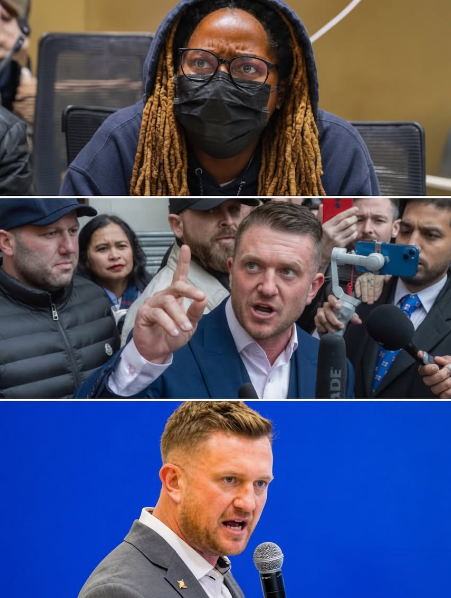
A recent confrontation involving British activist Tommy Robinson and a Muslim heckler has become another example of this phenomenon. Video clips circulating online show a heated verbal exchange between Robinson and an individual challenging him in a public setting. The footage has attracted significant attention across social media platforms, generating thousands of comments, reactions, and competing interpretations. While supporters and critics of Robinson have each presented their own narratives about what occurred, the available short clips alone do not necessarily provide the complete context surrounding the encounter. As with many viral videos, determining the full sequence of events requires caution until additional verified information is available.
The exchange has once again placed Tommy Robinson at the center of public discussion. Robinson, whose real name is Stephen Yaxley-Lennon, has remained one of Britain’s most recognizable and controversial political activists for well over a decade. Supporters describe him as someone willing to raise issues they believe mainstream politicians and media organizations avoid discussing, particularly topics relating to immigration, integration, public safety, and Islamist extremism. Critics, however, argue that his rhetoric contributes to social division, unfairly stigmatizes Muslim communities, and inflames political tensions. Because of these sharply opposing views, almost every public appearance involving Robinson tends to generate significant public attention.
According to videos widely shared online, the latest confrontation began during what appeared to be a public gathering where Robinson was interacting with members of the public. At some point, an individual identified by numerous online accounts as a Muslim man began challenging Robinson verbally. What followed was an increasingly heated exchange, with both men speaking forcefully while bystanders watched and, in some cases, recorded the incident on their phones. Different versions of the footage emphasize different parts of the conversation, making it difficult to determine precisely how the interaction began or whether any comments have been omitted through editing.
As the clips spread online, social media users quickly divided into opposing camps. Some argued that Robinson remained composed while responding to criticism and defended his right to express his political opinions publicly. Others contended that the confrontation reflected the increasingly hostile nature of political discourse and criticized the tone adopted during the exchange. Still others suggested that both participants contributed to escalating the situation, highlighting the difficulty of maintaining constructive dialogue when discussions involve emotionally charged political and religious subjects.
One reason the video has attracted such widespread attention is the broader political environment in which it emerged. Immigration continues to rank among the most debated issues in the United Kingdom. Successive governments have introduced measures intended to reduce irregular migration, reform asylum procedures, and strengthen border enforcement. At the same time, humanitarian organizations, legal experts, and civil society groups have continued to argue that migration policies should uphold international legal obligations while protecting vulnerable individuals. Because these debates touch on questions of national identity, economic policy, security. and human rights, public emotions often run high whenever related incidents receive widespread publicity.
Religious identity has likewise become an increasingly visible aspect of Britain’s broader public conversation. The United Kingdom has long described itself as a multicultural society, with diverse religious communities contributing to national life. Muslims represent one of the country’s largest religious minorities and participate across business, education, healthcare, politics, public service, and numerous other sectors. However, discussions concerning integration, discrimination, religious freedom, counterterrorism, and social cohesion have periodically generated political controversy. Incidents involving individuals identified through religious affiliation therefore often attract attention extending well beyond the immediate event itself.
The viral nature of modern social media further amplifies these moments. Short video clips can accumulate millions of views within hours, yet they frequently lack surrounding context. A recording beginning halfway through a conversation may unintentionally-or deliberately-shape public perception by excluding earlier remarks. Likewise, edited versions emphasizing only the most dramatic exchanges may receive substantially greater engagement than longer, more complete recordings. As a result, journalists, researchers, and digital literacy experts often encourage viewers to seek full footage whenever possible before reaching definitive conclusions about what occurred.
The online response to the Robinson confrontation reflects broader trends in digital political engagement. Algorithms frequently promote emotionally engaging material because users are more likely to comment, share, or react to controversial content. As discussions become increasingly polarized, many participants interpret events primarily through existing political loyalties rather than evaluating each incident independently. Supporters often view footage as confirmation of previously held beliefs, while opponents may reach equally confident but opposite conclusions using the same evidence. This dynamic contributes to growing political polarization across many democratic societies.
Another important dimension concerns freedom of expression. The United Kingdom protects freedom of speech while also maintaining laws addressing harassment, threatening behavior, incitement to violence, and certain forms of hate speech. Balancing these principles has become an ongoing subject of legal and political debate. Some argue that robust democratic societies should tolerate even deeply offensive opinions unless they directly incite violence or criminal conduct. Others contend that governments have a responsibility to protect vulnerable communities from speech that may encourage hostility or discrimination. Incidents like this frequently revive these longstanding discussions.
Public confrontations also raise questions regarding civic culture and respectful disagreement. Democracies rely upon the ability of citizens holding fundamentally different beliefs to coexist peacefully despite profound disagreements. Political rallies, public speeches, demonstrations, and protests are all longstanding features of democratic societies. Yet maintaining productive public discourse becomes considerably more difficult when conversations deteriorate into personal hostility. Many observers therefore emphasize the importance of encouraging vigorous but respectful debate, even when discussing highly sensitive subjects involving politics, religion, or national identity.
Media organizations covering controversial incidents often face challenges of their own. Decisions about which clips to publish, which quotations to highlight, and how headlines are framed can significantly influence public understanding. Responsible journalism generally seeks to distinguish verified facts from opinion, provide relevant context, identify uncertainties, and avoid drawing conclusions unsupported by available evidence. Where conflicting accounts exist, careful reporting acknowledges those differences rather than presenting speculation as established fact. This approach becomes especially important when covering rapidly evolving stories driven largely by social media content.
Experts studying political communication note that confrontational encounters frequently become symbolic rather than merely personal. Viewers often project broader societal concerns onto a single exchange between two individuals. For some audiences, Robinson represents concerns about immigration, national sovereignty, or free speech. For others, he symbolizes exclusionary politics or rhetoric they consider harmful toward minority communities. Similarly, interpretations of the individual challenging Robinson may differ substantially depending upon viewers’ own political experiences and assumptions. Consequently, public reactions often reveal as much about broader social divisions as they do about the specific confrontation itself.
The role of online communities further shapes how such events are understood. Social media users frequently create highlight compilations, commentary videos, reaction streams, and discussion threads within hours of a viral incident. These secondary interpretations often reach audiences far larger than the original footage itself. Influencers, commentators, journalists, and political organizations may each frame the same encounter differently, emphasizing aspects consistent with their own editorial perspectives. This multiplicity of interpretations contributes to an increasingly fragmented information environment where consensus becomes difficult to achieve.
Academic researchers examining political polarization have observed similar patterns across numerous democracies. As citizens increasingly consume news through personalized digital feeds, individuals are more likely to encounter interpretations reinforcing existing viewpoints. Confirmation bias-the tendency to favor information supporting preexisting beliefs-can make balanced evaluation more challenging. Consequently, two people viewing identical footage may reach entirely different conclusions regarding what occurred, why it happened, and who bears primary responsibility.
It is also worth recognizing that confrontations involving highly recognizable public figures rarely occur in isolation. Robinson’s previous activism, legal history, media appearances, and public statements inevitably influence how audiences interpret any new incident involving him. Likewise, broader discussions concerning Islam, immigration, counterterrorism, community relations, and British politics provide context that shapes public reaction. Understanding the significance of the latest exchange therefore requires appreciating these wider social and political dynamics rather than focusing solely upon a few minutes of recorded footage.
For viewers seeking to evaluate the incident objectively, several principles remain valuable. First, distinguish clearly between verified facts and interpretations offered by commentators or social media users. Second, whenever possible, review longer or complete recordings rather than relying exclusively on edited clips. Third, consider multiple credible news sources that present differing perspectives. Finally, remain open to revising initial impressions should additional verified information emerge. Such habits are increasingly important in an era where viral content spreads faster than comprehensive reporting.
Ultimately, the confrontation between Tommy Robinson and a Muslim heckler has become more than a brief public argument. It has evolved into another focal point for ongoing national conversations surrounding political polarization, immigration, religious diversity, freedom of expression, and the influence of social media on democratic debate. Whether individuals ultimately sympathize with Robinson, his critic, both participants, or neither, the incident illustrates how quickly isolated moments can become catalysts for much broader public discussion.
As of now, publicly available information primarily consists of videos and online commentary, and the complete context of the encounter may not yet be fully established. Readers should therefore approach claims circulating on social media with appropriate caution and recognize the distinction between verified reporting and opinion. While debates surrounding this incident are likely to continue, careful evaluation of evidence, respectful dialogue, and a willingness to consider differing perspectives remain essential for understanding controversial events in an increasingly polarized public sphere.