
Poland–Belarus Border Crisis: Viral Images of Migrants Facing Polish Security Forces Resurface — But the Story Is More Complicated Than “Muslims Tried to Mass Migrate Into Poland”
Images from the Poland–Belarus frontier have returned to social media alongside dramatic claims that large numbers of Muslims attempted to enter Poland and were simply “rejected.” The photographs reflect a real and serious border confrontation, particularly the 2021 crisis, but framing the episode primarily around religion leaves out crucial facts about migration status, Belarus’s role, asylum law and the humanitarian consequences.
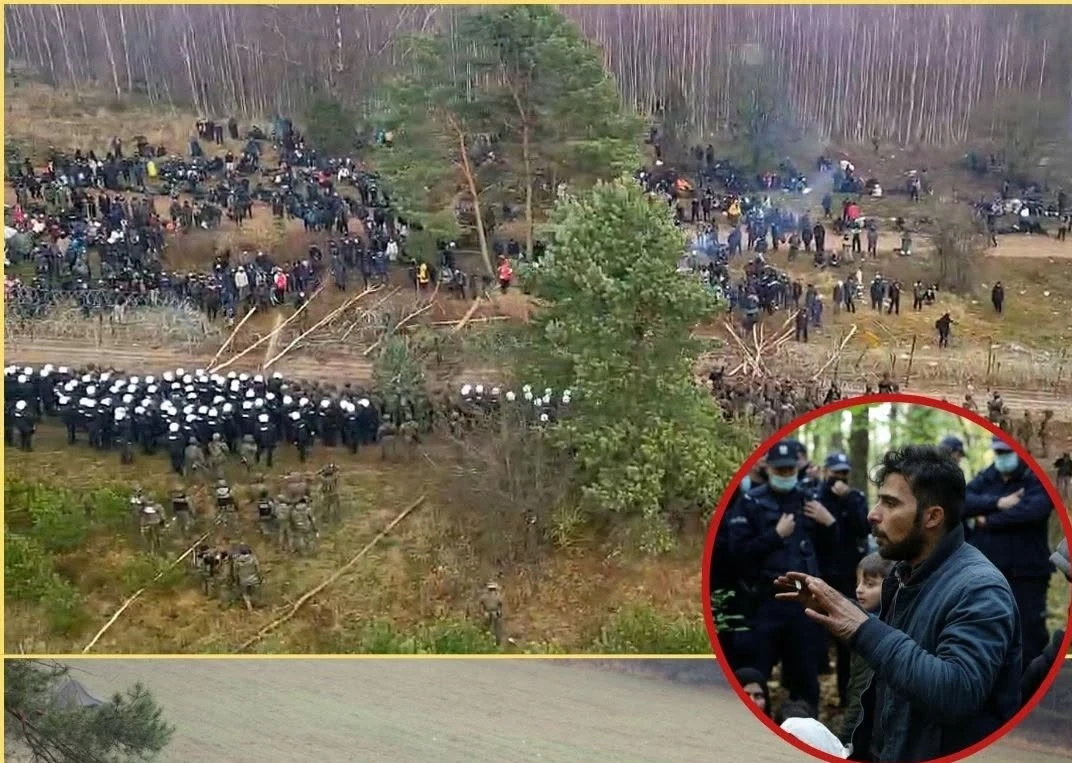
Images of hundreds—sometimes thousands—of people gathered opposite heavily equipped Polish security forces remain among the most striking pictures produced by Europe’s migration disputes.
Rows of police stand behind barriers.
Soldiers patrol nearby.
Razor wire separates groups of migrants from European Union territory.
Men, women and children gather in forests exposed to freezing temperatures.
Years after the most dramatic confrontations on the Poland–Belarus border, those images continue to circulate online under increasingly provocative captions.
One recurring version claims:
“Muslims tried to mass migrate into Poland, then got rejected at the border.”
There is a genuine historical event behind the imagery. Poland did confront large groups of migrants attempting to enter from Belarus, particularly during the extraordinary escalation of 2021.
But the viral description compresses a complicated geopolitical and humanitarian crisis into a religious confrontation.
The people at the frontier were migrants and asylum seekers of different nationalities and circumstances. Many came from predominantly Muslim countries in the Middle East, but their religion was not the legal basis on which Poland controlled its border.
More importantly, the confrontation did not develop simply because thousands of people independently decided one morning to march into Poland.
Belarus played a central role.
Understanding that distinction radically changes the story.
What Happened at the Poland–Belarus Border?
The crisis escalated dramatically during the second half of 2021.
Thousands of migrants and asylum seekers began appearing along Belarus’s borders with Poland, Lithuania and Latvia—all European Union members.
Many had travelled from countries including Iraq, Syria and Afghanistan.
By November, the situation had reached a critical point.
More than 1,000 people arrived together near the Polish frontier during one particularly dramatic escalation, while larger numbers were dispersed elsewhere throughout the border region.
Reporting at the time documented Belarusian authorities accompanying groups toward the Polish frontier. (The Guardian)
Poland responded by reinforcing the border.
Security forces deployed in large numbers.
Temporary barriers and razor wire were installed, and Poland subsequently constructed a substantial permanent border barrier.
The scenes quickly became international news.
Some migrants attempted to cut through fencing or force their way across.
Polish forces resisted them.
At some confrontations, water cannon, tear gas or other crowd-control measures were deployed.
People became trapped between two governments determined not to accept responsibility for them.
It was simultaneously an immigration crisis, a security confrontation, a humanitarian emergency and a geopolitical dispute.
Why Belarus Is Central to the Story
Perhaps the biggest omission from viral versions of the story is Belarus.
The European Union accused the government of Belarusian President Alexander Lukashenko of deliberately facilitating migration toward the EU frontier.
European governments described the operation as a form of “hybrid” pressure.
The argument was that Belarus was using vulnerable migrants as geopolitical leverage against the European Union after relations between Minsk and Brussels deteriorated dramatically.
Belarus rejected accusations that it had deliberately engineered the crisis.
But contemporary reporting documented Belarusian security personnel directing or accompanying migrants toward frontier areas.
On November 8, 2021, for example, reporting described Belarusian authorities escorting an estimated 1,000 people—many from the Middle East—toward the Polish border. (The Guardian)
That context is essential.
The episode cannot accurately be reduced to:
“Muslims decided to invade Poland.”
It developed within a much larger confrontation between Belarus and the European Union.
Why Were Migrants Going to Belarus in the First Place?
For many migrants, Belarus appeared to offer a possible route into the European Union.
People travelled legally by air to Belarus in many cases before attempting to reach the EU frontier.
Once inside Belarus, some were transported toward areas close to Poland, Lithuania or Latvia.
The hope was relatively straightforward:
enter EU territory and ultimately travel west.
Germany was reportedly a preferred destination for many.
Some migrants had been given unrealistic expectations about how easily the journey could be completed.
That produced an unusual migration route.
Instead of attempting dangerous Mediterranean crossings from North Africa or travelling through the traditional Balkan corridor, people could fly much closer to the EU’s eastern frontier.
But reaching Belarus was not equivalent to receiving permission to enter Poland.
Once migrants reached the border, they encountered heavily reinforced Polish security forces.
Were They All Muslim?
There is no sound basis for reducing everyone involved to a single religious identity.
Many migrants came from predominantly Muslim countries and many were undoubtedly Muslim.
But immigration authorities determine legal status through questions such as nationality, documentation, residence rights and asylum claims—not by simply categorising an entire crowd according to religion.
This distinction becomes especially important because viral captions can transform a migration dispute into what appears to be a civilisational confrontation between “Muslims” and “Poland.”
That is not a neutral description of what happened.
A more accurate description would be:
Large groups of migrants and asylum seekers, many originating from Middle Eastern countries, attempted to cross from Belarus into Poland during a geopolitical crisis in 2021.
It is less sensational.
It is also considerably more precise.
Poland Refused to Open the Border
On one point, the viral narrative captures something real.
Poland refused to allow uncontrolled mass entry across its frontier.
Warsaw maintained that Belarus was deliberately creating the crisis and argued that allowing large groups through would reward the strategy and encourage further attempts.
Polish authorities deployed police, border guards and military personnel.
The government declared a state of emergency in areas near the border.
Access for journalists and humanitarian organisations was restricted.
Physical border infrastructure was strengthened.
The government presented its response as a defence of both Polish sovereignty and the EU’s external frontier.
For supporters of strict immigration enforcement, Poland’s actions became an international symbol of border control.
Images of Polish forces standing behind barriers circulated widely among groups advocating tougher migration policies elsewhere in Europe.
Why Poland’s Supporters Applauded the Response
The argument in favour of Poland’s approach rested on several principles.
First, supporters said every sovereign country has a right and responsibility to control its borders.
Second, they argued that governments cannot allow large groups to determine immigration policy simply by arriving at a frontier.
Third, Polish officials maintained that the situation was not an ordinary spontaneous refugee movement but a politically manipulated operation facilitated by Belarus.
Fourth, supporters warned that allowing people through could create an incentive for Belarus to transport even larger numbers toward Europe.
From this perspective, border enforcement was not merely immigration policy.
It was national security.
Poland was defending an external frontier of the European Union against pressure deliberately generated by an authoritarian neighbouring state.
That interpretation gained substantial support among European governments.
But Human-Rights Organisations Saw Another Side
The Polish response also generated serious criticism.
Human Rights Watch documented allegations of abuses involving both Belarusian and Polish authorities.
Migrants interviewed by the organisation described being pushed back into Belarus by Polish border guards even after requesting asylum.
On the Belarusian side, migrants described violence, coercion and degrading treatment.
Human Rights Watch concluded that people had effectively become trapped between the two countries. (Human Rights Watch)
Amnesty International conducted its own investigation into a group of 32 Afghan nationals stranded near the frontier.
Using satellite imagery, photographs, videos and spatial reconstruction, Amnesty concluded that the group’s position had shifted from Poland back into Belarus and described what it believed was an unlawful pushback.
The group included 27 men, four women and a 15-year-old girl. (Amnesty International)
Those allegations complicate the triumphant version of the story sometimes presented online.
Border enforcement and treatment of asylum seekers are related questions, but they are not identical.
The Humanitarian Crisis in the Forest
Behind the political confrontation were people living in increasingly desperate circumstances.
Temperatures fell.
Migrants spent nights outdoors.
Food and clean water became scarce.
Some people reportedly became ill.
Others suffered hypothermia.
People died.
Human Rights Watch described migrants and asylum seekers trapped along the frontier and exposed to freezing conditions, with some reporting repeated movements between Polish and Belarusian forces. (Human Rights Watch)
Contemporary reporting similarly described women and children among those living near the border as nighttime temperatures dropped below freezing. (The Guardian)
These circumstances do not automatically determine who possessed a valid asylum claim or who should ultimately have been permitted to remain in Poland.
They do establish that the episode had a humanitarian dimension that cannot responsibly be removed from the story.
Border Control and Asylum Are Not Exactly the Same Thing
This distinction is central to understanding the dispute.
A country has the authority to police its borders.
That does not necessarily mean authorities may ignore every request for international protection made by someone arriving irregularly.
International refugee law was created partly because refugees are not always capable of obtaining visas before escaping persecution.
Consequently, the legal question can become considerably more complicated than whether someone crossed at an authorised checkpoint.
Governments have increasingly argued that asylum systems are exploited by economic migrants and smuggling networks.
Human-rights organisations counter that automatically pushing people away can prevent genuine refugees from accessing protection.
Both concerns sit at the centre of Europe’s contemporary migration debate.
The 32 Afghans Became an Important Test Case
The experience of the Afghan group investigated by Amnesty did not simply disappear when the immediate crisis faded from international headlines.
The European Court of Human Rights later considered proceedings concerning R.A. and Others v. Poland.
According to the Court, the case involved 32 Afghan nationals who said they had fled Afghanistan after the Taliban returned to power.
They were stranded in a makeshift camp on the Belarus–Poland border between August and October 2021. (ECHR)
That illustrates why the legal debate cannot be reduced to a simple binary of “accepted” versus “rejected.”
European courts have had to examine whether states respected their human-rights obligations while defending their borders.
Why Poland Feared Creating a Precedent
From Warsaw’s perspective, however, there was another major concern.
Imagine that Belarus could transport thousands of people toward the EU frontier and Poland simply allowed them to continue.
What would prevent the process from being repeated?
Ten thousand could become twenty thousand.
Twenty thousand could become fifty thousand.
The border could become an instrument through which another government placed continuous political pressure on the European Union.
Polish officials therefore argued that preventing entry was necessary to break the mechanism itself.
The message was intended not only for migrants at the fence.
It was also directed at Minsk.
Using migration to pressure Poland would not succeed.
Europe’s Accusation of “Hybrid Warfare”
The expression “hybrid warfare” became closely associated with the crisis.
Hybrid pressure generally refers to coercive activity operating below the level of conventional military conflict.
It can include cyberattacks, disinformation, economic pressure, political interference and the manipulation of migration flows.
European officials argued that Belarus was effectively weaponising human movement.
Migrants became caught in a confrontation they did not control.
From the European perspective, Belarus could generate instability without sending tanks across a frontier.
Instead, it could place thousands of desperate people at the EU border and force European governments into an impossible political choice.
Allow them through, and Belarus’s strategy appears successful.
Stop them, and disturbing images of suffering dominate international media.
That dilemma explains much of Poland’s uncompromising response.
Belarus Rejected the European Narrative
Belarus disputed accusations that it deliberately manufactured the crisis.
Minsk blamed European sanctions and Western policies.
Belarusian authorities also accused Poland of mistreating migrants.
This competing narrative presented Belarus as responding to rather than orchestrating the crisis.
But Western governments remained convinced that the unusual migration route and Belarusian involvement in moving people toward frontier areas were not accidental.
The dispute therefore became inseparable from the broader deterioration of relations between Lukashenko’s government and Europe.
What the Photographs Actually Show
Images from the crisis are dramatic because they capture an extraordinary physical confrontation.
On one side:
large groups of migrants.
On the other:
police, soldiers and border guards.
Between them:
fences, razor wire and barricades.
Yet photographs cannot independently establish the immigration status, nationality, religion or intentions of every individual depicted.
Nor can a collage establish that every photograph was taken at precisely the same moment.
Images are evidence of a scene.
Captions supply interpretation.
That distinction becomes particularly important when old photographs are recirculated years later as though they depict a new event.
Reuters’ archive, for example, contains photographs documenting the migrant crisis at the Poland–Belarus border in late 2021, including imagery from the Kuznica–Bruzgi area and migrants staying at the Bruzgi logistics centre. (Reuters Connect)
So when dramatic border imagery reappears online, audiences should always ask:
When was this photograph actually taken?
Old Border Images Frequently Return During New Immigration Debates
Migration imagery has unusual longevity on social media.
A photograph from 2015 can resurface in 2026.
A confrontation in Greece can be described as occurring in Poland.
An image from Poland can be attached to a story about Germany.
A refugee camp can be presented as a crowd actively storming a frontier.
None of this requires manipulating the photograph itself.
Changing the caption is enough.
This is one reason visual verification has become increasingly important in political reporting.
“Mass Migration” Is a Political Description
Another term requiring care is “mass migration.”
There unquestionably were large numbers of people involved in the Belarus–Poland crisis.
At particularly dramatic moments, groups numbering more than a thousand appeared together near particular sections of the border, while thousands more were present throughout the wider region.
So describing the overall phenomenon as a large-scale migration crisis is reasonable.
But “mass migration” can mean different things politically.
Some use it descriptively for large population movements.
Others use it as a broader ideological term encompassing legal immigration, asylum seekers, refugees and irregular migrants.
Those categories should remain distinguishable.
Refugees, Asylum Seekers and Migrants Are Not Identical Categories
Language matters.
A migrant is a broad term for someone moving from one place to another.
An asylum seeker is someone requesting protection and awaiting determination of that claim.
A refugee, in the legal sense, is someone who meets defined criteria for international protection.
An irregular migrant is someone entering or remaining outside the applicable immigration rules.
A single person can move between some of these categories as a legal case develops.
Calling everyone at the Belarusian border simply an “illegal immigrant” can therefore prejudge individual cases that authorities have not assessed.
Conversely, calling every person automatically a “refugee” can also be inaccurate.
Responsible reporting avoids deciding someone’s legal status from a photograph.
Religion Was Not the Border Test
The viral headline’s emphasis on “Muslims” creates another misleading implication: that Poland stood at its frontier asking whether travellers were Muslim and rejecting them on that basis.
That is not an accurate description of the crisis.
The central issue was irregular entry from Belarus.
Many people involved were indeed from Muslim-majority countries.
But nationality and immigration circumstances—not collective religious identity—were the relevant legal issues.
This distinction is particularly important because Poland has historically maintained comparatively restrictive immigration policies while simultaneously accepting very large numbers of people from neighbouring Ukraine following Russia’s full-scale invasion.
The contrast has itself generated debate about Europe’s differing responses to different refugee populations.
Why Poland Became a Symbol for Immigration Hardliners
Whatever one’s assessment of the humanitarian and legal controversies, Poland’s response produced an unmistakable political result.
The border did not simply open.
Polish forces maintained control.
That turned Poland into an example frequently cited by politicians and activists elsewhere who advocate tougher borders.
Their argument is straightforward:
A border can be controlled if a government is politically willing to control it.
That message has been especially influential in countries struggling with irregular migration.
Britain’s Channel crossings are often compared with Poland.
So are Mediterranean routes into Italy and Greece.
But such comparisons can be misleading because geography, international law, bilateral relationships and migration routes differ substantially.
Stopping people across a land frontier with Belarus is not operationally identical to intercepting small boats at sea.
The Security Argument
Supporters of Poland’s approach also raise security concerns.
When hundreds or thousands of people arrive simultaneously without normal documentation and screening, authorities may have difficulty establishing identities quickly.
Governments therefore argue that controlled entry allows security checks to occur before individuals enter the country.
This is particularly important at the EU’s external frontier because entry into one Schengen country can potentially facilitate onward travel through much of continental Europe.
Poland was therefore defending more than its national boundary.
It was policing part of the external Schengen frontier.
The Human-Rights Counterargument
Critics respond that national security cannot eliminate legal safeguards.
They argue that states must maintain mechanisms through which individuals can seek protection.
Human Rights Watch’s investigation accused both Belarus and Poland of serious abuses during the crisis and said people were trapped between the two governments. (Human Rights Watch)
From this perspective, migrants were being treated as objects in a geopolitical struggle.
Belarus allegedly used them to pressure Europe.
Poland allegedly pushed some back without adequately examining protection claims.
The people themselves paid the price.
Both Things Can Be True
This is where binary social-media narratives become particularly inadequate.
It is possible to conclude simultaneously that:
Belarus exploited migration for geopolitical purposes.
And:
individual migrants still possessed human rights.
It is possible to support:
Poland’s right to defend its border.
While also demanding:
lawful procedures for people seeking asylum.
Likewise, recognising suffering among migrants does not require supporting unlimited entry.
And supporting border enforcement does not require treating every migrant as dangerous.
Those positions are not logically contradictory.
The Crisis Changed Europe’s Thinking
The Belarus episode became part of a broader transformation in European migration policy.
For years after the 2015 refugee crisis, European governments struggled to reconcile humanitarian obligations with increasing public demands for stronger border enforcement.
The Belarus crisis added a new dimension.
Migration was no longer viewed exclusively as a humanitarian or economic phenomenon.
It could also become a geopolitical weapon.
That concern subsequently became especially significant along Europe’s eastern frontier as relations with Belarus and Russia deteriorated further.
Countries bordering Russia and Belarus increasingly viewed border infrastructure through both immigration and national-security lenses.
Poland Built a Stronger Physical Border
Temporary razor-wire defences were eventually supplemented by permanent infrastructure.
Poland constructed a substantial barrier along much of its frontier with Belarus.
The government’s reasoning was that manpower alone could not indefinitely secure a long forested border against repeated crossing attempts.
Physical barriers could slow movement, direct crossings toward controlled checkpoints and give border guards more time to respond.
Critics questioned both the humanitarian impact and environmental consequences.
Supporters viewed the project as overdue protection for the EU frontier.
The disagreement reflected a broader European debate over whether physical border walls are effective, ethical or necessary.
The Forest Remains Dangerous
Even after the most dramatic scenes disappeared from television screens, attempts to cross the Belarus–Poland frontier continued.
The geography itself makes the journey hazardous.
Dense forests, wetlands and severe winter temperatures can become deadly.
People attempting to avoid border patrols may spend prolonged periods outdoors.
That produces a cruel dynamic.
The stronger the border becomes, the more dangerous clandestine attempts can become.
But governments argue that weakening enforcement because crossing is dangerous can encourage more people to attempt the journey.
This tension exists on migration routes around the world.
Smuggling Networks Benefit From Confusion
Another group frequently missing from simplified narratives is smugglers.
Whenever people believe they can reach a wealthy destination despite lacking conventional immigration pathways, an illicit market emerges.
Smugglers sell routes.
They sell transportation.
They sell supposed knowledge of border patrols.
Sometimes they sell false promises.
Migrants may spend enormous sums based on claims that a route is safe or that authorities will eventually allow them through.
The Belarus route was particularly attractive because it initially appeared easier than crossing the Mediterranean.
When Poland closed the frontier, people who had invested significant money in the journey found themselves trapped.
Who Bears Responsibility?
There is no single answer.
Belarus bears responsibility if, as European governments maintain, its authorities deliberately facilitated the movement of migrants toward EU borders as political pressure.
Smuggling networks bear responsibility for exploiting people financially and encouraging dangerous journeys.
European governments bear responsibility for ensuring border enforcement complies with applicable law.
Countries of origin have responsibilities toward citizens whose economic and political circumstances drive migration.
And individuals themselves retain agency over decisions they make.
Complex crises rarely have a single villain or a single victim.
Why the Word “Invasion” Should Be Used Carefully
Some social-media accounts describe the Poland–Belarus episode as an “invasion.”
That word carries a specific military meaning.
The migrants were not an organised army invading Poland.
They were civilians.
However, the Polish government and its allies argued that the migration flow was being manipulated by a foreign state to destabilise the EU.
That is why the concept of hybrid warfare gained traction.
The distinction is subtle but important.
The migrants themselves were not necessarily combatants simply because another government allegedly exploited their movement for political purposes.
A person can be used as an instrument of geopolitical pressure without knowingly participating in a geopolitical operation.
What Happened to the Migrants?
Not everyone remained indefinitely at the frontier.
Some returned to their countries of origin.
Others entered Belarusian accommodation facilities.
Some succeeded in reaching European Union territory.
Others continued attempting crossings.
Reuters documented migrants staying at the Bruzgi transport and logistics centre on the Belarusian side in November 2021 as the immediate confrontation evolved. (Reuters Connect)
The highly visible camps near the frontier gradually diminished.
But the political dispute never completely disappeared.
Poland’s Position Resonated Far Beyond Poland
The crisis had significant political consequences throughout Europe.
For governments worried about irregular migration, Poland provided evidence that a determined state could resist concentrated pressure at an external border.
For humanitarian organisations, it demonstrated the danger of normalising pushbacks.
For security analysts, it demonstrated how migration could be manipulated as part of hybrid conflict.
For anti-immigration movements, it became powerful visual propaganda.
For migrant-rights organisations, it became evidence of Europe’s increasingly fortified borders.
Everyone looked at the same photographs.
They saw very different stories.
Why the Viral Caption Matters
The statement:
“Muslims tried to mass migrate into Poland and were rejected”
contains fragments of reality but rearranges them into a misleadingly simple narrative.
Yes, many people involved came from Muslim-majority countries.
Yes, large groups attempted to enter Poland.
Yes, Polish forces blocked many attempts.
But that formulation omits almost everything necessary to understand why the confrontation happened.
It omits Belarus.
It omits the EU.
It omits asylum claims.
It omits allegations of pushbacks.
It omits smugglers.
It omits geopolitical coercion.
It omits the people trapped in freezing forests.
And it converts an immigration-status dispute into a religious confrontation.
A More Accurate Headline
A responsible headline would therefore look something like this:
Poland–Belarus Border Crisis Resurfaces Online: What Really Happened When Thousands of Migrants Were Blocked From Entering the EU
That framing does not hide Poland’s border enforcement.
Nor does it romanticise irregular migration.
It simply describes the event using categories supported by evidence.
What Poland’s Experience Does—and Does Not—Prove
The crisis demonstrates that governments can significantly strengthen physical border enforcement.
It also demonstrates that doing so can carry humanitarian, diplomatic and legal consequences.
It shows that migration flows can potentially be manipulated by hostile governments.
It shows how quickly smugglers and political actors can exploit expectations about migration routes.
And it demonstrates that a border crisis can become an ideological symbol long after the original event ends.
What it does not establish is that Europe faced a simple confrontation between Muslims and Christians, or between Islam and Poland.
That interpretation imposes a religious framework onto a much more complicated event.
The Bigger Question: Who Controls Europe’s Borders?
Beneath the arguments about individual photographs lies a fundamental political question.
Who determines who enters Europe?
Governments argue that democratic states must make that decision through immigration law.
If people can circumvent those rules simply by reaching a border in sufficiently large numbers, public confidence in immigration systems can collapse.
Migration advocates respond that legal pathways must remain available for genuine refugees and that border enforcement cannot become a mechanism for avoiding international obligations.
Europe has still not fully resolved this tension.
It probably never will.
Every asylum system must somehow distinguish between people requiring protection and people migrating primarily for economic reasons.
Every border system must determine how to handle individuals arriving without prior authorisation.
And every democracy must decide how much migration it is willing and able to absorb.
The Lesson From 2021
The Poland–Belarus crisis ultimately demonstrated something larger than whether Poland could stop a particular group at a fence.
Migration had become intertwined with geopolitics.
Borders were no longer merely administrative lines.
They could become pressure points between states.
Belarus was accused of discovering that sending desperate civilians toward an EU frontier could generate enormous political disruption without conventional military action.
Poland responded by transforming the frontier into an increasingly fortified security zone.
Migrants became trapped between those strategies.
That is the tragedy at the centre of the story.
Conclusion: The Border Confrontation Was Real — The Religious Simplification Is Not
The dramatic images from the Poland–Belarus frontier are rooted in a genuine crisis.
Thousands of migrants and asylum seekers travelled through Belarus toward the European Union during 2021.
Large groups approached Poland’s border.
Polish police, soldiers and border guards prevented many from entering.
At certain moments, attempts to breach barriers produced direct confrontations.
Poland insisted that it was defending its sovereignty and the EU’s external border against a migration crisis deliberately manipulated by Belarus.
There is substantial contemporary reporting documenting Belarusian involvement in moving migrants toward the frontier. (The Guardian)
But there is another documented part of the story.
Human-rights organisations reported people trapped in dangerous conditions between the two countries and accused authorities of unlawful or abusive pushbacks. Amnesty’s investigation of 32 Afghan nationals became part of a case subsequently considered by the European Court of Human Rights. (Amnesty International)
Both realities belong in the historical record.
Poland confronted a genuine border-security challenge.
Migrants also experienced a genuine humanitarian crisis.
Belarus’s alleged manipulation of migration does not eliminate the rights of individual asylum seekers.
And the existence of those rights does not eliminate Poland’s authority to control its frontier.
Most importantly, describing the event simply as “Muslims trying to mass migrate into Poland” substitutes religious identity for the actual legal and geopolitical questions at stake.
The central confrontation was not Poland versus Muslims.
It was a crisis involving Poland, Belarus, the European Union, migrants and asylum seekers, international law, border security and geopolitical pressure.
That story is less convenient for a viral caption.
But it is much closer to what actually happened.