Musl!ms thought Florida would roll over and accept Sharia…
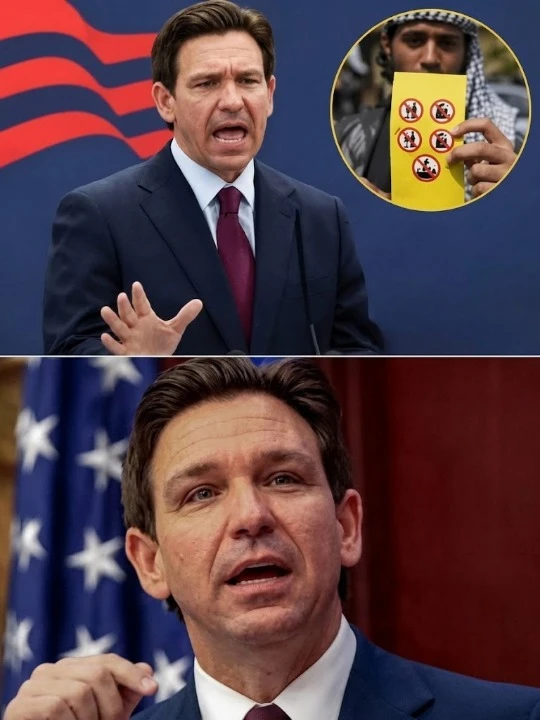
Florida’s New Law, Sharia and the Constitution: What Ron DeSantis Actually Signed—and Why It Has Triggered a Major Civil-Liberties Fight
Supporters call HB 1471 a defence of one constitutional legal system and a new weapon against extremist organisations. Critics warn that its language could stigmatise Muslims, chill protected speech and expand state power in ways that will almost certainly be tested in court.
Florida has once again placed itself at the centre of one of America’s most combustible political arguments: where should a state draw the line between protecting constitutional government and targeting ideas, organisations or religious practices that public officials consider dangerous?
On April 6, 2026, Governor Ron DeSantis signed House Bill 1471, formally titled “Systems of Law and Terrorist Organizations.” His administration presented the legislation in sweeping terms, saying Florida was strengthening protections against foreign and religious legal rules that violate constitutional rights while giving the state additional authority to identify and punish organisations associated with terrorism.
The law took effect on July 1.
Its passage quickly became the subject of dramatic online claims. Some supporters described it as an outright prohibition on Sharia law. Others portrayed Florida as stopping an organised attempt by Muslims to replace the United States Constitution with Islamic law. Civil-rights groups responded with equally intense language, accusing the state of building an unconstitutional framework that could be used against religious organisations, political advocacy and protected speech.
The reality is both more specific and more complicated.
HB 1471 does address religious law, and Governor DeSantis explicitly described the measure as one that would “ban Sharia law in Florida.” But the operative legal language is broader and narrower at the same time: it applies to foreign law or religious law generally, and it prohibits their application by courts or other tribunals when doing so would violate a person’s constitutional rights. The statute does not declare Islam illegal, does not prohibit Muslims from observing their religion and does not literally erase every private agreement influenced by Islamic principles.
At the same time, the legislation goes far beyond a symbolic declaration about the supremacy of the Constitution.
It also establishes a significant new state framework for designating domestic and foreign terrorist organisations, criminalises certain forms of material support and participation, permits consequences for designated organisations and introduces restrictions involving public institutions and education. Florida later announced that state security officials intended to use these powers in relation to the Council on American-Islamic Relations, or CAIR, the Muslim Brotherhood, Antifa and dozens of federally designated foreign terrorist organisations.
That combination—religious law, terrorism designations, political expression and state enforcement power—is why the measure has become far more than another symbolic culture-war statute.
Supporters see a straightforward principle: Florida should operate under one constitutional system, and organisations genuinely involved in terrorism should not receive public resources or legal protection.
Critics ask an equally important question: who decides which organisation qualifies as terrorist, what evidence is required, and what happens when a state government’s political opponents or unpopular advocacy groups become targets?
Those questions are now at the centre of a national debate that stretches well beyond Florida.
What HB 1471 Actually Does
Understanding the controversy begins with separating the statute itself from the political messaging surrounding it.
According to the Florida Senate’s official summary, HB 1471 prohibits a court, administrative law judge, hearing officer, agency, arbitration panel or other governmental authority or tribunal from applying a provision of foreign law or religious law when that application would violate a person’s constitutional rights.
That wording is critical.
The restriction is not written only around Islam or Sharia. It applies to religious and foreign legal systems generally. Nor does the statute say that any reference to religious law automatically becomes unlawful.
Instead, the central trigger is the violation of constitutional rights.
That distinction gets lost in many viral descriptions of the law.
A headline saying “Florida bans Sharia” suggests that Islamic religious principles have been prohibited across the state. The actual statute is framed around the supremacy of constitutional rights when courts or other authorities encounter foreign or religious legal rules.
There is an obvious reason that principle has political appeal.
No religious rule can override the U.S. Constitution merely because believers consider it sacred. A state court cannot deny someone equal protection because a religious tradition demands unequal treatment. It cannot impose a punishment forbidden by constitutional law because a foreign legal system permits it. It cannot deprive someone of due process on the theory that another jurisdiction uses different procedures.
American courts are already bound by the Constitution.
That raises one of the first serious questions about HB 1471: if constitutional rights were already supreme, how much additional protection does this law provide?
Supporters argue that explicit statutory language is useful. It creates a clear rule for judges, agencies and arbitrators and ensures that no ambiguity develops as America becomes more religiously and culturally diverse.
Critics respond that the rule may be largely redundant in its legitimate applications while creating a politically charged framework that disproportionately focuses public suspicion on Islam.
Governor DeSantis’ own announcement made that political focus clear. His office said the law strengthens protection against “foreign and religious laws—including Sharia law—that violate constitutional rights.”
For supporters, explicitly naming Sharia identifies what they consider the primary concern.
For critics, it reveals the ideological target of a law written in formally neutral language.
That disagreement will likely remain central to any future constitutional litigation.
Sharia Is Not a Parallel Government
One of the most misleading claims in the broader political discussion is that Muslim communities in the United States possess the power to replace state or federal law with Sharia.
They do not.
The Constitution remains supreme law throughout the United States. Florida courts derive their authority from the U.S. Constitution, the Florida Constitution and valid statutes. Religious institutions have no power to substitute a separate criminal code for state law.
This applies to Islam exactly as it applies to Christianity, Judaism and other religions.
Religious communities can nevertheless create voluntary rules governing aspects of their internal lives.
A Jewish couple may use a rabbinical tribunal to resolve a religious dispute. Christians may structure church governance according to theological rules. Muslims may enter financial or marital agreements influenced by Islamic principles. Parties may sometimes agree to private arbitration grounded partly in religious standards.
American law generally distinguishes between voluntary religious practice and government coercion.
A private religious agreement may be enforceable when it operates as an ordinary contract and does not violate public policy or constitutional protections.
A court cannot, however, enforce an agreement that violates fundamental legal rights merely because the agreement is religious.
This is why the phrase “Sharia law in American courts” requires careful explanation.
A judge recognising the terms of a valid contract influenced by Islamic finance is not replacing the Constitution with Sharia.
A court considering the meaning of a Jewish prenuptial agreement is not replacing American law with Halakha.
A court enforcing an arbitration agreement between members of a Christian organisation is not establishing a Christian legal state.
Courts regularly encounter private agreements shaped by culture, religion and foreign legal systems.
The constitutional question is whether enforcement remains consistent with American law.
That distinction is at the heart of the dispute over HB 1471.
Why Supporters Believe a Specific Law Is Necessary
Supporters of the Florida legislation argue that waiting until a constitutional violation occurs is insufficient.
Their concern is preventative.
They believe American legal institutions should make explicit that constitutional law cannot be displaced by foreign doctrines, particularly in areas such as family law, property rights, inheritance, arbitration and gender equality.
Some advocates point to disputes involving religious arbitration or marriages conducted under foreign legal traditions as evidence that courts may increasingly confront conflicts between private religious rules and constitutional principles.
In their view, HB 1471 creates clarity before those disputes multiply.
There is also a broader ideological argument.
DeSantis and his supporters frequently describe Western constitutional government as facing pressure from political ideologies that do not accept liberal democratic principles.
From this perspective, radical Islamism is not merely a religion expressed strongly. It is a political doctrine that, in its most extreme forms, seeks to subordinate civil government to religious authority.
That phenomenon exists.
Extremist Islamist movements such as ISIS and al-Qaeda have explicitly rejected secular democratic government and sought states governed according to their interpretation of Islamic law. The United States has fought organisations inspired by these ideologies for decades.
The political disagreement arises when discussion shifts from violent Islamist movements to American Muslims generally.
There are millions of Muslims living in the United States whose religious practice coexists with ordinary participation in constitutional democracy.
They vote, serve in the military, practise law, operate businesses, work in government and participate in civic organisations.
Treating Islam itself as equivalent to political extremism collapses distinctions essential to both factual accuracy and religious freedom.
The government can legitimately prosecute terrorism.
It cannot legitimately treat a citizen as dangerous merely because that citizen is Muslim.
Any successful legal framework has to maintain that boundary.
The Terrorism Provisions May Be More Consequential Than the Sharia Debate
Much of the attention surrounding HB 1471 has focused on religious law.
But the legislation’s provisions concerning terrorist organisations may ultimately have greater practical significance.
Under the new system, Florida’s Chief of Domestic Security can recommend that an organisation be designated a domestic or foreign terrorist organisation when statutory requirements are satisfied.
The proposed designation must be communicated to the governor, Florida Cabinet and affected organisation. The governor and Cabinet can then approve or reject the designation by majority vote, after which an approved designation is published through the state’s administrative process.
The legislation also creates or strengthens criminal consequences for certain activities involving designated groups.
According to the Florida Senate’s official description, these include knowingly providing or attempting to provide material support or resources to a domestic terrorist organisation, receiving certain military training and serving under the direction or control of such an organisation with specified intent.
The state can also administratively dissolve certain corporations connected to terrorist organisations.
These are substantial powers.
Few people dispute that governments should be able to act aggressively against genuine terrorist networks.
Financing a group that plans bombings is not ordinary political advocacy.
Recruiting members for violent attacks is not merely speech.
Training people for terrorism is not protected civic activity.
The constitutional difficulty emerges at the boundary between criminal support for violence and association with controversial political movements.
If the definition is broad, politically influenced or insufficiently constrained by evidence, government could punish lawful association.
That concern is especially serious because political language surrounding terrorism has historically expanded during moments of national fear.
Democratic systems therefore require both powerful security tools and meaningful safeguards against abuse.
Florida Moves to Use the New Authority
Florida did not leave the new designation framework unused for long.
On July 1, the day HB 1471 became effective, DeSantis announced that state officials intended to begin implementing the law.
His office said recommendations had been made concerning CAIR, the Muslim Brotherhood, Antifa and more than 90 foreign terrorist organisations, including major drug cartels and internationally recognised extremist groups.
The governor’s office said that, once confirmed through the required state process, designations could prevent state and local governments from providing funding, contracts or public support to listed organisations. Public schools, colleges and universities would also face restrictions involving state resources, while material support could trigger criminal penalties under Florida law.
That announcement immediately illustrated why the statute is controversial.
The list includes organisations that occupy very different legal categories.
International terrorist groups officially designated by the federal government are one thing.
A domestic American civil-rights organisation is another.
An amorphous political label such as “Antifa” presents yet another category entirely.
Each raises different evidentiary and constitutional questions.
Grouping them under a common state terrorism framework therefore guarantees legal scrutiny.
The CAIR Dispute Predated HB 1471
CAIR had already become a direct target of DeSantis before the legislation was passed.
In late 2025, the governor issued an executive order targeting CAIR and the Muslim Brotherhood. CAIR rejected the accusations and announced plans to challenge the action in court.
The organisation argued that a state governor did not possess constitutional authority to unilaterally label an American civil-rights organisation a terrorist group without adequate legal basis.
That confrontation produced an important development several months later.
In March 2026, a federal judge issued an injunction blocking DeSantis’ earlier executive action targeting CAIR while litigation continued.
CAIR and the organisations representing it described the ruling as a victory against what they considered an unconstitutional attempt to use terrorism designations against protected advocacy.
That history matters enormously to understanding HB 1471.
The new law provides a statutory process where the earlier action depended substantially on executive authority.
Supporters could therefore argue that Florida’s legislature has now created explicit procedures and legal criteria that did not previously exist.
Critics see something different.
They argue that after the governor’s earlier effort encountered constitutional resistance, Florida lawmakers provided a new statutory mechanism capable of pursuing the same objective.
Whether that mechanism survives judicial scrutiny will depend on how the law is interpreted and implemented.
CAIR’s Objections
CAIR-Florida strongly opposed HB 1471 before DeSantis signed it.
The organisation characterised the legislation as a dangerous expansion of state power and argued that its provisions risk violating free speech, religious liberty, due process and equal protection.
CAIR also challenged the legislation’s religious-law provisions.
Its position was that American courts sometimes legitimately enforce private contracts, wills, burial instructions or arbitration decisions influenced by religious tradition, provided those arrangements comply with ordinary law.
From that perspective, an overly broad prohibition on religious law could interfere with lawful religious practice rather than simply protecting constitutional rights.
CAIR further argued that vague definitions involving ideology and terrorism could be used to stigmatise organisations without criminal convictions or federal terrorist designations.
After DeSantis signed the bill, CAIR-Florida announced a public response and again described the legislation as threatening speech, due process and religious freedom.
Those claims are arguments made by an interested party, not settled judicial findings.
But they raise constitutional questions that courts are likely to take seriously.
Free Speech Is Where the Legal Fight Could Become Difficult
The First Amendment does not protect every form of interaction with terrorist groups.
The U.S. government can criminalise material support to organisations lawfully designated as foreign terrorist organisations.
Money, weapons, training, personnel and coordinated services can all create legitimate national-security concerns.
But the government cannot simply criminalise agreement with an unpopular idea.
The difference between advocacy and coordination becomes crucial.
Imagine a student publicly saying that a political organisation has legitimate grievances.
That may be offensive or deeply controversial.
It is still generally political speech.
Now imagine that the same student secretly raises money for an organisation planning violent attacks.
That is fundamentally different conduct.
Between those examples lies a complicated constitutional territory involving recruitment, organised support, propaganda and coordination.
HB 1471 attempts to define some of these boundaries.
During the legislative process, language concerning promotion of terrorist organisations was refined. An amendment described promotion in contexts involving true threats of unlawful violence, material disruption of a learning environment, substantial disorder or invasion of others’ rights, material support or recruitment.
Those qualifications matter because they attempt to distinguish protected political discussion from conduct more directly connected to violence or unlawful organisational activity.
Whether they are sufficient will depend on how officials enforce them.
A narrowly administered statute targeting genuine threats and material assistance may prove easier to defend.
A broad application punishing unpopular political views would face much greater constitutional difficulty.
The Meaning of Religious Freedom
The debate also creates a striking constitutional tension.
Supporters of HB 1471 say the statute protects Americans from religious law being imposed against their constitutional rights.
Critics argue that government hostility toward a particular religious tradition would itself violate constitutional principles.
Both propositions can be true.
The United States was built around a system in which government neither establishes an official religion nor prohibits its free exercise.
That means a Muslim cannot compel the state to replace constitutional law with Islamic jurisprudence.
It also means the state cannot deny Muslims ordinary religious freedoms because officials dislike Islam.
The same applies to Christianity, Judaism, Hinduism and every other faith.
Suppose two adults voluntarily structure a financial transaction using Islamic principles prohibiting interest.
The government generally has no reason to interfere if the arrangement complies with ordinary law.
Suppose, however, that a religious tribunal attempts to deprive someone of property without legal consent or discriminates in a manner prohibited by law.
The state is not obligated to enforce that decision.
The Constitution already supplies the hierarchy.
Religion is protected.
Government coercion remains subject to constitutional law.
The policy challenge is preserving both principles simultaneously.
Did Muslims Really Try to Replace the Constitution in Florida?
This is perhaps the largest factual leap in the viral version of the story.
The claim that Muslims were mounting a significant movement to replace the U.S. Constitution with seventh-century Islamic law requires evidence.
The passage of HB 1471 does not itself prove such a movement existed.
Neither the law’s official legislative summary nor the governor’s signing announcement establishes that American Muslims in Florida had successfully constructed or were about to construct a parallel legal government capable of overriding the Constitution.
There certainly are Islamist organisations internationally that advocate theocratic government.
There may also be individuals within the United States who hold anti-democratic religious views.
Neither fact justifies attributing those beliefs to Muslims as a whole.
That distinction is particularly important because the word Sharia has multiple meanings depending on context.
For many Muslims, it encompasses personal religious practices involving prayer, fasting, charity, diet, family ethics and daily conduct.
For extremist political movements, the same term can refer to an authoritarian state system enforcing a particular theological interpretation through government power.
Treating those two realities as identical leads to serious misunderstanding.
A Muslim avoiding pork because of Sharia is exercising religion.
A terrorist movement attempting to overthrow democratic government and establish a theocracy is engaging in political extremism.
The same word does not make the two actions equivalent.
Why the “Seventh-Century Law” Description Is Politically Powerful
Referring to Sharia as “seventh-century law” is rhetorically effective because it frames the dispute as modern constitutional democracy versus ancient authoritarianism.
Historically, Islamic religious traditions developed beginning in the seventh century, but modern Islamic jurisprudence is not simply an unchanged legal code transported intact from that era.
Like Jewish and Christian legal traditions, it contains centuries of interpretation, competing schools of thought and enormous variation among believers.
The political phrase therefore functions more as a warning than as a precise legal description.
Supporters use it to emphasise practices associated with authoritarian interpretations of Islamic law, including severe corporal punishment, unequal treatment of women, restrictions on religious conversion and punishment for certain speech.
Those practices genuinely conflict with American constitutional norms.
But constitutional law already prevents Florida from implementing them.
A state judge cannot sentence someone to corporal punishment because a religious authority demands it.
Florida cannot legally establish Islam as its official religion.
A Muslim court cannot acquire criminal jurisdiction independent of the state.
This is why critics ask whether legislation such as HB 1471 solves an existing legal vulnerability or primarily creates political reassurance.
Supporters reply that explicit safeguards matter precisely because constitutional traditions should be defended before they are challenged seriously.
That disagreement is likely to remain unresolved by rhetoric alone.
Why DeSantis Frames the Issue as “One Legal System”
The governor’s central political message has been consistent: Florida should have one supreme constitutional system rather than competing legal regimes.
At the bill signing, DeSantis said the Constitution must remain the law of the land and connected that principle with protecting institutions from terrorist organisations.
The slogan has obvious political strength.
Most Americans, including the overwhelming majority of religious believers, are likely to agree that the Constitution should govern public law.
The controversy lies in what follows from that premise.
If the law merely says constitutional rights always prevail over religious rules, it may receive broad support.
If implementation begins treating voluntary religious practices as suspect because they come from Islam, the constitutional calculation changes.
Likewise, if terrorism provisions prosecute direct material assistance to violent organisations, the justification is strong.
If political advocacy becomes sufficient for designation or punishment, First Amendment concerns grow considerably.
The wording and the enforcement therefore matter more than the slogan.
A National Movement Against Sharia?
The Florida law is part of a much older American political debate.
For more than a decade, legislators in various states have considered measures addressing foreign law or religious law.
Some were explicitly described as anti-Sharia legislation.
Others avoided naming any religion and instead prohibited application of foreign legal rules inconsistent with constitutional rights.
Supporters argued that such legislation provided necessary protections for American sovereignty and individual liberty.
Civil-rights groups argued that the proposals frequently addressed hypothetical dangers while signalling suspicion toward Muslims.
Courts have previously confronted versions written too explicitly around religion.
That history encouraged many legislatures to use religion-neutral language concerning foreign law, constitutional rights and public policy.
HB 1471 follows that broader legal architecture while simultaneously being promoted by Florida officials in explicitly anti-Sharia terms.
This creates a familiar constitutional dynamic: formally general statutory language combined with politically specific rhetoric.
Courts examining future disputes may therefore consider both the text and the circumstances of implementation.
Texas and Florida Are Not Identical Cases
Online commentary surrounding Florida’s measure sometimes describes Texas as having “started” a national campaign against Sharia.
That formulation oversimplifies a collection of state-level disputes involving foreign-law legislation, local development, religious institutions and political rhetoric.
Texas has certainly seen intense political controversies involving proposed Muslim communities and concerns about whether developers intended to create separate religious governance structures.
State officials have argued that all communities must comply with Texas and federal law.
That principle is unremarkable in constitutional terms: no private development can exempt itself from criminal law, civil-rights requirements or other valid statutes merely by invoking religion.
But the existence of a Muslim residential development does not by itself establish an attempt to create a sovereign Islamic legal territory.
Each situation should therefore be judged by evidence rather than analogy.
What Florida and Texas clearly share is a political environment in which Republican leaders increasingly present themselves as defenders of constitutional and Western institutions against what they describe as political Islam.
That argument is likely to become more prominent nationally.
The Difference Between Islam and Islamism
A serious discussion of the issue requires distinguishing two concepts often collapsed together.
Islam is a religion practised by roughly two billion people globally, containing enormous theological, cultural and political diversity.
Islamism generally refers to political movements seeking to organise government or society according to an explicitly Islamic political programme.
Even Islamism is not a single ideology. Some Islamist movements participate peacefully in elections. Others reject democracy. Still others embrace terrorism.
Violent jihadist organisations represent the extreme end of that spectrum.
Public policy becomes dangerously imprecise when the behaviour of violent Islamist organisations is attributed to Muslims generally.
That imprecision is not merely offensive. It can undermine security.
Counterterrorism depends on distinguishing people who present genuine threats from enormous populations who do not.
Muslim communities have themselves suffered attacks from jihadist organisations and can provide critical information to law enforcement.
Alienating an entire religious population would therefore be counterproductive as well as unjust.
At the same time, avoiding anti-Muslim prejudice should not require governments to pretend violent Islamist ideology does not exist.
Democratic states can oppose extremist ideology while protecting Muslims’ religious freedom.
Those obligations are complementary.
What About CAIR?
The Council on American-Islamic Relations has become one of the most controversial organisations in this dispute.
CAIR describes itself as a Muslim civil-rights and advocacy organisation.
It brings discrimination lawsuits, represents Muslim Americans in religious-liberty cases and publicly advocates on domestic and foreign-policy questions.
Critics, including DeSantis and other conservative politicians, have accused it of troubling associations and ideological extremism.
CAIR rejects those accusations and says officials are attempting to stigmatise lawful Muslim advocacy.
The legal distinction is essential.