
Counter-Protests in Manchester Draw Heavy Police Presence as Demonstrations Over Migration Turn Confrontational
A demonstration over migration policy in Manchester drew significant public attention after opposing groups gathered in the city centre, leading to a series of confrontations that required a substantial police response. While videos shared online showed tense exchanges, shouting, and isolated physical altercations, authorities have urged the public not to rely solely on viral footage, noting that short clips may not capture the full sequence of events. The incident has reignited debate over migration, public order, freedom of assembly, and policing, with political leaders and community representatives offering sharply different interpretations of what occurred.
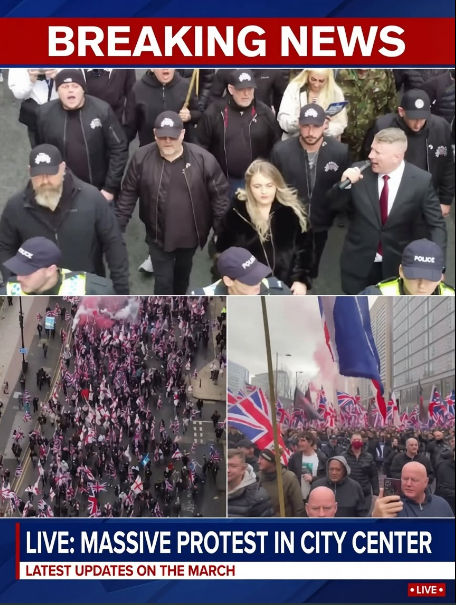
The demonstrations began after campaign groups opposing current migration policies announced plans to march through central Manchester. Organizers said they wished to highlight concerns about border security, asylum policy, public spending, and community cohesion. In response, several anti- racism and community organizations organized counter-demonstrations, arguing that migration should be discussed in a way that respects human rights and avoids stigmatizing minority communities. As the two groups assembled within close proximity, police established barriers and deployed officers to keep the demonstrations apart.
According to police, officers had prepared in advance for the possibility of disorder after assessing the likelihood of rival groups gathering in the same area. Public order units, mounted officers, and additional personnel were deployed to manage crowds, redirect traffic, and reduce the risk of direct confrontation. Temporary road closures and transport disruptions affected parts of the city while the demonstrations were underway.
As the events unfolded, several confrontations were reported between individuals from opposing groups. Witnesses described heated verbal exchanges that, in some locations, escalated into pushing, throwing objects, and isolated fights before officers intervened. Police moved quickly to separate participants and restore order. While social media posts characterized the scene in dramatically different ways, authorities emphasized that investigations would rely on available evidence rather than online commentary.
Video footage recorded by participants and bystanders spread rapidly across social media platforms, generating millions of views within hours. Some users argued the footage demonstrated growing public frustration over immigration policy, while others said it illustrated the dangers posed by increasingly polarized political demonstrations. Media analysts cautioned that viral clips often focus on the most dramatic moments and may omit events that occurred before or after the recorded incidents.
The demonstrations took place against the backdrop of continuing national debate over immigration and asylum policy in the United Kingdom. Successive governments have introduced measures aimed at reducing irregular migration, accelerating asylum decisions, and strengthening border security, while human rights organizations have argued that refugee protection and international legal obligations should remain central considerations. These policy disagreements have contributed to increasingly visible public demonstrations in several British cities.
Political reactions reflected the wider divisions within the country. Some politicians argued that the demonstrations highlighted legitimate public concerns about migration and called for stronger border controls and faster asylum processing. Others condemned the violence while emphasizing that peaceful protest remains a democratic right. Across party lines, many leaders urged participants to express their views lawfully and without intimidation or violence.
Community leaders also appealed for calm following the clashes. Representatives from faith organizations, neighborhood associations, and local charities encouraged residents not to judge entire communities based on the actions of a small number of individuals involved in disorder. They emphasized the importance of maintaining dialogue and avoiding rhetoric that could further inflame tensions.
Legal experts noted that British law protects the rights to peaceful protest and freedom of expression while also giving police powers to intervene where there is a risk of serious disorder, violence, or criminal damage. Individuals who engage in assault, vandalism, or other criminal offences during demonstrations may face arrest and prosecution regardless of the cause they support.
Policing experts observed that demonstrations involving opposing groups present significant operational challenges. Officers must balance protecting the right to protest with preventing violence, safeguarding bystanders, and minimizing disruption to the wider public. Decisions about crowd management, barriers, and public order tactics are generally based on dynamic risk assessments made throughout an event.
The events in Manchester have also renewed discussion about political polarization in Britain. Analysts say debates over immigration, identity, economic pressures, and public services have become increasingly contentious in recent years, contributing to more frequent demonstrations and stronger rhetoric from campaign groups across the political spectrum. Many observers argue that reducing tensions will require both effective public policy and respectful public debate.
Researchers studying social media caution that emotionally charged headlines and dramatic videos often spread faster than verified reporting. They recommend waiting for official police statements, court proceedings, and reporting from established news organizations before drawing conclusions about the scale of incidents or assigning responsibility. Early online narratives frequently change as additional evidence emerges.
Authorities have indicated that they are reviewing video evidence, witness statements, and other material to determine whether criminal offences occurred and whether further arrests are warranted. Police have also encouraged anyone with relevant information or recordings to come forward to assist the investigation.
As inquiries continue, many questions remain unresolved. While the demonstrations clearly highlighted deep divisions over migration policy, the full sequence of events and responsibility for individual acts of violence will ultimately depend on the findings of police investigations and, where appropriate, court proceedings. Until those processes conclude, officials continue to urge the public to distinguish between verified facts, eyewitness accounts, political opinion, and unconfirmed claims circulating online.