Tommy Robinson, Keir Starmer and the Battle Over Faith, Politics and Moral Authority
A heated political debate involving Keir Starmer and Tommy Robinson has sparked a wider conversation about religion, morality, social issues, and the role of faith in public life.
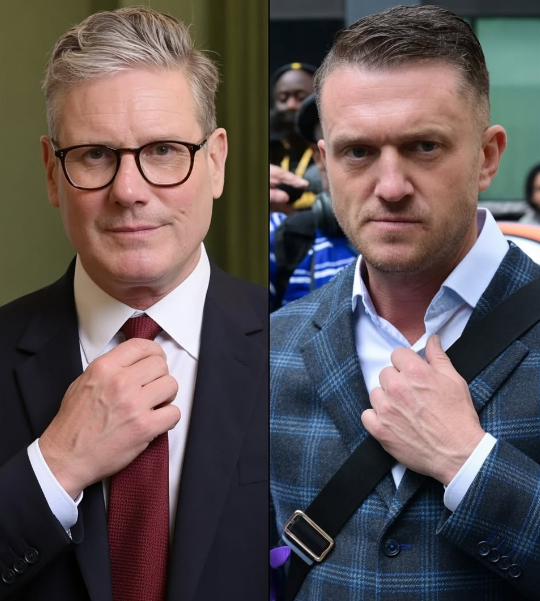
A widely circulated account describes a dramatic exchange in which Robinson responded to criticism by invoking Christian teachings and challenging political leaders over issues including healthcare, inequality, war, immigration, and government accountability.
The story has attracted attention because it combines several highly sensitive topics at once:
⚫ religion and politics,
⚫ freedom of expression,
⚫ social justice,
⚫ immigration,
⚫ and the moral responsibilities of leaders.
However, the specific wording and details of the exchange should be treated carefully unless independently verified. The statements circulating online represent a political narrative around Robinson’s views rather than confirmed evidence of every detail.
Nevertheless, the themes behind the controversy reflect a much larger debate taking place across Britain:
How should religious values influence political discussions, and who has the authority to claim the moral high ground?
A Clash Between Two Very Different Political Styles
Keir Starmer and Tommy Robinson represent very different approaches to public debate.
Starmer’s political identity has been built around institutional leadership, legal experience, and presenting himself as a serious governing figure.
Before entering politics, he had a career as a human rights lawyer and later served as Director of Public Prosecutions.
His supporters often describe him as a politician focused on stability, public services, and rebuilding trust in government.
Robinson, by contrast, has built his public profile through activism and direct confrontation.
He is known for campaigning on issues including immigration, Islam, crime, and cultural identity.
Supporters view him as someone willing to discuss subjects they believe mainstream politicians avoid.
Critics argue that his approach can increase division and that some of his claims require careful
examination.
The contrast between them represents a wider political divide:
Institutional politics versus outsider activism.
Religion as a Political Language
One of the most significant aspects of the controversy is the use of Christian language in a political argument.
For centuries, religious ideas have influenced debates about morality, justice, and leadership.
Politicians across different traditions have referenced religious principles when discussing:
- poverty.
⚫ equality.
⚫ war,
healthcare,
⚫ human dignity,
⚫ and social responsibility.
Supporters of Robinson’s argument believe that Christian teachings should encourage politicians to focus on compassion and fairness.
They argue that faith should not only be discussed during ceremonies or elections but should influence how societies treat vulnerable people.
However, critics argue that religious interpretations vary widely.
Different Christians may reach different conclusions about political issues, and religious teachings can be applied in different ways.
“What Truly Offends Jesus?” – The Moral Argument
At the centre of the circulating account is a rhetorical strategy:
Instead of simply defending himself, Robinson reframed the discussion around broader moral questions.
The argument presented suggests that the focus should not only be on individuals’ personal beliefs or statements but on larger issues affecting society.
This style of argument has a long history.
Religious figures and political activists have often challenged leaders by asking whether their actions match their stated values.
Examples throughout history include movements focused on:
- poverty reduction,
⚫ civil rights,
⚫ peace campaigns,
⚫ and social reform.
The effectiveness of this approach depends heavily on the audience.
Supporters may see it as a powerful moral challenge.
Opponents may view it as using religious language to advance a political position.
Faith, Politics and Social Justice
Many of the issues mentioned in the controversy are central to political debates around the world.
Healthcare and inequality
Questions about healthcare access and economic inequality have long been connected to moral discussions.
Some argue that societies have a responsibility to ensure vulnerable people receive support.
Others debate how governments should fund services while maintaining economic growth.
The disagreement is often not about whether healthcare matters, but about the best way to provide
it.
War and civilian suffering
The reference to war reflects another major moral debate.
Throughout history, religious leaders and political movements have questioned the human cost of military conflicts.
Supporters of stronger military policies argue that defence is necessary to protect nations and citizens.
Critics argue that governments must consider the consequences of military action, particularly for civilians.
This tension between security and humanitarian concerns remains one of the most difficult questions in international politics.
Immigration and human dignity
Immigration is one of Britain’s most politically sensitive issues.
Different groups approach the subject through different moral frameworks.
Some emphasise
⚫ national borders,
public services,
⚫ legal enforcement,
⚫ and government responsibility to citizens.
Others emphasise:
- humanitarian protection,
⚫ compassion,
⚫ and the rights of migrants and refugees.
Religious perspectives also vary.
Some faith groups focus strongly on welcoming strangers and helping vulnerable people.
Others emphasise the importance of laws, social order, and national responsibility.
The Politics of Moral Authority
A key question raised by the debate is:
Who gets to define what is morally right in politics?
Political leaders often attempt to present their positions as reflecting values such as:
⚫ fairness,
⚫ compassion,
⚫ justice,
- freedom,
⚫ or responsibility.
Different groups may agree on these values but disagree on how they should be applied.
For example:
A politician may argue that strict immigration controls protect society.
Another may argue that humanitarian policies better reflect compassion.
Both may claim moral reasoning.
This is why political debates involving religion often become especially intense.
They are not only disagreements about policy.
They are disagreements about values.
Supporters of Robinson’s Message
Those who support Robinson’s response argue that he challenged political leaders by focusing on principles rather than personalities.
They believe he highlighted issues they feel are ignored by traditional politics.
For supporters, the significance of the speech is not simply about Robinson himself.
It is about questioning whether governments consistently follow the values they publicly promote.
They argue that politicians should be judged by actions, not just words.
Critics of Robinson’s Approach
Critics argue that moral arguments require careful consideration of complexity.
They point out that issues such as healthcare, immigration, and foreign policy involve difficult choices with competing consequences.
They argue that governments must balance multiple responsibilities rather than focusing on one moral perspective.
Some critics also question whether Robinson’s political history affects how his statements are interpreted.
For some, the issue is not only what is said but who is saying it and the broader context surrounding their activism.
Why the Debate Spread Online
The controversy gained attention because it fits the modern pattern of political communication.
Strong statements involving:
⚫ religion,
⚫ identity.
immigration,
⚫ and criticism of leaders
often spread quickly online.
Social media rewards emotional and memorable messages.
A short quotation can reach large audiences without the surrounding context of a longer discussion.
This creates both opportunities and challenges.
Public figures can communicate directly with supporters.
But complex debates can also become simplified into competing narratives.
The Changing Relationship Between Religion and Politics
Britain has a long history of connections between Christianity and public life.
The monarch is linked constitutionally to the Church of England, and religious language has historically appeared in political speeches.
However, Britain today is also a diverse and increasingly secular society.
This creates ongoing debates about:
⚫ the role of religion in government,
⚫ whether religious arguments should influence laws,
⚫ and how different belief systems should coexist.
Some argue that religious values provide important moral guidance.
Others argue that political decisions should primarily rely on secular reasoning that applies equally to all citizens.
Public Figures and Responsibility
The controversy also highlights the responsibility carried by influential figures.
Politicians and activists both have large platforms.
Their words can influence public attitudes and shape national conversations.
Supporters argue that outspoken voices are necessary because they challenge accepted ideas.
Critics argue that influential figures must ensure their messages are accurate and avoid creating unnecessary division.
This balance between freedom and responsibility is central to democratic debate.
A Larger Conversation About Britain’s Future
The disagreement between figures like Starmer and Robinson reflects deeper questions facing Britain.
What values should guide national decisions?
How should the country balance compassion and control?
What role should religion play in public debate?
How should leaders respond when society is deeply divided?
These questions extend far beyond one political argument.
They represent ongoing discussions about identity and the future direction of the country.
Conclusion: Beyond the Argument, a Debate About Values
The reported clash between Keir Starmer and Tommy Robinson has attracted attention because it combines politics with morality and faith.
Supporters see Robinson’s message as a powerful challenge to political leaders and a call to apply moral principles consistently.
Critics argue that complex issues cannot be reduced to simple moral accusations and require careful policy analysis.
Regardless of political position, the debate demonstrates something important about modern Britain: Political disagreements are increasingly becoming disagreements about values.
Questions about immigration, healthcare, war, and social justice are not only about policy choices.
They are also about competing visions of what a fair and responsible society should look like.
And that conversation is likely to continue long after this particular controversy fades from the headlines.