
A PRIME MINISTER IS BEING TAKEN TO COURT BY HIS OWN POLICE. BECAUSE HE’S LETTING A COP’S KILLERS WALK FREE.
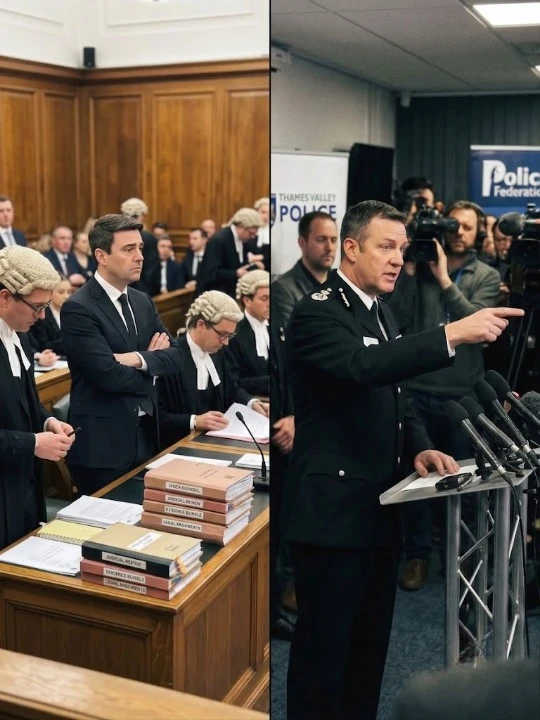
PC Andrew Harper Early-Release Row Puts Burnham Under Pressure From Police, Victims, and Parliament
A fierce political and legal row has erupted over reports that two of the men convicted over the death of PC Andrew Harper may still be eligible for early release under the government’s prison-capacity scheme.
Harper was 28 when he died in August 2019 while responding to a quad bike theft in Berkshire. He became caught in a strap attached to a getaway vehicle and was dragged along a road, suffering fatal injuries. Three teenagers were later convicted of manslaughter, not murder. Henry Long, the driver, received a 16-year sentence; Jessie Cole and Albert Bowers received 13-year sentences. Under Harper’s Law, introduced after campaigning by his widow Lissie Harper, someone convicted today of manslaughter of an emergency worker while committing another crime would face a mandatory life sentence unless exceptional circumstances applied. Thames Valley Police has noted that if Harper’s killers were sentenced under the law bearing his name today, they would receive life sentences.
Why the Case Has Returned to the Centre of Politics
The latest controversy is about the Sentencing Act 2026 and the government’s early-release measures, designed to ease pressure on an overcrowded prison estate. Reports say Cole and Bowers could become eligible for release halfway through their 13-year sentences, while Long is not eligible under the scheme. ITV reported that Prime Minister Andy Burnham said the main perpetrator, Long, “will not be subject to any early release,” but that concern remained over the other two men.
For Harper’s family, police officers, and many members of the public, that distinction has not calmed the anger. The emotional argument is simple: a police officer died doing his job, and those convicted in connection with his death should not benefit from a general prison-capacity policy.
Thames Valley Police Chief Constable Jason Hogg publicly expressed concern after reports that Bowers and Cole may be eligible for early release. Thames Valley Police and Crime Commissioner Matthew Barber has also written to the Prime Minister and Lord Chancellor urging emergency legislation to prevent the early release of the two men.
“Final Betrayal” Versus “Consistency”
Supporters of a legal challenge argue that the government has already shown it can create exemptions when political pressure becomes intense. Recent reports say ministers moved to exclude rapists, serious child sex offenders, and grooming-gang perpetrators from early release, reducing the expected number of releases from about 6,000 to around 5,000. But reports also say those convicted over PC Harper’s death remain eligible unless the rules are changed again.
That has created the charge of inconsistency. Critics ask why the government can exempt some categories of serious offenders but not those convicted of killing an emergency worker. To police representatives and Harper’s supporters, this is not an administrative detail. It is about whether the state stands behind officers who risk their lives.
The government’s defence is that emergency release rules must be applied consistently and lawfully, rather than rewritten case by case. That argument may be legally cautious, but politically it is difficult. The public does not experience this case as a sentencing category. It experiences it as the death of a young officer whose killers may leave prison earlier than many expected.
The Police Response
The police reaction has been unusually strong. Reports say the head of Thames Valley Police has considered joining or supporting a potential legal challenge, while Police Federation figures have also explored legal options. The Guardian reported that the government had resisted pressure to exempt Harper’s killers even as the chief of his former force considered joining a legal challenge.
The Sun reported that senior policing figures, including Metropolitan Police Commissioner Sir Mark Rowley, criticised the prospect of early release as damaging to officers’ confidence that the law is behind them. The same report said hundreds of thousands of people had signed a petition seeking to block the move.
This matters because police legitimacy depends not only on public confidence, but on officer confidence too. Officers are asked to run toward danger. If they believe the state will not treat attacks on them with exceptional seriousness, morale suffers.
Lissie Harper and the Victims’ Rights Question
Lissie Harper’s campaign after her husband’s death led to Harper’s Law, making her one of the most prominent victims’ rights campaigners in Britain. Her opposition to early release carries particular weight because she has already lived through the trial, sentencing, public debate, and years of campaigning for legal change.
The wider question is whether victims and their families should be told in court that a sentence means one thing, only to discover later that release rules mean something very different in practice.
That gap between sentence and time served has long damaged public trust. Early-release schemes make it worse because they appear to change the punishment after the fact. Even when legally permitted, they can feel morally wrong to families who believed the original sentence had finality.
The Government’s Prison Crisis
The government is not inventing the prison-capacity problem. England and Wales have faced severe pressure across the prison estate, and ministers argue that emergency release measures are needed to prevent wider breakdown. The Guardian reported that Burnham paused or reviewed the scheme amid backlash, but officials still faced the reality that the system remained near capacity and alternatives were limited.
That is the government’s hardest dilemma. If prisons are full, the justice system cannot operate properly. Courts, police custody, probation, prison staff, and public safety all come under strain. But if the government releases serious offenders early, it risks appearing to solve a capacity failure by asking victims to absorb the consequences.
In political terms, that is almost impossible to defend unless the exemptions are clear, principled, and publicly trusted.
Why This Case Is Different
Some ministers may argue that the scheme cannot be designed around individual cases. But Harper’s case is not ordinary. It involved the death of a serving police officer responding to a crime. It helped produce a major change in sentencing law. It remains a national symbol of the risks faced by emergency workers.
That does not mean courts should ignore legal categories. The men were convicted of manslaughter, not murder, and the law at the time determined their sentences. But it does mean the government must explain why a later law that recognises the special gravity of killing an emergency worker does not inform early-release policy.
Critics are not asking ministers to change a jury verdict. They are asking ministers to decide whether people convicted in such cases should be excluded from a discretionary release scheme.
The Parliamentary Route
The Conservatives are reportedly seeking to block the release through an amendment to the Sentencing Act 2026, excluding those convicted of manslaughter of an emergency worker from the scheme.
That may prove to be the cleanest route if ministers accept the principle. Rather than intervene in one named case, Parliament could create a general exemption for offenders convicted of manslaughter of emergency workers. That would address the legal concern about individual treatment while answering the public demand for principle.
But such a change would also raise practical questions. How many prisoners would be affected? Would the rule apply retrospectively to current prisoners? Would it include all emergency workers? Would it apply only where the victim was on duty? Would similar arguments then be made for other categories of manslaughter?
These questions are difficult, but not impossible. Parliament exists to draw such lines.
What Burnham Must Answer
The Prime Minister now faces several direct questions.
Why can the government exclude rapists, serious child sex offenders, and grooming-gang perpetrators, but not those convicted over the manslaughter of an emergency worker?
What legal advice says such an exemption is impossible, if that is the government’s position?
Will ministers support emergency legislation?
What role will victims’ families have in future early-release decisions?
How will police officers be reassured that the state values their service?
And if the prison crisis is so severe that offenders in cases like this must be released early, why should the public believe the justice system is functioning at all?
Until those questions are answered clearly, the row will continue.
Conclusion
The PC Andrew Harper early-release controversy has become one of Andy Burnham’s first major justice tests because it cuts through legal complexity and speaks directly to public morality.
The government says it must manage a prison system under extreme pressure. Police leaders, Harper’s family, and many members of the public say that cannot justify allowing two men convicted over the death of a police officer to benefit from early release.
This is not simply a dispute over sentence calculations. It is a test of whether the state stands behind those who protect the public.
If ministers believe the current policy is legally necessary, they must explain why. If they accept the moral force of the objection, they should legislate.
What they cannot do is ask police officers and victims’ families to trust a system that appears unable to distinguish between administrative convenience and justice.