
CHRISTIAN NATION DECLARED WAR

Faith, Fury and the Fight for Britain: Tommy Robinson’s Christian Message Electrifies a Huge London Crowd — and Deepens a National Divide
Crosses rose above a sea of Union Jacks. Chants invoking Christ rolled through central London. Thousands packed the streets as police lined the route, while speeches from the stage mixed religion, national identity, immigration and warnings about the future of Britain.
Then Tommy Robinson turned the conversation toward Africa.
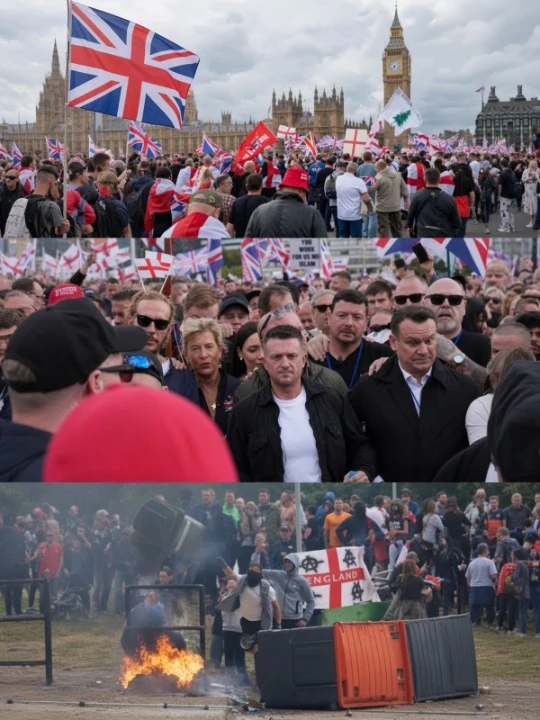
At his “Unite the Kingdom” demonstration in London on May 16, Robinson — whose real name is Stephen Yaxley-Lennon — spoke about Christians being killed in Nigeria and accused powerful Western institutions of failing to give their suffering sufficient attention. A Nigerian Anglican bishop also appeared at the rally to discuss violence affecting Christian communities. For Robinson, it became part of a much broader argument: Britain should rediscover its Christian identity and become more willing to defend Christians facing persecution abroad.
The moment captured something much larger than one speech.
Christianity is increasingly becoming central to the political movement Robinson is trying to build.
And that transformation is creating one of the most combustible debates in modern British politics.
A Crowd That Looked More Like a Religious Revival
Police estimates cited by major British outlets put attendance at Robinson’s May demonstration at roughly 60,000 people. Supporters filled parts of central London carrying British and English flags, crosses and religious signs. Chants of “Christ is King” could be heard among the crowd, while Robinson urged supporters to become more politically active ahead of future elections.
The scale mattered.
Robinson has organised protests for years, frequently centred on immigration, Islam, free speech and national identity. But Christianity has become increasingly prominent in the imagery surrounding his movement. Earlier rallies had already featured prayers, worship music, crosses and public declarations of Christian faith.
At the May demonstration, that symbolism fused with another emotionally powerful subject: the killing of Christians overseas.
Robinson focused particularly on Nigeria, describing the violence there in extraordinarily stark terms and arguing that Christians were facing a catastrophe largely ignored by the West.
There is no doubt that Nigeria is experiencing a severe security and religious-freedom crisis.
The U.S. Commission on International Religious Freedom says armed groups, including Islamist organisations and some Fulani militant networks, have carried out deadly attacks on religious communities. Christians have frequently been victims, including communities in Nigeria’s Middle Belt. USCIRF reported in May that some Fulani militants had committed particularly notorious attacks against religious communities, “often but not exclusively” targeting Christians.
Recent events underline the brutality.
More than 150 worshippers were abducted from three churches in Kaduna State in January. In April, five people were killed during an Easter church service in another attack.
But the situation is more complicated than a simple war between two religions.
Muslims are also routinely murdered by extremist groups. In February, militants slaughtered at least 162 people in predominantly Muslim villages in Kwara State after residents resisted their extremist preaching. Nigeria’s government has rejected claims that the country is experiencing a specifically anti-Christian “genocide,” arguing that terrorism, criminality, ethnic conflict, competition over land and weak state security all contribute to the bloodshed.
That distinction matters enormously.
It also explains why Robinson’s speech became so controversial.
The Argument His Supporters Believe Britain Avoids
To Robinson’s supporters, however, the fundamental question is much simpler.
Why, they ask, does the persecution of Christians appear to receive less political attention than other global human-rights causes?
For people standing beneath crosses at his rally, Nigeria provided powerful evidence for an argument they already believed: Christianity is increasingly treated with embarrassment in the West even while Christians elsewhere suffer because of their faith.
That perception is helping Robinson connect two issues that once occupied different political worlds.
One is religious persecution overseas.
The other is British national identity at home.
His message increasingly suggests that Britain cannot credibly defend persecuted Christians abroad unless it first remembers that Christianity helped shape Britain itself.
That is where the argument becomes explosive.
Britain undoubtedly possesses deep Christian historical roots. The Church of England remains established by law, the monarch is its Supreme Governor, and Christian traditions remain embedded throughout British institutions and ceremonies.
But modern Britain is also religiously diverse and increasingly secular.
Millions of British citizens are Muslim, Hindu, Sikh, Jewish or members of other faiths. Millions more have no religion at all.
So when someone declares that Britain must once again become explicitly Christian, the obvious political question follows:
What does that mean for everybody else?
Christian Revival — or Political Nationalism?
Robinson’s supporters insist that celebrating Christianity does not require persecuting anyone.
They argue that a country can proudly acknowledge its inherited religion while protecting complete freedom of worship for minorities. From that perspective, displaying crosses, praying publicly or declaring Britain a Christian country is no more threatening than acknowledging its language, monarchy or national flag.
Critics see something different.
They argue that Christianity is being incorporated into a nationalist political movement whose history is heavily associated with opposition to Islam and immigration. Robinson founded the English Defence League and has spent years campaigning around those issues. His critics therefore question whether the current emphasis on Christianity represents spiritual revival or whether religious language is becoming another weapon in Britain’s culture wars.
Some Christian leaders have voiced similar unease.
The Church of England and other religious figures have previously criticised attempts to connect Christianity with exclusionary nationalism, arguing instead that Christian teaching demands compassion and dignity across racial and religious lines.
That creates an unusual confrontation.
Robinson increasingly presents himself as defending Christianity.
Some established Christian leaders argue that he is distorting it.
Meanwhile, thousands of people attending his demonstrations clearly respond to the message.
The “Battle of Britain”
The language surrounding the May demonstration sharpened those tensions further.
Robinson told supporters to prepare politically for what he called the “battle of Britain” ahead of the 2029 general election and encouraged them to become involved in political parties and local organisation. In context, this was presented as a political struggle rather than a literal declaration of war — despite much more sensational descriptions circulating online.
The distinction is important because rhetoric matters.
Britain already has an increasingly confrontational protest culture. The Metropolitan Police deployed approximately 4,000 officers across London on May 16 as Robinson’s event coincided with a large pro-Palestinian demonstration. Police later recorded 43 arrests connected with the day’s protests.
Authorities were trying to protect two principles simultaneously: the right to protest and the obligation to prevent violence and hate crime.
That balancing act is likely to become harder if rallies continue growing.
Something Bigger Is Happening
It would be easy to dismiss Robinson’s increasingly religious messaging as another provocative chapter in a long and controversial career.
That may underestimate what is happening.
The crowd suggests there is a constituency in Britain that believes three things simultaneously: that Christianity is disappearing from public life, that Britain’s national identity is weakening, and that violence against Christians abroad is receiving inadequate attention.
Robinson is attempting to fuse those anxieties into one movement.
His opponents believe doing so risks turning faith into an instrument of political division.
His supporters believe the real scandal is that mainstream institutions surrendered Britain’s Christian identity long ago — and now condemn anyone who tries to recover it.
The argument will not disappear by calling one side extremists or the other side traitors.
There are genuine Christians facing murder, kidnapping and displacement in parts of Nigeria. There are also Muslims suffering from the same extremist violence.
Britain likewise has a genuine Christian inheritance.
It is also a pluralistic democracy whose citizens do not need to share the same religion to belong.
Those realities can coexist.
The political battle begins over what conclusions Britain should draw from them.
Tommy Robinson has already made his answer clear. His movement is placing Christianity, patriotism and national identity closer together than at any previous stage of his activism.
Whether that produces a lasting Christian political revival, remains confined to Robinson’s existing support base, or provokes an even stronger backlash remains uncertain.
But after tens of thousands gathered beneath crosses and British flags in London, one thing is increasingly difficult to deny:
Religion has returned to the centre of Britain’s culture war — and this time, it may not be leaving quietly.