FRANCE STRIKES BACK: UK MILITARY PLAN DECLARED “ILLEGAL”!
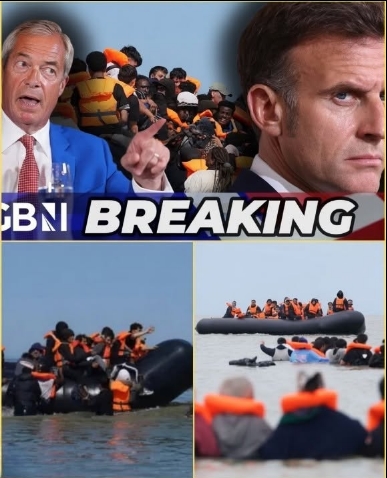
France Strikes Back as Farage’s “Operation Fortress” Plan Sparks Legal and Border Row
France has issued a sharp warning over Nigel Farage’s proposed “Operation Fortress,” saying any attempt by the UK to use the Royal Navy to force small boats back to French shores would be illegal and a violation of French sovereignty.
The response came after Reform UK unveiled one of its most dramatic border proposals yet: a military-led operation in the English Channel designed to stop unauthorised small boat crossings and return migrants to France or Belgium. Farage has vowed that a Reform government would stop small boat crossings within two weeks, using the Navy and other armed forces to intercept boats before they reach British shores.
For Reform supporters, the plan is a long-awaited show of force after years of failed promises from successive governments.
For critics, it is a legally questionable slogan that collides with maritime law, international obligations and basic diplomatic reality.
France has now made clear which side of the argument it stands on.
What France Said
A spokesperson for the French Interior Ministry said Reform’s plan would breach international law and violate French sovereignty. The warning was direct: Britain cannot simply send people back to France by military force without French agreement.
That response cuts to the heart of the issue.
Farage can promise to intercept small boats in the Channel. But returning people to France requires France to accept them. If UK vessels attempted to force boats or passengers back into French territory without consent, Paris says that would breach maritime and international law.
This is not only a political disagreement. It is a sovereignty dispute.
France is effectively saying: Britain may control its own waters, but it cannot impose a returns policy on French territory.
What “Operation Fortress” Would Do
Reform UK has described Operation Fortress as the largest military operation in the English Channel since the Second World War. The plan would involve the Royal Navy, Royal Marines, RAF and Army working together to intercept unauthorised vessels and prevent any small boat from reaching the UK.
Farage argues that the policy would save lives, break the business model of people-smuggling gangs and end what he sees as the collapse of border control. Reform figures have said the UK would pick up people attempting irregular crossings and return them to France, arguing that France is a safe country where asylum claims should be processed.
But the plan has drawn criticism from military and legal observers. A former Royal Navy officer told The Guardian that Reform’s proposal lacked substance and questioned whether warships should be diverted from real military threats to conduct migrant interception operations.
That criticism reflects a wider concern: a military operation may sound decisive, but the Channel is not a battlefield. It is a busy, legally complex maritime zone involving distressed boats, search-and-rescue duties, French cooperation, human life and international law.
The 14-Day Promise
The most politically explosive part of Farage’s claim is his promise to stop all small boat crossings within two weeks of taking power.
That promise is designed to contrast Reform with both Labour and the Conservatives, who have repeatedly pledged to reduce crossings but failed to eliminate them entirely.
The appeal is obvious. Many voters are tired of hearing that the issue is complicated. They see repeated arrivals, huge costs, legal appeals and public services under pressure. A two-week deadline sounds like control, urgency and political will.
But the same simplicity is also the weakness.
Stopping small boats completely would require not only patrols, but also French agreement, lawful returns routes, detention capacity, safe interception procedures, rapid processing, and a strategy for smugglers who adapt their tactics. Without those elements, a two-week promise risks becoming a headline rather than an operational plan.
The Border Deal Farage Is Attacking
Farage’s criticism also targets the UK-France border partnership, which he argues has cost vast sums while failing to stop the boats.
The UK government says its cooperation with France has prevented tens of thousands of attempted crossings. A government statement in April said joint work with France had prevented more than 42,000 small boat crossing attempts since the election, while a later Home Office update said UK-French cooperation had stopped over 46,000 attempted crossings.
The government has also announced expanded personnel, new specialist police units in northern France, stronger intelligence sharing and measures to target “taxi boats” used by smuggling gangs.
Supporters of the deal say this proves cooperation is working, even if crossings have not ended.
Farage’s counterargument is that partial prevention is not enough. If boats still arrive, he says the system has failed.
That is the political divide: the government measures success by attempts prevented; Reform measures failure by arrivals that still happen.
The Real Flaw in the System
There is a genuine flaw in the current system, though it is not hidden.
Britain depends heavily on French cooperation to stop departures. But French police cannot always intervene once boats are in the water, especially if doing so risks lives. Smugglers know this and increasingly use tactics designed to reach the water quickly, sometimes launching from wider stretches of coastline or using so-called “taxi boats.” The Home Office has said the new UK-France deal includes expanded maritime tactics to target that problem.
That is why the issue is so difficult.
The UK wants France to stop departures before boats reach the Channel.
France says it is already doing more but must operate within its own law, safety duties and sovereignty.
Smugglers exploit the gap between land enforcement, maritime rescue and legal returns.
Operation Fortress is Reform’s proposed answer to that gap.
France’s response is that Reform’s answer would create a new legal crisis.
Why the Legal Question Matters
International maritime law places strong duties on states and vessels to protect life at sea. If a small, overcrowded dinghy is in distress, the priority becomes rescue, not political messaging.
There are also refugee-law and human-rights questions. Even people who enter irregularly may claim asylum. Governments can remove people who have no right to remain, but removals usually require lawful procedures and agreements with receiving countries.
France’s warning is therefore not just diplomatic anger. It reflects a broader legal reality: border control at sea is harder than border control on land.
A state can patrol its waters.
It can intercept boats.
It can rescue people.
It can process claims.
It can negotiate returns.
But it cannot simply impose returnees on another sovereign country without consent.
That is the barrier Farage would have to overcome.
Reform’s Political Advantage
Even with the legal questions, Reform benefits politically from this row.
France’s rejection allows Farage to argue that the British state is trapped by foreign governments, international law and weak political will. To his supporters, the French response may not weaken Operation Fortress; it may strengthen the belief that only a radical break with the current system will work.
That is why the policy is powerful as politics.
It identifies a visible problem.
It names an enemy: smugglers, legal constraints, French resistance, Westminster failure.
It offers a simple solution: send the Navy, turn the boats back, stop crossings fast.
The challenge is whether that simplicity can survive contact with law, diplomacy and operational reality.
Conclusion: A Border Plan Meets International Reality
France’s response has turned Operation Fortress from a domestic British campaign pledge into an international row.
Farage says he can stop small boats within two weeks and use the military to return migrants to France.
France says that would be illegal.
The UK government says cooperation with France has already prevented tens of thousands of attempted crossings.
Reform says prevention is meaningless if boats keep arriving.
Both sides are now speaking to different public fears: the fear of uncontrolled borders, and the fear of reckless policy that breaks legal and diplomatic rules.
The truth is that Britain’s small boats crisis cannot be solved by slogans alone. It requires enforcement, returns agreements, safe procedures, serious diplomacy, faster decisions and action against smuggling gangs.
Operation Fortress has exposed public anger with the current system.
France’s response has exposed the limits of unilateral action.
That is why this row matters: because it shows that stopping the boats is not only a question of political will.
It is a question of law, sovereignty, cooperation and whether Britain can build a border policy that is both firm and workable.