
IF MILLIONS OF MUSLIMS ARE “UNWANTED,” THEN WHAT DOES THAT SAY ABOUT AMERICA?
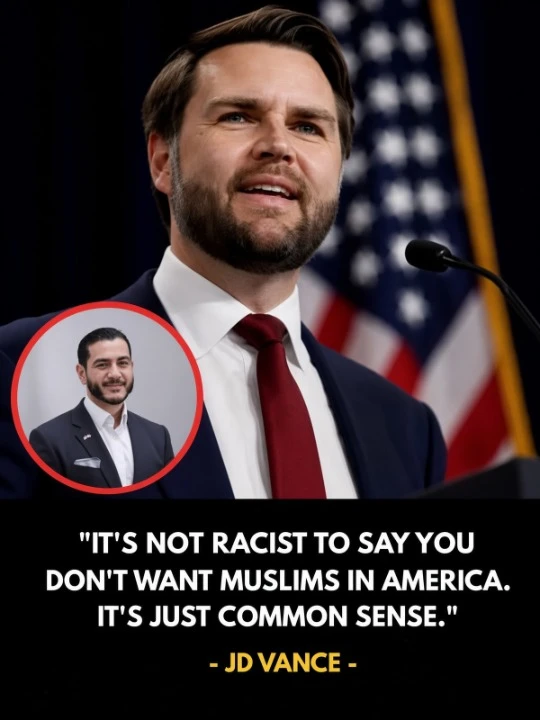
“We Don’t Want Certain People”: A Viral JD Vance Quote Reopens America’s Most Difficult Question About Muslims, Immigration and Who Belongs
WASHINGTON — The sentence spreading across social media is explosive because of its simplicity.
“It’s not racist to say you don’t want Muslims in America. It’s just common sense.”
The words have been attributed to JD Vance, now vice president of the United States, and they have triggered exactly the kind of reaction such a statement would be expected to produce: outrage, applause, arguments about Islam, warnings about extremism and accusations that America is losing sight of its commitment to religious liberty.
There is just one problem.
That viral sentence does not appear to be what Vance actually said.
The real comments are more complicated — and arguably more revealing.
During Vance’s October 31, 2024 appearance on The Joe Rogan Experience, the conversation turned to Islam, immigration, assimilation and fears about Sharia law in Western societies. Vance warned about what he described as “religious tyranny” emerging when some immigrant communities fail to assimilate. But he also explicitly drew a distinction between ordinary Muslims and Islamists, saying the two should not be treated as synonymous.
Minutes later, while discussing immigration more broadly, Vance complained that Americans were discouraged from considering the backgrounds, skills and characteristics of people seeking entry into the country.
“Somehow it’s fundamentally racist to say, well, we don’t want certain people of certain backgrounds to be in the United States of America,” he said.
Then came the words that helped generate the viral controversy:
“No, it’s just common sense.”
That is substantially different from declaring that America should exclude all Muslims.
But it still raises a serious question.
When politicians talk about “certain backgrounds,” where exactly is the line between legitimate immigration screening and collective suspicion of an entire religious community?
The Context Changes the Quote — But Not the Debate
Vance’s next example is important.
He did not immediately say that Muslims should be excluded. Instead, he asked listeners to imagine immigrants coming from Mexico and argued that criminal history, literacy, language skills and the ability to integrate should influence immigration decisions. He framed his argument around whether individual immigrants would benefit the United States.
That context makes the viral version misleading.
But the earlier portion of the same conversation was unmistakably focused on Islam.
Rogan and Vance discussed activists they believed wanted Sharia law, Muslim population growth and the possibility of religiously driven political movements gaining influence in Western countries. Vance said he feared situations in which immigrants did not assimilate into Western values and instead attempted to establish what he called religious tyranny locally.
At the same time, Vance inserted a crucial qualification.
“There are Muslims who are not Islamists,” he said, explaining that by “Islamists” he meant theocrats.
That distinction matters enormously.
A Muslim is a follower of Islam.
An Islamist, in the political usage Vance was employing, refers to someone advocating a political system grounded in a particular interpretation of Islamic governance.
Conflating those categories can turn a debate about political ideology into suspicion directed toward an entire religion.
And that is precisely why the viral quote has resonated so powerfully even though its wording is inaccurate.
Muslim America Is Not One Thing
One of the fundamental problems with treating “Muslims” as a single political category is that Muslim Americans are extraordinarily diverse.
Pew Research Center’s 2023–24 Religious Landscape Study found that Muslims constitute roughly 1% of the American adult population, with no single racial or ethnic group forming a majority. Roughly 30% identify as White, around 30% as Asian, about 20% as Black and 11% as Hispanic. Some are immigrants; others were born in the United States. Some are intensely religious, while others say religion plays a far smaller role in their lives.
That diversity matters when political rhetoric begins using religion as shorthand for political behavior.
A Muslim physician in Chicago, a Muslim shop owner in Texas, a Muslim university student in Michigan and a Muslim military veteran are not necessarily connected by anything beyond their religious identity.
They may disagree about abortion.
They may disagree about taxation.
They may disagree about Israel and Palestine.
They may disagree about Donald Trump.
They may even disagree fundamentally about Islam itself.
That is what pluralistic societies look like.
America Can Screen Immigrants Without Screening Faith
There is nothing inherently discriminatory about a country deciding whom to admit as an immigrant.
Governments routinely evaluate security threats, criminal histories, visa qualifications and other eligibility criteria.
A person with documented terrorist connections can be investigated.
Someone involved in violent extremism can be denied entry where the law permits.
Someone committing crimes can be prosecuted.
An immigration system can favor skills, family connections or other qualifications.
Those are judgments about conduct and eligibility.
The constitutional problem becomes far more serious when government policy moves from evaluating individuals to treating religious affiliation itself as a proxy for dangerousness.
The First Amendment bars government from establishing religion or prohibiting its free exercise. America’s constitutional tradition also rejects religious tests for public office.
Those protections do not mean every religious practice overrides secular law.
They do mean the government cannot casually divide Americans into legitimate and illegitimate citizens according to theology.
That protection belongs to Christians.
It belongs to Jews.
It belongs to Muslims.
It belongs to Hindus, Buddhists, atheists and everyone else.
Religious freedom becomes meaningless if it applies only to religions enjoying political popularity.
The Vance of 2026 Adds Another Complication
There is an additional reason simplistic interpretations of Vance’s position should be treated carefully.
Vance is now serving as vice president in the Trump administration.
And when he returned to Rogan’s podcast in July 2026, his language about religious pluralism was noticeably more expansive.
Discussing religion in public schools, Vance said people should not have religion forced upon them and described religious freedom as important to individual dignity. During that conversation, he acknowledged “an important contribution from the Muslim world” to Western intellectual and legal traditions and spoke about different faiths sharing space in a pluralistic democracy.
That does not erase his previous comments about immigration or Islamism.
It does demonstrate why political figures should be judged by their actual words rather than memes constructed from pieces of different conversations.
Vance can simultaneously believe immigration should be much more selective, worry about Islamist political movements, distinguish Islamists from ordinary Muslims and recognize Muslims as participants in American pluralism.
Those positions may still be fiercely debated.
But they are not the same as simply saying, “Muslims are unwanted.”
The Bigger Danger Is Collective Guilt
The strongest case against sweeping anti-Muslim rhetoric does not require pretending that Islamist extremism is imaginary.
Violent extremism is real.
Governments have a responsibility to confront it.
The same principle applies regardless of ideology.
If someone plots terrorism, investigate the plot.
If someone finances terrorism, follow the money.
If a religious leader directly incites violence, examine the evidence and apply the law.
If a foreign national poses a legitimate security threat, immigration authorities can act under applicable law.
But none of those facts logically establishes that millions of people sharing a religious label represent the same threat.
Security policy based on individual evidence is law enforcement.
Suspicion based principally on identity is something very different.
And history repeatedly shows how quickly the second can masquerade as the first.
The Real Question Is Who Gets to Be an American
The controversy surrounding Vance’s comments therefore reaches beyond one podcast.
It touches an argument as old as the United States itself.
What makes someone American?
Blood?
Birthplace?
Religion?
Political ideology?
Or loyalty to a constitutional system that allows people with radically different beliefs to live under the same law?
The American constitutional answer has never required citizens to worship the same God.
Indeed, the First Amendment was constructed around precisely the opposite principle: government cannot establish an official religion and cannot simply prohibit the exercise of another.
That principle becomes most meaningful when society is frightened.
It is easy to defend religious liberty when everyone involved is familiar and popular.
The difficult test comes when the religion is misunderstood, politically controversial or associated in the public imagination with genuine acts of extremism committed by some of its adherents.
That is where democratic discipline matters.
Debate the Policy. Demand the Evidence. Judge the Individual.
Americans can have an uncompromising debate about immigration without declaring an entire religion unwelcome.
They can demand secure borders.
They can debate refugee admissions.
They can oppose Islamist political ideology.
They can insist that American constitutional law takes precedence over any religious code.
They can investigate terrorist networks and prosecute violent extremists.
None of that requires assuming that a peaceful Muslim neighbor, citizen, soldier, doctor, teacher or student shares responsibility for someone else’s ideology.
And none of it requires changing a politician’s real words into a more inflammatory sentence.
The authentic Vance remarks are controversial enough to debate on their own.
He argued that America should examine the backgrounds and qualities of potential immigrants. He described that position as common sense. He expressed serious fears about Islamist political influence and failures of assimilation. But he also specifically distinguished Muslims from Islamists.
Those distinctions matter.
Because in a country built around freedom of religion, the most important dividing line should not be between Muslim and Christian.
It should be between those who obey the law and those who break it, between peaceful citizens and genuine threats, and between evidence about an individual and suspicion attached to a group.
America can protect itself without declaring millions of people permanently suspect.
It can confront extremism without confusing extremism with Islam.
And it can demand loyalty to the Constitution without demanding religious conformity.
That is not weakness.
That is what constitutional citizenship is supposed to mean.