Indiana Lieutenant Governor’s Remarks on the Public Islamic Call to Prayer Spark Debate Over Religious Freedom and Public Expression
Public comments by Indiana Lieutenant Governor Micah Beckwith regarding the Islamic call to prayer have prompted renewed discussion across the United States about the balance between religious liberty, freedom of expression, and the role of government in regulating activities that take place in public spaces. While the remarks have been welcomed by some who argue for stricter limits on amplified religious activities, they have also been criticized by others who believe they raise important constitutional questions concerning equal treatment of different faith communities. The discussion has expanded beyond Indiana, becoming part of a broader national conversation about how religious diversity should be accommodated in an increasingly pluralistic society.
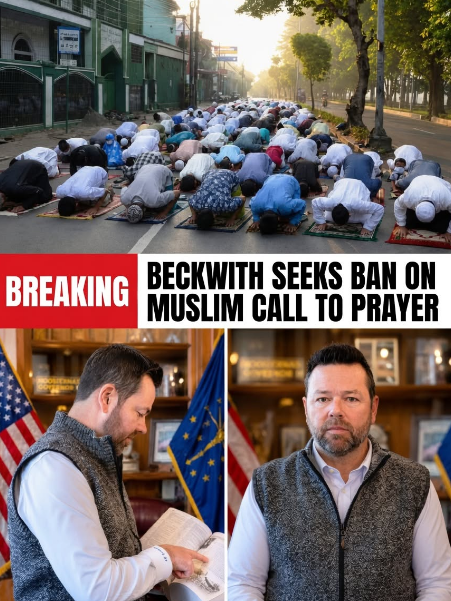
The controversy began after Beckwith stated that the public Islamic call to prayer, commonly known as the adhan, should not be permitted. His comments quickly circulated through news outlets, political commentary programs, and social media platforms, where supporters and opponents offered sharply contrasting interpretations. Although the statement itself was relatively brief, it touched upon longstanding debates involving religious liberty, public space, community standards, and constitutional protections.
The Islamic call to prayer is a centuries-old religious tradition observed by Muslims around the world. Traditionally recited five times each day, the adhan serves as an invitation for believers to gather for prayer. In many Muslim-majority countries, the call is broadcast publicly from mosque loudspeakers. In the United States, however, practices vary significantly depending on local regulations, community preferences, and municipal ordinances governing amplified sound.
Many American mosques conduct the call to prayer entirely inside their buildings without external amplification. Others have obtained permits allowing limited outdoor broadcasts, often subject to the same local noise regulations that apply to churches ringing bells, public announcements, or other amplified sounds. Municipal rules differ from city to city, meaning there is no single nationwide policy governing public calls to prayer.
Beckwith’s remarks entered this existing legal and cultural landscape, immediately raising questions about whether restrictions should focus on the content of religious expression or on neutral standards such as noise levels and public disturbance. Legal scholars frequently note that constitutional questions involving religion often require governments to apply rules consistently regardless of which faith is involved. As a result, discussions surrounding one religious practice frequently expand into broader conversations about equal protection and the First Amendment. Supporters of Beckwith’s position argue that government officials have a responsibility to consider the interests of surrounding communities when evaluating requests for amplified religious broadcasts.
Some believe that public loudspeaker systems, regardless of the religion involved, can affect neighborhood quality of life if not carefully regulated. Others argue that local governments should retain broad authority to establish reasonable time, place, and manner restrictions designed to minimize disruption while remaining neutral toward religious belief.
Some supporters also frame the discussion within broader concerns about preserving local traditions and maintaining consistency in how public spaces are managed. They contend that debates over amplified religious practices should not automatically be viewed as attacks on any particular faith but rather as legitimate policy discussions about balancing competing community interests. From this perspective, officials should evaluate applications using objective criteria rather than making exceptions based solely on religious identity.
Critics of Beckwith’s remarks, however, argue that specifically singling out the Islamic call to prayer raises concerns about equal treatment under the law. Civil rights advocates and representatives of several religious organizations have emphasized that the First Amendment protects the free exercise of religion while also limiting government actions that discriminate among faiths. They argue that if one religious tradition is permitted certain forms of public expression under applicable local regulations, similar standards should generally apply to others.
Many legal experts point out that American constitutional law has historically required governments to avoid favoring or disadvantaging particular religions. Courts have repeatedly examined disputes involving religious displays, public ceremonies, zoning decisions, and the use of public property by religious organizations. While outcomes vary depending on the facts of each case, judges often evaluate whether government policies are neutral, generally applicable, and consistent across different religious groups.
The debate also reflects changing demographic patterns across the United States. Over recent decades, many communities have become increasingly religiously diverse, leading local governments to address new questions concerning houses of worship, religious festivals, public accommodations, and community relations. Municipal leaders often seek to balance constitutional protections with practical considerations such as traffic, parking, noise, and neighborhood concerns.
The discussion surrounding the Islamic call to prayer is not unique to Indiana. Similar debates have emerged in various American cities over the past several years as Muslim communities have requested permission to broadcast the adhan publicly during certain prayer times or religious holidays. In some locations, local officials approved limited broadcasts after public hearings and consultations with residents. In others, requests generated significant community debate before decisions were made.
Comparable discussions have also taken place in several European countries, where policymakers have considered how religious practices intersect with local regulations concerning public sound, cultural traditions, and urban planning. Some municipalities have authorized limited outdoor calls to prayer under specific conditions, while others have adopted more restrictive approaches. These differing policies illustrate how democratic societies continue to grapple with balancing religious liberty and community preferences.
Public reaction to Beckwith’s comments has reflected the broader polarization often seen in discussions involving religion and politics. On social media, some users praised the remarks as defending community standards or raising legitimate questions about public policy. Others viewed the comments as unnecessarily targeting one religious community and argued that constitutional principles require governments to treat all faiths equally. As is common with politically sensitive topics, online discussions frequently included strong opinions from multiple perspectives.
Political observers note that debates involving religion often resonate beyond the specific issue under discussion. Questions concerning religious liberty, cultural identity, immigration, integration, and constitutional interpretation frequently become interconnected in public discourse, even when the original issue involves a relatively narrow policy question. Consequently, statements by elected officials can generate national attention because they touch upon multiple ongoing political and legal debates simultaneously.
The First Amendment to the United States Constitution contains both the Free Exercise Clause and the Establishment Clause, creating a legal framework that has shaped religious liberty for more than two centuries. Courts have repeatedly emphasized that individuals generally possess broad rights to practice their religion, while governments must avoid establishing an official religion or discriminating among faiths. At the same time, governments may impose certain content-neutral regulations that serve legitimate public interests, provided those regulations are applied consistently.
Whether a particular regulation affecting religious expression is constitutional often depends on its specific language, purpose, and implementation. For example, noise ordinances that apply equally to churches, mosques, temples, concerts, and commercial activities may be viewed differently from rules that single out one religious practice. Legal analysis therefore typically focuses not only on the regulation itself but also on how it is enforced across comparable situations.
Religious organizations representing a variety of faith traditions have long participated in discussions regarding public expression of belief. Churches may ring bells, synagogues may hold outdoor ceremonies, temples may organize festivals, and mosques may seek permission for amplified calls to prayer. Local governments routinely consider permit applications, zoning issues, and community feedback while attempting to comply with constitutional requirements. These processes can vary considerably depending on local laws and community circumstances.
Community leaders often encourage dialogue during periods of controversy involving religious practices. Interfaith organizations, civic groups, and local officials frequently emphasize the importance of respectful discussion, particularly when issues involve deeply held beliefs. Supporters of such dialogue argue that open communication can reduce misunderstandings and help communities navigate complex questions without unnecessarily increasing tensions.
The current debate also highlights the broader challenge elected officials face when commenting on matters involving constitutional rights. Public statements by government leaders often receive heightened scrutiny because they may influence public perceptions, legislative discussions, or future
policy proposals. Even when no immediate legal action follows, political remarks can shape broader conversations about governance, civil liberties, and community values.
At present, Beckwith’s comments have primarily contributed to public discussion rather than establishing any new statewide policy regarding the Islamic call to prayer. Any changes affecting religious practices in Indiana would generally require appropriate legal or legislative processes and would likely be subject to constitutional review if challenged in court. As with many issues involving religious freedom, future developments will depend on actions taken by lawmakers, local governments, religious communities, and, where applicable, the judiciary.
The conversation surrounding the public Islamic call to prayer illustrates the continuing complexity of balancing religious liberty, freedom of expression, community standards, and governmental authority in a diverse democratic society. Supporters and critics continue to disagree over where those boundaries should be drawn, while constitutional principles remain central to the discussion. As debates over religion in public life continue across the United States, the issues raised by Beckwith’s remarks are likely to remain part of broader national conversations about civil liberties, equal treatment, and the evolving relationship between faith and the public sphere.