
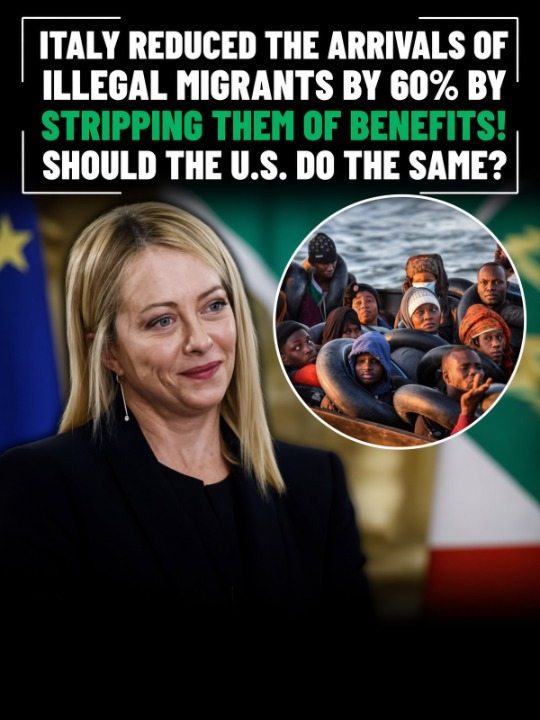
Italy cutting illegal migrant arrivals by sixty percent simply by ending the benefits proves what common sense has said all along.
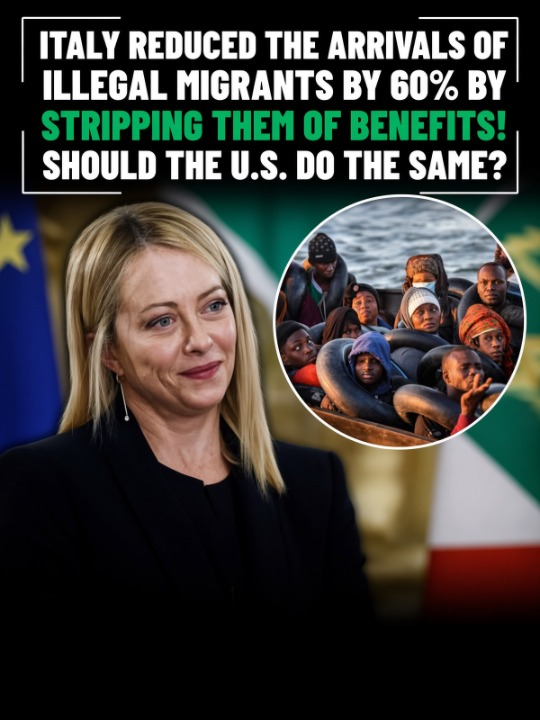
Italy’s Migration Strategy: Did Cutting Benefits Really Reduce Illegal Arrivals by 60 Percent?
ROME — Italy’s hard-line approach to irregular migration has become a political talking point far beyond Europe.
Supporters of Prime Minister Giorgia Meloni argue that her government has demonstrated a basic principle of border policy: when the incentives surrounding irregular migration change, the number of people attempting the journey can change too.
The argument is increasingly being picked up in the United States, where immigration remains one of the most divisive political issues.
But one claim deserves particularly careful examination.
The idea that Italy reduced illegal migrant arrivals by 60 percent simply by ending benefits is a powerful political message—but it oversimplifies a much more complicated reality.
Italy’s experience is real.
The decline in irregular arrivals is real.
The debate over welfare, asylum accommodation and migration incentives is real.
But the causes are considerably more complicated than one policy change.
And understanding that distinction is essential if other countries—including the United States—want to learn anything useful from Italy.
Italy’s Dramatic Decline
Italy experienced an extraordinary surge in irregular maritime arrivals in 2023.
According to Italian government data cited by Reuters, approximately 157,000 migrants arrived by sea in 2023, one of the highest totals in recent years. By 2024, arrivals had fallen to roughly 66,000, a decline of nearly 60 percent. In 2025, the number fell further to around 66,300?—illustrating why precise dates and datasets matter when discussing percentages and trends.
The decline immediately became a political success story for Meloni.
Her government had campaigned on stronger borders and a tougher immigration policy.
So when arrivals dropped dramatically, supporters naturally argued that the government’s approach was working.
But correlation is not automatically causation.
The question is not whether arrivals fell.
They did.
The question is why.
The Benefits Argument
The political argument behind cutting benefits is straightforward.
Migrants make decisions based partly on expectations about what will happen after arrival.
If a country provides accommodation, financial assistance, healthcare, education and other services to asylum seekers, some politicians argue that these benefits can become a “pull factor.”
Under that theory, reducing benefits should reduce the attractiveness of irregular migration.
This argument is especially popular among politicians who believe European asylum systems have become too generous.
But researchers have repeatedly emphasized that migration decisions are influenced by many factors.
War and persecution.
Economic conditions.
Family networks.
Smuggling routes.
Border enforcement.
Weather.
Policies in neighbouring countries.
Conditions in countries of transit.
The likelihood of receiving asylum.
And expectations about employment.
Financial assistance is only one piece of a much larger puzzle.
What Actually Happened Under Meloni?
Meloni’s government did not rely on a single policy.
Italy pursued a broad strategy that included stronger cooperation with North African countries, particularly Tunisia and Libya, efforts to disrupt smuggling networks, faster processing procedures and agreements designed to reduce departures across the Mediterranean.
The most controversial initiative was the Italy-Albania migration agreement, under which Italy sought to process certain asylum seekers outside Italian territory.
Italy also invested heavily in diplomatic efforts with countries from which migrants depart.
These measures happened alongside changing conditions in North Africa and along Mediterranean migration routes.
That makes it difficult to isolate one variable and declare it responsible for the entire decline.
A serious assessment therefore needs to look at the complete policy package.
The Tunisia Factor
One of the most important developments was Italy’s relationship with Tunisia.
Tunisia became a major departure point for migrants attempting to reach Italy.
In 2023, Meloni and European officials intensified efforts to persuade Tunisian authorities to prevent departures and strengthen border controls.
The European Union subsequently reached a controversial agreement with Tunisia involving financial support and cooperation on migration.
If fewer boats leave Tunisia, fewer people arrive in Italy.
That sounds obvious—but it also demonstrates why the “benefits alone” explanation is incomplete.
Italy’s falling arrivals may have reflected changes in the behaviour of transit-country authorities as much as changes in Italian welfare policy.
Smuggling Networks Matter
Another factor is the criminal infrastructure behind irregular migration.
People generally do not arrive on Mediterranean shores by accident.
Smuggling networks organise boats, routes, payments and logistics.
When governments disrupt those networks, journeys can become more expensive and dangerous.
When boats become harder to launch, departure numbers can fall.
This means effective border policy may depend less on removing every possible benefit and more on changing the probability that an irregular journey will succeed.
That is a fundamentally different policy question.
What Does This Mean for America?
The Italian example has obvious appeal in the United States.
American immigration politics increasingly revolves around the concept of “pull factors.”
Supporters of stricter enforcement argue that migrants will continue attempting to cross the southern border if they believe they will be released into the country, receive assistance and eventually obtain legal status.
The argument is politically powerful.
And there is some evidence that expectations about U.S. enforcement policies can influence migration patterns.
But the United States is not Italy.
The geographic situation is completely different.
Italy is a maritime destination positioned along major Mediterranean migration routes.
The United States shares a long land border with Mexico.
Migration into the United States involves Mexico, Central America, South America and increasingly other regions of the world.
The legal systems are different.
The asylum systems are different.
The labour markets are different.
The distances are different.
The smuggling networks are different.
A policy that produces one result in Italy cannot simply be copied and pasted into America.
“Stop Rewarding Illegal Entry”
The strongest political argument is nevertheless worth examining.
Governments have a legitimate interest in preventing irregular migration.
They also have a legitimate interest in ensuring that immigration law is enforced consistently.
If people believe that crossing a border unlawfully guarantees eventual entry and residence, the credibility of the immigration system can suffer.
That is a serious policy problem.
But the phrase “rewarding illegal entry” can also be misleading when applied broadly to asylum seekers.
International and domestic legal systems often require countries to assess protection claims rather than simply reject everyone who enters irregularly.
Some people crossing borders unlawfully may have genuine claims to asylum.
Others may not.
A functioning system has to distinguish between them.
That requires enforcement—but also due process.
The Human Cost
Any discussion of deterrence must also consider consequences.
The Mediterranean has become one of the world’s deadliest migration routes.
Thousands of people have died attempting to cross the sea in recent years.
If governments make migration more difficult, people may decide not to travel.
But they may also choose more dangerous routes.
That creates a difficult policy dilemma.
A successful deterrence strategy should ideally reduce irregular migration without simply pushing desperate people toward more lethal alternatives.
That is why cooperation with countries of origin and transit is so important.
Safe legal migration channels can reduce pressure on irregular routes.
Faster asylum decisions can reduce uncertainty.
Effective deportation of people whose claims are rejected can reinforce the credibility of the system.
And genuine refugees need meaningful protection.
Meloni’s Political Achievement
Even with all those qualifications, Meloni has achieved something politically significant.
She turned immigration into one of the defining issues of her government and demonstrated that voters can reward a leader who promises stronger control.
The decline in arrivals gave her government a powerful political narrative.
It allowed Meloni to tell Italians that her strategy was producing results.
Critics disagree about why arrivals fell and whether every government policy has been effective.
But politically, the message has been successful.
Italy has become a reference point for conservatives across Europe and the United States.
What America Should Actually Learn
If Washington wants to learn from Italy, the lesson should not be “cut benefits and the problem disappears.”
The more useful lesson is broader:
Migration policy works best when governments control the entire system rather than focusing on one isolated measure.
That means securing borders.
It means disrupting smuggling networks.
It means cooperating with transit countries.
It means processing asylum claims efficiently.
It means returning people who have no legal basis to remain.
It means creating lawful alternatives for people with legitimate reasons to migrate.
And it means communicating clearly about the consequences of irregular entry.
Most importantly, it requires credible enforcement.
A border policy that exists only on paper is unlikely to deter anyone.
The Real Debate
The political slogan that “strong nations stop paying for their own invasion” may generate applause, but it is not an adequate description of the policy challenge.
Migrants are not an invading army.
They are individuals making complicated decisions under very different circumstances.
Some seek jobs.
Some seek family reunification.
Some flee persecution.
Some exploit weak enforcement.
Some have legitimate asylum claims.
Some do not.
A serious immigration system has to distinguish among them.
That is not weakness.
It is governance.
Italy’s Warning—and Opportunity
Italy’s experience offers a valuable lesson, but perhaps not the one political slogans suggest.
Yes, irregular arrivals have fallen dramatically from the extraordinary levels seen in 2023.
Yes, Meloni’s government can legitimately point to that decline as evidence that its broader migration strategy may be contributing to the change.
But attributing a roughly 60 percent reduction entirely to the withdrawal of benefits ignores diplomacy, transit-country cooperation, weather, smuggling networks, enforcement changes and shifting migration routes.
The real lesson is therefore more complicated—and more useful.
Borders matter. Incentives matter. Enforcement matters. International cooperation matters. And credible asylum systems matter.
For the United States, the challenge is not to copy Italy’s policies word for word.
It is to understand why migration flows change and build a system that is simultaneously secure, lawful and humane.
Because a strong country does not prove its strength by abandoning compassion.
It proves its strength by establishing clear rules—and having the capacity, consistency and political will to enforce them.