
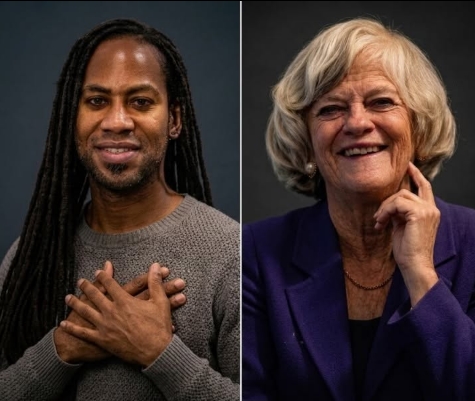
Man on the left weaves a web of lies to make money, gets found out and k!lls himself.
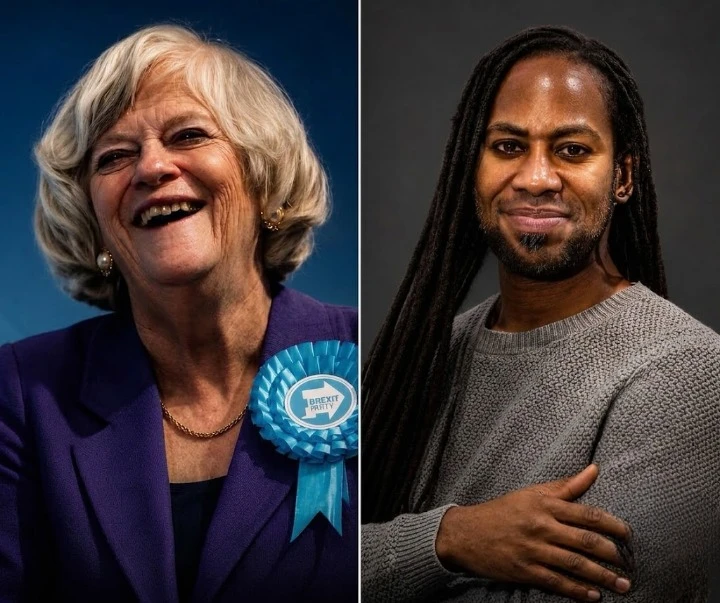
Two British Tragedies, One Accusation of Double Standards: What the Jason Arday and Ann Widdecombe Cases Really Show
Britain’s increasingly polarised political culture has produced a striking comparison on social media: the death of former Cambridge professor Jason Arday on one side, and the killing of veteran politician Ann Widdecombe on the other. The argument being advanced is that sections of the political left responded to Arday’s death with grief, accusations of racism and condemnation of those who scrutinised his career, while allegedly reacting with mockery or indifference to Widdecombe’s killing. It is a powerful accusation of political hypocrisy—but the facts behind the two cases are more complicated than the viral framing suggests.
Jason Arday, 41, had become one of Britain’s most prominent academics after being appointed Cambridge University’s youngest Black professor in 2023. His life story attracted widespread attention: he described being autistic, non-verbal until childhood and unable to read or write until his late teens before eventually building a successful academic career. But in the summer of 2026, Arday came under intense scrutiny after allegations emerged concerning plagiarism, academic credentials and elements of his public biography. Cambridge announced a formal investigation after receiving what it described as new information, and Arday resigned shortly afterwards.
The allegations were serious, but they had not been fully adjudicated before his death. Reporting documented questions about similarities between parts of his doctoral work and earlier academic material, as well as disputed claims about fundraising, athletic achievements and professional positions. Arday rejected the suggestion that he had deliberately fabricated his career and said that media scrutiny and public accusations had taken a severe personal toll.
Days after his resignation, Arday was found dead. Authorities said the death was not considered suspicious, while some media outlets and commentators have described the circumstances as consistent with suicide. However, it is important not to state as established fact that criticism of him directly caused his death. His family and supporters have argued that the intensity of the scrutiny, online abuse and what they viewed as racially charged coverage contributed to unbearable pressure, while others have maintained that journalists and academics had a legitimate responsibility to investigate credible questions about his work.
The reaction to Arday’s death quickly became a political issue in its own right. Cambridge Chancellor Chris Smith described parts of the media coverage as a “racist feeding frenzy,” while campaigners organised public vigils and petitions demanding scrutiny of the press treatment he received. Tens of thousands expressed solidarity with his family. Critics of that response argued that focusing heavily on racism risked obscuring legitimate questions about academic integrity and institutional vetting.
At almost the same time, Britain was still processing the violent death of Ann Widdecombe, one of the country’s most recognisable conservative political figures. Widdecombe, 78, had spent decades in national politics as a Conservative MP, cabinet minister, Brexit supporter and, later, a prominent Reform UK figure. She was known for outspoken socially conservative views on religion, abortion, immigration and national identity, opinions that won her passionate supporters and equally determined opponents.
Widdecombe was found dead at her home in Devon with serious injuries in July. A 28-year-old man was arrested on suspicion of murder. Early police statements cautioned against speculation and initially said investigators had no evidence that the killing was politically motivated. Later reporting, however, indicated that detectives were examining whether hostility toward Widdecombe’s political beliefs, Reform UK or another ideological cause could have played a role in what was described as a targeted attack. That remained an investigative line rather than a proven motive.
It is this uncertainty that makes the viral claim—that she was “brutally bludgeoned to death because of her honestly held political beliefs”—too definitive. She was indeed violently killed, and police have investigated political motivation, but the available public evidence does not yet justify presenting ideological hatred as conclusively established.
The second part of the allegation—that “the far Left, in vast numbers, found it hysterical”—is also difficult to substantiate as a general factual claim. Offensive reactions almost certainly appeared online, as happens increasingly after the death of divisive public figures. Social-media platforms make it easy to find examples of celebration, cruelty or political point-scoring following almost any major tragedy. But individual posts do not necessarily demonstrate the attitudes of millions of people or an entire political movement.
Indeed, mainstream political reactions to Widdecombe’s death were overwhelmingly condemnatory. The Home Secretary addressed Parliament, offering condolences and praising Widdecombe’s decades of public service. Commentators across ideological divides argued that disagreement with her politics could never justify violence or dehumanisation. One Guardian commentary explicitly warned that treating political opponents as less than human creates a culture in which violence becomes easier to rationalise.
So why does the perception of double standards nevertheless resonate with some voters?
Part of the answer lies in the radically different moral frameworks through which political tribes interpret events. Arday’s supporters tend to see his story through the lenses of race, institutional exclusion and the dangers of disproportionate public humiliation. They argue that a Black academic became a symbolic target in a wider cultural war over diversity policies and that alleged professional wrongdoing was used to discredit far more than one individual.
Critics see the same episode differently. They argue that academic standards must apply regardless of race and that accusations of racism can become a way to delegitimise legitimate investigation. From that perspective, the sympathetic reaction to Arday appears excessive because it seems to shift attention away from the underlying allegations and toward those who exposed them.
Widdecombe’s case generates almost the reverse ideological instincts. Conservatives may view her killing as evidence of the dangerous consequences of demonising right-wing or socially conservative figures. Those on the left may focus more narrowly on the criminal act itself while resisting broader claims that left-wing ideology bears responsibility for it. This asymmetry—each side contextualising violence differently depending on the victim—is where accusations of hypocrisy flourish.
Social media intensifies the problem. Algorithms reward the most inflammatory examples rather than the most representative ones. A handful of celebratory posts about a political opponent’s death can be screenshotted, reposted and presented as evidence of the mindset of an entire ideological bloc. Meanwhile, large numbers of ordinary people condemning the violence receive far less attention because outrage travels faster than moderation.
There is also a broader issue of selective empathy. Political communities are often quicker to recognise injustice when the victim resembles people they already sympathise with. The left may instinctively focus on racialised harassment and institutional inequality. The right may focus on political violence, ideological intolerance and hostility toward conservative beliefs. Neither concern is inherently illegitimate. The problem arises when empathy becomes conditional upon political identity.
That is perhaps the most important lesson linking the Arday and Widdecombe cases.
If allegations concerning an academic’s work are credible, they should be investigated without racial prejudice and without turning one individual into a symbol of an entire ethnic group. If a politician is murdered, her political beliefs should never be used to diminish the seriousness of the crime, whether those beliefs were conservative, socialist, nationalist or progressive.
The principle should be consistent: evidence matters, collective blame is dangerous, and human dignity should not depend on whether the victim belongs to one’s political tribe.
The comparison circulating online therefore identifies a genuine anxiety about Britain’s increasingly tribal political atmosphere, but it overstates several facts. Arday faced serious allegations, but labelling him definitively a “fraudster” goes beyond what had been formally established before his death. Widdecombe was murdered, but a political motive remains an investigative question rather than a settled fact. And claims that the “far Left” broadly celebrated her death require far more evidence than screenshots of offensive social-media posts.
Britain certainly has a double-standards problem—but it may be less ideological than universal.
Too many people condemn cruelty most loudly when it targets someone they identify with and rationalise it more easily when the target belongs to the other side.
The better standard is much simpler.
Investigate wrongdoing fairly. Condemn political violence consistently. Reject racism without using the accusation to prevent legitimate scrutiny. And refuse to turn death into another weapon in an endless partisan battle.
That principle should apply equally to Jason Arday and Ann Widdecombe.