

MASS BORDER CLASH.

Poland’s Border Standoff Ignites Fresh Migration Battle — But Viral “Mass Muslim Wave” Claims Need Context
Poland’s eastern frontier has once again become the stage for one of Europe’s most emotionally charged political battles, as Polish border authorities continue intercepting migrants attempting to enter the country illegally from Belarus.
Images and descriptions of migrants approaching fences, crossing rivers and being confronted by border guards have fueled dramatic social-media claims of a “mass border clash” and a huge wave of Muslim migrants attempting to force their way into Poland.
The reality is serious — but more complicated than the viral headlines suggest.
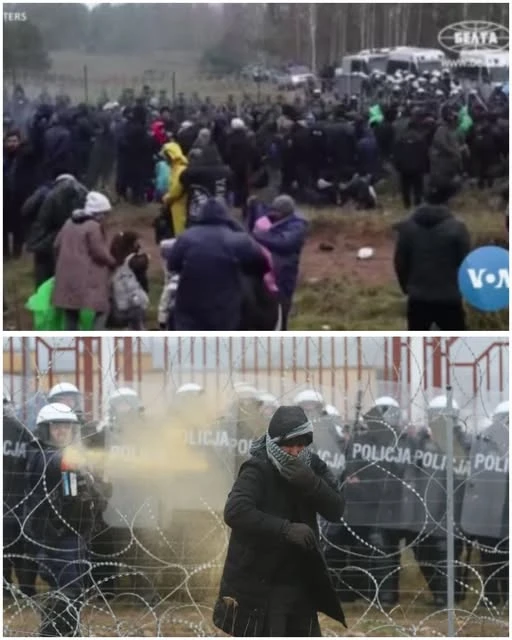
Polish authorities have indeed continued dealing with illegal crossing attempts along the Belarusian frontier. Some of the migrants encountered in recent operations have come from predominantly Muslim countries, including Afghanistan and Pakistan. Yet official Polish figures do not support describing the most recent incidents as an unprecedented “massive wave,” and authorities generally identify migrants by nationality rather than religion.
That distinction has done little to cool the political temperature.
For Poland, the border is no longer simply an immigration issue. It has become a question of national sovereignty, European security, relations with Belarus and Russia — and the limits of what a government is prepared to do to prevent unauthorized entry.
The Frontier Remains Under Pressure
During the weekend of July 10–12, Polish Border Guard officers recorded 37 attempted illegal crossings from Belarus into Poland.
Officials said 18 attempts occurred on Friday, nine on Saturday and ten on Sunday. Some migrants retreated back into Belarus, while others were detained after reaching Polish territory.
The Border Guard said those attempting to cross included people from Afghanistan and Pakistan. Police also arrested a Ukrainian citizen suspected of travelling toward the border to pick up five migrants who had entered illegally.
Other recent incidents have been smaller.
On July 26, four migrants attempted to cross the Świsłocz border river but failed to reach the Polish side and returned toward Belarus. Earlier that month, eight migrants successfully crossed through another border river before Polish officers intervened.
These are genuine border-security incidents.
But there is an important numerical reality often missing from viral coverage.
Polish authorities reported just over 260 attempted illegal crossings along the relevant section of the Poland-Belarus border during the first part of 2026, compared with more than 15,000 during the comparable period of 2025.
That represents a dramatic decline.
So while pressure has not disappeared, describing every confrontation as evidence that Poland is suddenly being overwhelmed can create an inaccurate picture of what is actually happening on the ground.
Why Poland Treats This Border Differently
The Poland-Belarus frontier is unlike a normal migration route.
Since 2021, Poland and other European governments have accused Belarusian leader Alexander Lukashenko’s government of deliberately facilitating migration toward the European Union as a form of political pressure.
Warsaw has argued that migrants were encouraged or assisted in reaching the border as part of a Belarusian strategy designed to destabilize Poland and the EU.
Belarus has rejected accusations that it is responsible for creating the crisis.
For Poland, however, the experience permanently changed how the eastern border is viewed.
A migrant trying to cross from Belarus is therefore not necessarily treated solely as an individual immigration case. Polish officials increasingly see the border itself as part of a wider confrontation involving Minsk, Moscow and European security.
That perception has driven the construction of physical barriers, expanded surveillance and deployment of thousands of security personnel.
It has also generated strong public support inside Poland for tougher enforcement.
The Human Dimension
The harder political question begins once the individual people at the border enter the picture.
Supporters of Poland’s tough approach argue that governments cannot allow groups to cross national borders simply by arriving at fences or riverbanks without authorization.
They say asylum rules cannot mean that governments surrender control over where and how people enter the country.
From this perspective, Poland is doing something basic: enforcing its border.
Critics respond that some migrants reaching the frontier may be fleeing conflict, persecution or severe instability and therefore could have legitimate asylum claims.
Human-rights organizations have repeatedly criticized so-called pushbacks at European borders, arguing that governments remain obligated to provide access to asylum procedures under international and European law.
That disagreement has become one of the defining contradictions of Europe’s migration debate.
How do governments maintain physical control of their borders without preventing legitimate refugees from exercising their legal rights?
There is no easy answer.
Religion Adds Another Explosive Layer
Online discussions frequently describe the migrants simply as “Muslim migrants.”
That framing can be politically powerful, but it can also obscure what authorities actually know.
Some migrants involved in recent Polish operations came from Afghanistan and Pakistan, countries where Islam is the dominant religion. Other border interceptions have involved people from Cameroon, Ghana, Somalia, Sudan, Morocco, Ethiopia and Bangladesh.
Nationality, however, does not automatically establish an individual’s religion.
More importantly, Poland’s legal authority to stop someone from crossing the border illegally does not depend on whether that person is Muslim, Christian, atheist or anything else.
The relevant issue is immigration status and the circumstances of entry.
That distinction becomes essential when political discussion shifts from illegal migration toward claims that followers of a particular religion are collectively threatening the country.
Border enforcement and religious exclusion are not the same policy.
Poland’s Political Identity Is Part of the Story
Nevertheless, religion cannot be completely separated from the political debate surrounding migration in Poland.
Poland remains one of Europe’s most culturally conservative countries, and successive Polish governments have argued that they should retain substantial control over who enters the country.
The country’s leaders have often resisted attempts by European institutions to distribute asylum seekers among EU member states.
Supporters of that position argue that Warsaw is defending democratic sovereignty.
Why, they ask, should officials in Brussels determine who Poland must accept?
Opponents argue that EU membership requires solidarity, particularly when southern European countries face far greater migration flows.
The argument touches everything from national sovereignty and demographic change to European integration and cultural identity.
That is why a relatively small confrontation at a border fence can trigger a nationwide political explosion.
The incident becomes symbolic.
A Crisis That Has Shifted East
Interestingly, recent migration pressure linked to Belarus appears to have moved substantially toward Latvia.
The Centre for Eastern Studies reported that Latvia had prevented approximately 8,000 attempted crossings from Belarus by mid-July 2026, while Poland had recorded only slightly more than 260 during the comparable period.
Latvia recorded roughly 1,000 attempts in just the first two weeks of July.
That comparison shows why regional context matters.
The broader Belarus-EU migration confrontation continues.
But Poland is currently experiencing far fewer attempts than it did during previous peaks.
A Border That Has Become a Symbol
None of that means Poland’s security concerns are imaginary.
Illegal crossings continue.
Smuggling networks continue.
Authorities are still arresting suspected facilitators. On June 23 alone, Polish Border Guard and police detained 46 migrants and seven people suspected of helping organize illegal movement across the Polish-Lithuanian border.
What the evidence does show is that the most dramatic language circulating online can outrun the facts.
There is a real border-security confrontation.
There are real migrants attempting to enter Poland without authorization.
There are real geopolitical concerns surrounding Belarus.
But there is not currently solid evidence supporting every viral description of a gigantic Muslim population physically storming the Polish frontier.
Poland’s border debate is already consequential enough without exaggeration.
And beneath the sensational headlines lies the much harder question confronting governments across Europe:
Who controls the border, who gets to enter, and how far should a democratic state go to defend that control?
For Poland, the answer has become increasingly clear.
Warsaw intends to keep the frontier under firm national control — and whatever happens next along that line separating Poland from Belarus will continue to resonate far beyond the forests and rivers of Eastern Europe.