
Muslim couple AMBUSH THE WRONG British dog For Walking in The Park.
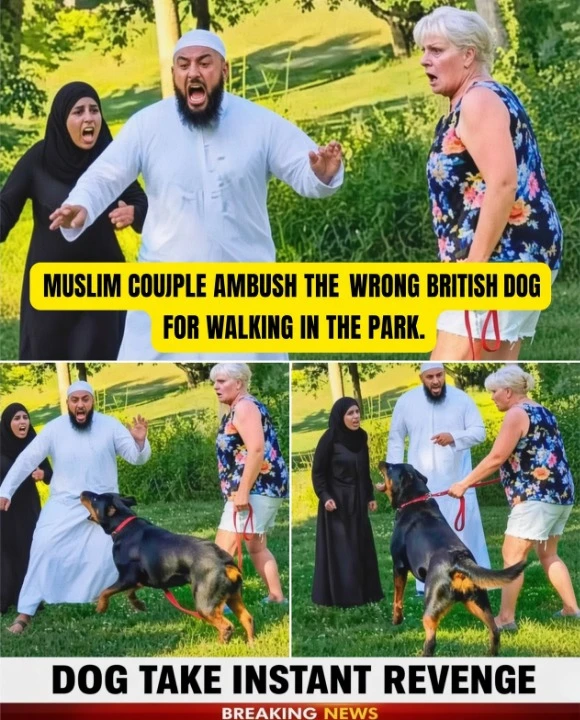
Viral Claim About a Muslim Couple and a British Dog Walker Raises Questions Over What Really Happened
A dramatic claim circulating online alleges that a Muslim couple confronted a British dog walker in a public park, with social-media posts describing the encounter as an “ambush” and suggesting that the confrontation quickly went wrong for those who initiated it. The provocative headline has attracted attention because it combines several subjects already capable of generating intense debate in Britain: religion, cultural differences, public spaces and the place of dogs in everyday life.
Yet the details supplied with the viral claim are extremely limited.
Without the original video, a confirmed location, a date, statements from those involved or a police account, it is impossible to establish from the headline alone exactly what happened. Even the description of the two people as Muslim would require independent confirmation rather than an assumption based on appearance or clothing.
That does not make the broader issue meaningless. Britain has experienced genuine disputes involving dogs, religious sensitivities and the use of parks. But those controversies need to be separated from claims about a specific incident that has not yet been independently established.
The first question is what the word “ambush” actually means in this context.
Online headlines frequently use highly dramatic terminology for ordinary arguments or confrontations. An ambush normally suggests that somebody deliberately waited for or unexpectedly attacked another person. A disagreement that begins after a dog approaches someone, by contrast, could be unpleasant or even threatening without necessarily fitting that description.
Video evidence can help establish what occurred, but even video has limitations.
A recording may begin after an argument has already started. It might show one participant shouting without revealing what prompted the reaction. An edited version can also remove important moments before or after the confrontation.
For that reason, determining responsibility requires more than identifying which person appears angriest during a short clip.
The involvement of a dog introduces another layer of complexity.
Britain is a country where dogs are extraordinarily common in public life. Millions of households own them, and walking dogs through parks and countryside is a routine activity. Dog owners generally expect to be able to use public spaces provided they follow applicable rules concerning leads, restricted areas, fouling and control of their animals.
People who dislike or fear dogs, however, also have legitimate rights in those spaces.
Some people have experienced previous attacks. Others simply do not want an unfamiliar animal approaching them. Parents may be particularly cautious when dogs run near young children.
Religion can sometimes add another consideration.
Within Islam, attitudes toward dogs vary. Some Islamic traditions regard contact with dog saliva as requiring ritual purification, while interpretations differ considerably among Muslim scholars and communities. Muslims around the world also keep dogs for purposes including security, farming and assistance.
It would therefore be inaccurate to claim that Muslims universally “hate dogs” or that Islamic belief requires Muslims to confront people walking dogs.
Even where an individual has a strong religious objection to contact with a dog, that does not generally give them authority to prevent another person from lawfully walking an animal through a British public park.
The same principle applies to other personal beliefs.
Public spaces function because people with different lifestyles and convictions accept that they will encounter activities they would not necessarily choose for themselves.
A person can avoid a dog where reasonably possible. A dog owner can prevent an animal from jumping on strangers. Neither side ordinarily needs the other to abandon the public space completely.
British law focuses primarily on the behaviour and control of the animal rather than the religion of people nearby.
Under the Dangerous Dogs Act 1991, it can be an offence for a dog to be dangerously out of control. Government guidance explains that an owner can face legal consequences if a dog injures someone or causes reasonable concern that it might injure somebody. These responsibilities can apply in both public and private places. (gov.uk)
Councils can impose additional local restrictions through Public Spaces Protection Orders.
Depending on the park, owners may be required to keep dogs on leads, prevent them from entering designated areas such as children’s playgrounds, or place them on a lead when instructed by an authorised officer.
These regulations offer an important framework for assessing any genuine confrontation.
If a dog walker was following the rules, keeping the animal under proper control and simply using a public path, another park user would have little justification for attempting to force them to leave because of religious preferences.
If the dog was uncontrolled, aggressively approaching people or entering an area where dogs were prohibited, the circumstances would look considerably different.
That is why the missing details matter.
The same applies to allegations of threats or physical violence.
If either party assaulted, threatened or deliberately intimidated the other, police could investigate regardless of the participants’ religion or ethnicity.
If religiously abusive language was used, that could become relevant to determining whether an offence had a hate-related element.
But those conclusions should follow evidence rather than precede it.
The online framing of such confrontations can create a wider problem.
A disagreement involving two or three individuals can quickly be transformed into a claim about millions of people.
If the people involved are Muslim, their conduct may be presented as evidence of what “Muslims” supposedly expect from Britain. If the dog walker responds aggressively, another audience may interpret the incident as evidence of widespread anti-Muslim hostility.
Neither conclusion logically follows from one confrontation.
Britain’s Muslim population is highly diverse, encompassing people with different national backgrounds, political beliefs and interpretations of religion. Britain’s dog owners are equally diverse.
Individual behaviour should therefore remain individual unless evidence demonstrates a broader organised campaign.
There is nevertheless a legitimate integration question underneath some of these debates.
What happens when cultural or religious expectations developed in one environment conflict with established customs in another?
In a liberal democracy, the normal answer is that national law provides the common framework.
People do not have to abandon private religious beliefs when they move to Britain. They can follow dietary restrictions, wear religious clothing, attend places of worship and organise their family lives according to their convictions within the boundaries of the law.
But those freedoms coexist with the freedoms of everybody else.
A religious objection to alcohol does not give someone the right to close a lawful pub. A vegetarian objection to meat does not allow somebody to prevent a neighbour from eating a hamburger. Similarly, a personal or religious concern about dogs does not automatically provide authority to prohibit lawful dog walking in a public park.
The principle also works in the opposite direction.
The fact that somebody is uncomfortable around dogs should not become an excuse for mocking their religion or deliberately allowing an animal to approach them after they have politely asked for distance.
Basic consideration can resolve many situations without requiring either side to surrender a fundamental right.
Social media, unfortunately, tends to reward confrontation rather than compromise.
A headline such as “Muslim couple ambush the wrong British dog” immediately creates protagonists and antagonists before viewers have examined the evidence. The phrase “the wrong” person or animal also promises an emotionally satisfying reversal in which someone supposedly receives instant consequences for their actions.
That storytelling structure is enormously successful online.
It is not necessarily reliable journalism.
Similar formats appear across thousands of viral posts: someone “picked the wrong veteran,” “confronted the wrong mother,” “attacked the wrong immigrant” or “challenged the wrong police officer.” Often, the headline is designed less to describe events precisely than to encourage viewers to keep watching until an anticipated moment of revenge or humiliation.
Responsible reporting requires a different approach.
Before presenting this incident as evidence of a cultural confrontation, several basic facts should be established: where the encounter occurred, whether police attended, whether anyone was arrested or injured, whether the dog was legally under control, what triggered the disagreement and whether the participants’ identities and motivations have been confirmed.
The answers could substantially change the story.
Perhaps evidence will show that a dog walker was genuinely harassed while doing nothing wrong. If so, the people responsible should be judged by their conduct, and any criminal behaviour should be investigated.
Perhaps additional footage will show that the dispute began because an uncontrolled dog approached frightened park users. That would require a different assessment.
Or perhaps the viral description has exaggerated an ordinary argument into a supposed confrontation between Islam and British culture.
At present, the information provided is insufficient to determine which interpretation is correct.
The broader principle, however, is much clearer.
British parks are shared spaces.
Muslims have the same right as everyone else to use them. Dog owners have the right to walk their animals where dogs are legally permitted. People who fear or dislike dogs deserve reasonable consideration, while dog owners remain responsible for controlling their animals.
Religion does not automatically override those rules, and neither does cultural tradition.
When genuine conflicts occur, the appropriate response is consistent enforcement of common laws rather than assumptions about entire communities.
That may be less dramatic than the viral headline.
But until the full circumstances of the confrontation are independently established, it is also the fairest conclusion: judge what each individual actually did, not what an online caption claims their identity tells us about them.