
Poland rejects the European Union migration pact and says no to taking in migrants or paying fines.
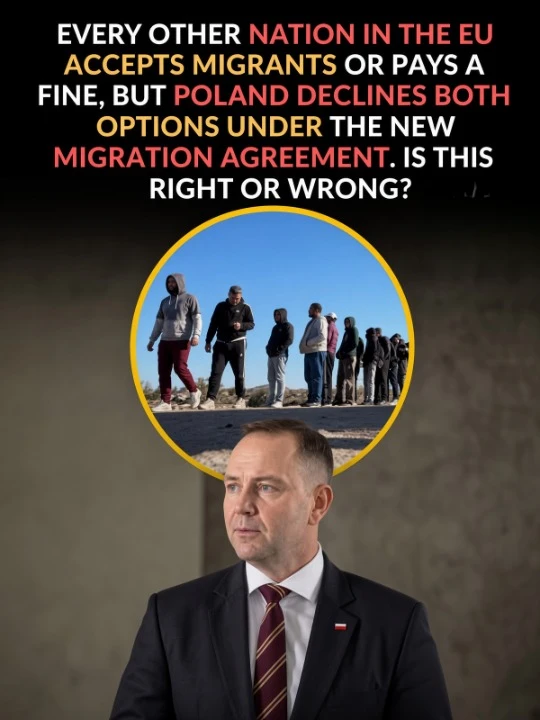
Poland Draws a Red Line on the EU Migration Pact: No Relocations, No Payments
Poland has spent years warning Brussels that migration policy cannot be imposed on countries regardless of their own security pressures, border crises and refugee burdens.
Now, as the European Union’s sweeping new Migration and Asylum Pact takes effect, Warsaw is making its position unmistakably clear.
Poland says it will not take migrants relocated from other EU countries. It says it will not pay financial contributions for refusing them. And it says it will implement only the parts of the pact that it believes make Poland’s borders more secure.
The declaration has immediately reopened one of Europe’s most combustible political fights: who should decide how migration is distributed across the European Union — national governments or Brussels?
Polish Prime Minister Donald Tusk has repeatedly insisted that his country should not be forced into a system of migrant redistribution, arguing that Poland’s circumstances are fundamentally different from those of many Western European states.
And on June 12, when the EU pact formally entered into application, Poland’s Interior Ministry put that position into official language.
“Poland will not accept migrants from other countries, nor bear the costs associated with this,” the ministry announced. It said negotiations over the previous two years had secured an exemption for Poland from migrant relocation and related financial obligations.
That sounds definitive.
But the political battle is nowhere near finished.
Because while Tusk’s government is celebrating a victory over compulsory relocation, his opponents are warning that Poland’s protection may not be permanent.
And that distinction could determine whether Warsaw’s dramatic “no migrants, no payments” pledge survives in the years ahead.
The Pact Europe Has Been Fighting Over for Years
The EU Migration and Asylum Pact is not a single law.
It is a package of 10 legislative measures designed to overhaul how the European Union registers migrants, processes asylum applications, controls its external borders and distributes responsibility between member states.
The system became fully applicable on June 12, 2026, after a two-year implementation period.
Among its most controversial elements is the so-called solidarity mechanism.
The European Commission describes it as mandatory but flexible. EU countries facing heavy migration pressure can receive assistance from other member states, while governments contributing to the system can do so through measures that may include relocating asylum seekers, financial contributions or other forms of operational support.
That nuance matters because the political slogan often heard across Europe — “take migrants or pay a fine” — simplifies a more complicated mechanism.
But politically, the distinction has done little to calm opposition.
In countries such as Poland and Hungary, the principle itself has provoked fierce resistance.
Why, critics ask, should Brussels have any mechanism capable of pressuring a sovereign country to participate in migrant redistribution?
For Poland, that question carries an additional dimension.
It is already hosting an enormous population displaced by another migration crisis entirely.
Ukraine.
Poland Says: We Have Already Done Our Part
Since Russia’s full-scale invasion of Ukraine in 2022, Poland has become one of the principal destinations for Ukrainians fleeing the war.
Warsaw argues that this burden cannot simply be ignored when Brussels calculates European migration “solidarity.”
That argument has helped Poland obtain special treatment under the new mechanism.
Deputy Interior Minister Maciej Duszczyk said in June that Poland had been exempted from the solidarity mechanism and therefore would neither have to receive relocated migrants nor incur the corresponding financial costs.
Warsaw also faces intense pressure on its eastern border with Belarus, where Polish and EU authorities have accused the Belarusian regime of deliberately facilitating migrant movements as a form of hybrid pressure against Europe.
For the Polish government, these are not abstract considerations.
Tusk told parliament on June 10 that his government had taken decisions domestically and at European level aimed at protecting Poland from illegal migration and strengthening the country’s borders.
The message from Warsaw is essentially this:
Poland is already carrying a major European security and humanitarian burden.
It should not be asked to shoulder another one.
“We Will Not Implement Everything”
Perhaps even more striking than Poland’s exemption is what the government says about the rest of the pact.
Warsaw has indicated that it does not intend to implement every provision.
Duszczyk said Poland would try to apply those parts that clearly tighten migration policy but would not implement the package in its entirety if officials believed doing so weakened national security.
The Interior Ministry was similarly blunt.
Poland, it said, would implement provisions that strengthen border protection, tighten migration controls and improve access to information useful in combating illegal migration.
That is a remarkable political posture for an EU government led by Tusk.
For years, Tusk has frequently been portrayed by his nationalist opponents as the consummate Brussels insider — a former president of the European Council, deeply connected to the European political establishment and supposedly more willing than Poland’s conservative opposition to compromise with EU institutions.
Migration has complicated that image dramatically.
On this issue, Tusk has sounded less like a Brussels federalist and more like a politician determined to prove that membership of the EU does not require surrendering control over Poland’s migration policy.
And that is no accident.
Migration Has Become Politically Radioactive in Poland
Few issues are easier for Tusk’s opponents to weaponize.
The conservative Law and Justice party and figures farther to its right have spent years warning that Western European migration policies produced social problems Poland should never import.
They have repeatedly accused Tusk of being unable — or unwilling — to resist Brussels.
So when the migration pact approached implementation, the prime minister faced pressure from both directions.
European institutions expected member states to implement common rules.
Polish voters expected their government to resist compulsory migrant relocation.
Tusk chose resistance.
But the opposition is not giving him credit so easily.
Critics argue that the current exemption is exactly that:
current.
Not necessarily permanent.
The Catch: Poland’s Exemption Can Be Reassessed
This is the most important qualification in the entire story.
Poland’s present exemption should not automatically be understood as an eternal opt-out from the EU migration system.
Euronews reported in June that Poland’s exemption from relocation obligations in 2026 was linked to the exceptional pressures created by the war in Ukraine and the situation along the Belarusian frontier.
The arrangement can be reassessed.
If European authorities continue to determine that Poland faces exceptional migratory or refugee pressure, special treatment could continue.
If those circumstances change, so could Poland’s obligations.
That is precisely why opposition figures are skeptical of the government’s triumphant rhetoric.
They argue that Tusk has not secured a permanent treaty-level exemption comparable to a permanent national opt-out.
From their perspective, he has won breathing room rather than a final victory.
The government sees things differently.
It argues that Poland’s circumstances have been successfully recognized within the European system and that Warsaw will continue fighting any mechanism it believes harms Polish security.
That legal and political ambiguity guarantees that the issue will return.
Ukraine Makes the Calculation Even More Complicated
The Ukrainian question is not about to disappear.
The EU has now extended temporary protection for people displaced from Ukraine until March 4, 2028.
That means Poland can continue pointing to a major displaced population living within its borders when arguing that it is already contributing enormously to Europe’s humanitarian responsibilities.
At the same time, Poland itself is beginning to adjust the special support arrangements introduced after the invasion.
Earlier this year, the Polish government drafted changes intended to phase out some extraordinary benefits for Ukrainians while maintaining key protections and access to employment.
Eventually, the war will end or the legal status of Ukrainians in Europe will change.
When that happens, Brussels may reconsider Poland’s migration burden.
That is the moment Tusk’s promise could face its biggest test.
Brussels Sees “Solidarity.” Warsaw Sees Sovereignty.
The disagreement reveals two very different ways of understanding the European Union.
From the Commission’s perspective, irregular migration reaches the EU as a whole.
Countries such as Italy, Greece, Spain and Malta sit on major external migration routes. If those states alone carry the burden, the Union’s internal system becomes politically unsustainable.
Hence the solidarity mechanism.
Countries under intense migratory pressure receive help from countries facing less pressure.
On paper, that sounds like burden-sharing.
But governments such as Poland’s ask a different question:
What if voters never consented to taking people who arrived somewhere else?
That is where “solidarity” collides with sovereignty.
Poland says it should control who settles on Polish territory.
Brussels says a common borderless European area requires common responsibilities.
Neither argument is going away.
Poland Is Not Rejecting Everything
One detail often lost in the loudest political rhetoric is that Poland has not announced it will simply ignore the entire European migration framework.
There are parts of the new system Warsaw actually welcomes.
The pact introduces tighter registration procedures for irregular arrivals, more standardized screening at external borders and faster procedures in certain asylum and return cases.
Poland says it will use measures that improve border security and help authorities identify and remove people who have no right to remain.
That creates a much more complicated position than “Poland rejects the EU pact.”
The reality is closer to:
Poland wants the enforcement tools.
It rejects redistribution.
It rejects paying because it refuses redistribution.
And it insists national security comes first.
That is a selective approach — and potentially a source of future legal confrontation with EU institutions.
The Stakes Go Far Beyond Poland
Other European governments are watching closely.
If Poland can remain inside the EU’s common migration system while effectively avoiding relocations because of its unique security circumstances, other countries may demand their own exceptions.
What counts as enough pressure?
Hosting refugees?
Defending an external border?
Economic hardship?
Domestic political opposition?
A European system built on compulsory solidarity becomes difficult to operate if every government argues that its situation is exceptional.
But forcing reluctant countries to participate carries its own danger.
Migration has become one of the strongest fuels for populist and eurosceptic movements across the continent.
Every confrontation with Brussels can reinforce the belief that decisions once made by national voters have been transferred to distant institutions.
That is the political minefield the EU is trying to cross.
Tusk Has Drawn His Line
For Donald Tusk, the message to Polish voters is clear.
Whatever Brussels calls solidarity, his government says Poland will not be forced to accept relocated migrants under the current arrangement.
It will not pay simply because it refuses those relocations.
And it will not apply provisions it believes undermine Polish security.
The government’s official June statement could hardly have been more direct:
Poland will not accept migrants from other states, and it will not bear the associated costs.
But the real story begins where that declaration ends.
Can Tusk turn today’s exemption into a durable Polish position?
Can Brussels maintain a common migration policy while allowing one of its largest member states to reject one of its most politically sensitive elements?
And what happens when the extraordinary circumstances created by the war in Ukraine eventually change?
For the moment, Warsaw believes it has won.
No compulsory relocation.
No associated payment.
But in Europe’s migration battle, nothing stays temporary forever without another political fight.
And Poland is already making clear that when that fight comes, it intends to say no again.