
POLAND TAKES A HARD LINE — AND EUROPE IS WATCHING!
Poland’s Hard Line at the Belarus Border Is Producing Results — but Europe Is Divided Over the Human Cost
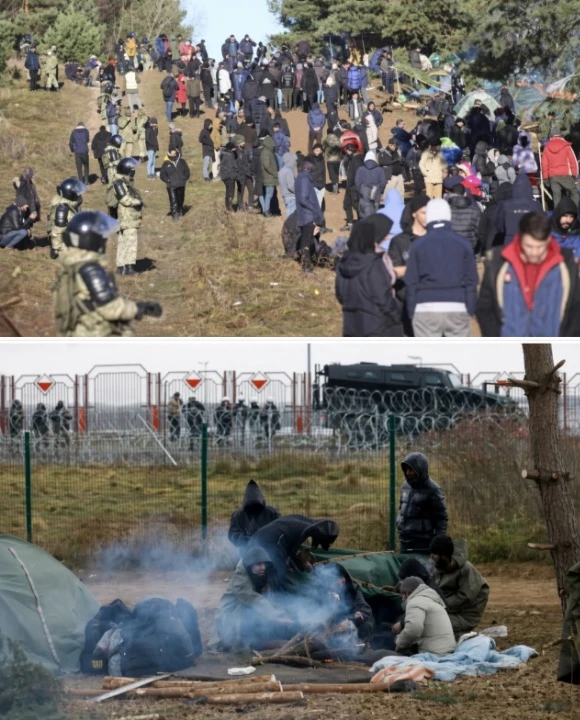
Poland’s increasingly uncompromising approach to irregular migration along its border with Belarus has become one of Europe’s most consequential experiments in border enforcement. Warsaw says reinforced barriers, electronic surveillance, tighter asylum rules and an expanded security presence have sharply reduced attempted crossings. Supporters argue that Poland is demonstrating what determined border control can achieve. Human-rights organisations counter that some of those measures risk denying vulnerable people access to asylum and exposing migrants to dangerous returns. The result is a debate extending far beyond Poland: how far can a democratic state go to secure its frontier while still respecting the rights of people seeking protection?
The latest figures help explain why supporters of the Polish model believe they have a strong case.
Poland’s Border Guard reported more than 300 attempted irregular crossings on the Podlaskie section of the Belarus frontier from the beginning of 2026 through early August. During the weekend of July 31 to August 2 alone, officers recorded more than 25 attempts, including a group of 16 people who tried to cross through the physical barrier. Officials said most retreated toward Belarus when confronted by Polish forces, while several who crossed were detained.
Those numbers are dramatically lower than during earlier phases of the crisis.
For Warsaw, the decline is evidence that deterrence works.
Why the Belarus Border Is Different
Poland does not regard the situation as an ordinary migration flow.
Since 2021, Polish officials and the European Union have accused Belarus of facilitating the movement of migrants from the Middle East, Africa and Asia toward Poland, Lithuania and Latvia as a form of political pressure.
Warsaw frequently describes this as the “instrumentalisation of migration.”
The argument is that migrants are being used by a hostile neighbouring government to create pressure on the EU’s external frontier.
That framing has transformed Polish migration policy.
Border guards are supported by soldiers and police. Physical barriers have been reinforced with electronic monitoring. Some official border crossings remain suspended, including Połowce and Sławatycze.
The Polish government therefore increasingly treats the Belarus frontier as part immigration border and part national-security perimeter.
Supporters argue that distinction is essential.
If another government is deliberately helping people reach the border in order to destabilise an EU member state, they say, conventional migration-management rules may be insufficient.
Poland Went Further by Restricting Asylum Applications
Perhaps the most controversial element of Poland’s strategy is not the fence.
It is the asylum system.
In March 2025, Poland introduced a mechanism allowing the government temporarily to restrict the right to submit applications for international protection along the Belarus frontier.
The restriction has since been repeatedly extended.
In May 2026, the Polish Interior Ministry announced another 60-day extension, describing it as the seventh renewal since the policy began. The government said the measure was helping discourage migrants from using the Belarus route.
Warsaw argues that normal asylum procedures can be exploited when migration itself is being deliberately manipulated by Belarus.
Government figures illustrate how significant the change has been.
Between March 27, 2025 and February 22, 2026, officials said applications from 451 foreigners at the Belarus frontier were not accepted under the restriction, while 94 people belonging to vulnerable categories were allowed to apply.
During a comparable earlier period, thousands of people had submitted protection applications at the border.
For supporters, that is evidence of a deterrent effect.
For critics, it is precisely the problem.
Human-Rights Groups Say Poland Has Crossed a Line
Human Rights Watch and Amnesty International have strongly criticised the asylum restrictions.
Human Rights Watch argues that Poland’s policy has enabled unlawful pushbacks and undermined the principle that asylum claims should receive individual consideration. Its 2026 country report says rights groups documented continued returns to Belarus and alleged that legal exemptions for children, pregnant women and other vulnerable people were not always respected in practice.
Amnesty International has similarly described the suspension mechanism as incompatible with international refugee protections and Poland’s constitutional obligations.
The central legal principle involved is non-refoulement.
Under international refugee law, states should not return a person to a territory where that individual faces persecution, torture or certain other serious dangers.
Human-rights organisations therefore argue that border security cannot justify simply returning everyone without examining individual circumstances.
Poland disputes the broader characterisation of its policy.
Its government points to statutory exceptions for vulnerable people and says extraordinary measures are necessary because Belarus has deliberately weaponised migration.
This Is Not Simply a Left-Right Disagreement
One reason Poland’s approach matters is that tougher border policies are spreading across Europe.
Poland itself has temporarily restored checks on its borders with Germany and Lithuania. The European Commission records those controls as running from April 5 through October 1, 2026, with Warsaw citing persistent irregular migration pressure and threats to public order.
Germany, Austria and Italy are among other Schengen countries currently using temporary internal controls for migration or security reasons.
That matters politically.
Measures once associated mainly with nationalist or populist parties are increasingly being implemented by governments of different ideological backgrounds.
The debate has therefore shifted.
The central argument in many European capitals is no longer whether stronger borders are necessary.
It is how strong those controls can become before they begin undermining asylum rights or the principle of free movement inside Europe.
The EU Is Also Toughening Its System
Europe’s broader migration framework is changing as well.
The EU’s Pact on Migration and Asylum became fully applicable in June 2026.
Among other measures, the system expands screening at the external border and provides for accelerated border procedures in certain cases.
The European Commission says people crossing irregularly are to be screened and recorded in the Eurodac database. Some applicants considered unlikely to qualify for protection, or those regarded as security risks, can remain in border procedures while their cases are examined.
Supporters say these reforms make Europe more capable of distinguishing quickly between genuine refugees and people without a legal basis to stay.
Human Rights Watch, however, has criticised aspects of the new pact, arguing that expanded border procedures may weaken access to effective asylum protection.
Poland is therefore pushing in a direction that Europe more generally is also moving toward — though Warsaw remains among the countries advocating the strongest measures.
Supporters Point to the Numbers
The strongest argument for Poland’s model is practical.
If attempted crossings fall dramatically after a country reinforces its frontier, it is difficult to argue that enforcement makes no difference.
Polish officials say the measures have reduced pressure substantially.
Physical barriers make crossings harder.
Electronic surveillance allows guards to detect groups earlier.
A stronger presence means attempted breaches can be confronted quickly.
Restrictions on asylum claims may also alter the calculation of migrants and smugglers by reducing expectations that reaching Polish soil will automatically begin a lengthy process of remaining inside the EU.
Supporters argue that this is exactly how deterrence is supposed to work.
If irregular entry becomes difficult and unlikely to lead to long-term residence, fewer people will pay smugglers to attempt it.
But Deterrence Can Redirect Migration Rather Than End It
There is an important limitation.
Migration routes adapt.
When one border becomes difficult to cross, smugglers may redirect people elsewhere.
Poland’s own decision to increase checks on the Lithuanian frontier reflects concern about secondary migration through neighbouring EU countries.
That means a successful national border policy may reduce pressure in one location without reducing the overall number of people attempting to reach Europe.
This is one reason EU officials argue that migration cannot be managed by individual countries alone.
Strong external borders, common asylum procedures and cooperation on returns all have to work together.
Poland’s Ukrainian Experience Complicates the Political Narrative
Poland’s tough stance toward irregular crossings should also not be confused with blanket opposition to refugees.
After Russia’s full-scale invasion of Ukraine, Poland became one of the principal destinations for Ukrainians seeking safety.
Hundreds of thousands remained in the country under temporary-protection arrangements.
That experience allows Warsaw to argue that it distinguishes between refugees arriving from a neighbouring war and migration facilitated through Belarus.
Critics respond that international refugee law does not permit governments to decide that one nationality is deserving while another may automatically be turned away.
The disagreement therefore concerns not whether Poland can be humanitarian, but how it determines who receives access to protection.
How Far Should Europe Go?
This is the question at the centre of the debate.
There is a strong democratic case for borders that actually function.
Governments have responsibilities to control entry, combat smuggling and reassure citizens that migration law is enforceable.
Border personnel also have a right to protection when confronted by violence.
But Europe also built its post-war refugee system around the principle that people genuinely fleeing persecution should have an opportunity to seek protection.
A system that protects only the border but provides no meaningful asylum route would fail that principle.
A system that provides asylum rights but cannot control irregular entry may eventually lose public legitimacy.
The challenge is constructing one capable of doing both.
Poland May Be Showing Europe Both the Power and the Risk of Deterrence
The evidence suggests that Poland’s tougher border strategy has had a substantial effect on the Belarus route.
Recent attempted crossings are far below levels seen during earlier phases of the crisis, and Polish authorities are continuing to maintain physical, technological and legal restrictions.
That gives supporters of the policy a genuine result to point to.
At the same time, credible human-rights organisations continue to document serious concerns about asylum access and pushbacks.
Both realities matter.
Poland’s experience therefore does not produce a simple answer that Europe should either copy or reject.
It presents a harder lesson.
Strong border enforcement can reduce irregular crossings. But the stronger that enforcement becomes, the more important transparent legal safeguards become for people who may genuinely need protection.
Europe’s future migration policy will likely move further toward deterrence.
The unresolved question is where the line will be drawn.
If borders become impossible to control, public confidence in migration policy may collapse.
If governments control them by abandoning access to asylum altogether, Europe risks weakening principles it has spent decades claiming to defend.
Poland is now testing where that balance lies.
And that is why the rest of Europe is watching so closely.