
Poland’s Tough Border Policy Fuels Renewed Debate Over Migration, Security, and Europe’s Future
Poland has once again found itself at the center of Europe’s migration debate following reports that border authorities prevented another group of migrants from entering the country along its frontier with Belarus. Images circulating on social media and international news platforms have intensified discussion over the country’s strict border policy, with supporters praising the government’s approach as a model for protecting national sovereignty and critics warning that the situation raises important humanitarian and legal concerns.
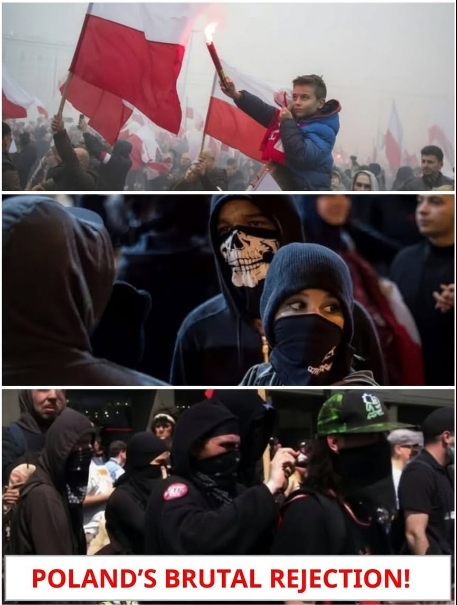
Viral posts accompanying the images have claimed that “Muslims tried to mass migrate into Poland and were rejected at the border.” While many migrants attempting to cross into Poland have come from predominantly Muslim-majority countries, authorities generally do not make decisions based on religion. Instead, Polish officials state that their enforcement actions target unauthorized border crossings regardless of an individual’s faith, ethnicity, or nationality. The incident has therefore become another example of how migration stories can quickly become intertwined with broader political narratives about identity, security, and Europe’s future.
Renewed Pressure on Poland’s Eastern Frontier
The latest incident occurred along Poland’s eastern border with Belarus, one of the European
Union’s most heavily guarded external frontiers.
Since 2021, Polish border guards have faced repeated attempts by groups of migrants to enter the country irregularly from Belarus. European Union officials and the Polish government have
consistently accused Belarus of facilitating these migration movements as part of a broader political strategy designed to place pressure on the EU following sanctions and diplomatic disputes. Belarus has repeatedly denied orchestrating or encouraging these crossings.
Whatever the underlying political context, the border has remained a focal point of European
migration policy and regional security for several years.
What Happened at the Border? According to Polish authorities, border personnel detected another organized attempt to cross into Polish territory. Border guards, supported by military units and surveillance technology, responded by intercepting the group before they entered further into the country. Officials reported that security procedures were carried out in accordance with Polish border regulations. While images from the scene spread rapidly online, authorities emphasized that each incident is assessed individually and that border personnel are trained to balance security responsibilities with applicable legal obligations.
No official statements indicated that the operation targeted people because of their religion.
Poland’s Border Strategy Poland has significantly strengthened its eastern border in recent years.
Measures introduced by successive governments include the construction of a steel border barrier, installation of advanced surveillance systems equipped with thermal cameras and motion sensors, deployment of additional border guards and military personnel, and expanded cooperation with other European security agencies.
Government officials argue that these investments have substantially reduced successful
unauthorized crossings while improving the country’s ability to respond rapidly to incidents along the frontier. Supporters contend that protecting the EU’s external border is essential for maintaining public confidence in immigration policy and discouraging criminal smuggling networks. Why Poland Has Taken a Different Approach Unlike several Western European countries that accepted large numbers of asylum seekers during the 2015 migration crisis, Poland has generally maintained a more restrictive approach toward irregular migration.
Government leaders argue that every sovereign nation has the right to determine who may enter its territory and under what legal conditions. Officials also distinguish between irregular migration and legal migration, noting that Poland has welcomed millions of Ukrainian refugees since Russia’s full-scale invasion in 2022 while continuing to issue work permits to foreign nationals through legal immigration channels. Supporters therefore argue that Poland is not opposed to immigration itself but instead prioritizes controlled and lawful entry.
Humanitarian Perspective Human rights organizations have expressed concern about conditions along the Poland-Belarus border.
Aid agencies report that migrants often arrive after long journeys through multiple countries and may face shortages of food, shelter, medical care, and protection from harsh weather.
Organizations advocating for refugees emphasize that international law recognizes the right of individuals to seek asylum and argue that governments should ensure access to fair asylum procedures while maintaining secure borders.
These groups stress that border enforcement and humanitarian obligations should not be viewed as mutually exclusive. Organized Smuggling Networks Polish authorities continue to emphasize that organized criminal networks play a central role in facilitating irregular migration.
Law enforcement agencies across Europe have repeatedly warned that smugglers charge migrants substantial sums of money while exposing them to dangerous conditions during their journeys.
Officials argue that stronger border controls not only reduce unauthorized entries but also weaken the business model of criminal organizations profiting from human smuggling.
International police cooperation targeting these networks has expanded in recent years as governments seek to address migration at its source rather than solely responding at the border.
Political Debate Across Europe Migration remains one of the European Union’s most divisive political issues.
Supporters of Poland’s approach argue that firm border controls strengthen public confidence, protect national sovereignty, and help maintain the integrity of the Schengen Area.
Critics contend that long-term migration challenges require broader European cooperation, efficient asylum systems, and continued adherence to international humanitarian commitments.
These differing perspectives continue shaping political debate not only in Poland but across the European Union.
Public Opinion in Poland Opinion surveys have often shown strong support among Polish voters for maintaining strict external border controls. Many citizens argue that secure borders are an essential responsibility of the state and that immigration policy should remain under national control. At the same time, public attitudes toward migration have shown important distinctions. Poland has received millions of people fleeing the war in Ukraine, reflecting broad public support for providing protection to those escaping an active armed conflict.
This contrast illustrates that Polish public opinion often differentiates between humanitarian refugee movements and irregular migration through unauthorized border crossings.
The Importance of Accurate Reporting The images circulating online have frequently been accompanied by emotionally charged captions referring specifically to Muslims attempting to enter Poland.
However, border authorities generally identify migrants according to nationality, legal status, or travel route rather than religion. Individuals attempting to cross the border originate from a variety of countries and backgrounds, and officials have not stated that religion forms part of their enforcement decisions. Presenting border incidents primarily as religious conflicts may therefore oversimplify a more complex situation involving migration policy, international law, regional security, and geopolitical tensions.
Looking Ahead Poland has indicated that it intends to continue strengthening border infrastructure while cooperating with European partners on migration management and security.
Meanwhile, the European Union continues discussing reforms to asylum procedures, external border protection, and responsibility-sharing among member states.
Migration pressures, geopolitical instability, and organized smuggling networks are expected to ensure that Poland’s eastern frontier remains one of Europe’s most closely watched borders.
Conclusion
The latest incident at Poland’s eastern border highlights the continuing challenges facing Europe as governments seek to balance national security, humanitarian responsibilities, and effective migration management. Polish officials maintain that strict border enforcement is necessary to protect both the country and the European Union’s external frontier, while humanitarian organizations emphasize the importance of ensuring that international legal protections remain accessible to individuals seeking asylum.
As debate continues across Europe, the discussion is likely to remain focused not only on border security but also on broader questions of sovereignty, integration, international cooperation, and the future direction of European migration policy.