
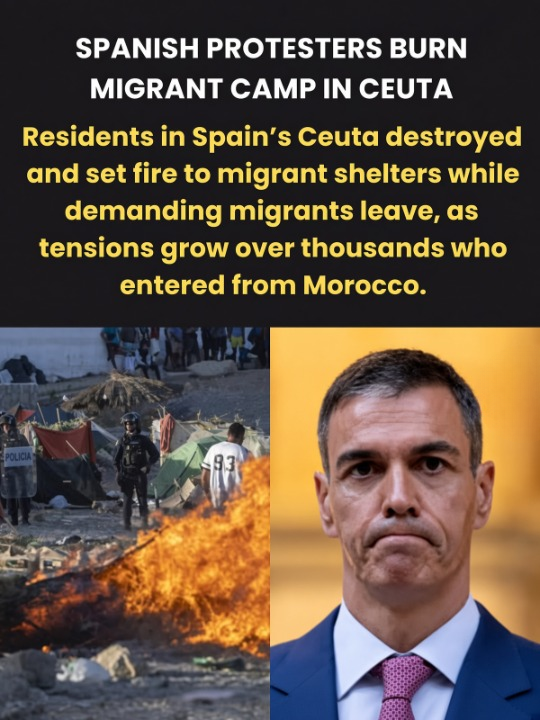
Protests over migration in Spain’s Ceuta turned vi@lent, with residents destroying makeshift migrant shelters and setting belongings on fire as police intervened.
Ceuta Erupts Over Migration: Anger, Burning Shelters and a Border Under Extraordinary Pressure
CEUTA, Spain — Tensions over migration have erupted into violence in Spain’s North African enclave of Ceuta, where protests against the presence of migrants reportedly escalated into the destruction of makeshift shelters, burning belongings and confrontations with police.
What began as public anger over migration rapidly became a highly charged confrontation between residents, migrants and authorities.
According to reports, protesters destroyed makeshift migrant shelters and set some belongings on fire while police intervened.
Demonstrators also reportedly blocked Red Cross food deliveries and demanded that migrants leave the area.
The scenes have placed Ceuta back at the centre of Europe’s migration debate — a debate increasingly defined not only by questions of borders and asylum, but also by public frustration, humanitarian responsibilities and the limits of local communities’ capacity to absorb sudden population movements.
Ceuta’s geography makes the situation particularly explosive.
The Spanish territory sits on the North African coast, surrounded almost entirely by Morocco, while forming part of Spain and the European Union.
That makes its streets, beaches and border fences part of one of Europe’s most politically sensitive migration frontiers.
And when thousands of people arrive in a short period, the pressure becomes impossible to ignore.
A city suddenly under pressure
Reports surrounding the latest crisis say that more than 70,000 people crossed from Morocco into Ceuta in late July, although the overwhelming majority were subsequently returned.
Even if most arrivals did not remain, such a sudden movement would represent an extraordinary challenge for any city.
Ceuta is small.
Its population, infrastructure and public services are limited compared with those of mainland Spain.
A sudden influx of tens of thousands of people can overwhelm accommodation, food distribution, medical services, border facilities and police resources almost immediately.
For residents, the issue can therefore feel less like an abstract European policy debate and more like a transformation of everyday life.
For migrants, meanwhile, the border represents an opportunity to reach European territory.
The same location can therefore symbolize hope for one group and insecurity for another.
That is the fundamental tension at the heart of Ceuta’s crisis.
When protest turns destructive
Public protest is a normal part of democratic life.
Residents have the right to express anger about government migration policy.
They can demand stronger borders.
They can criticize the handling of asylum applications.
They can call for authorities to return people who have no legal right to remain.
But the reported destruction of shelters and burning of belongings represents a different line.
Once property is destroyed or fires are deliberately started, the dispute moves beyond political expression.
It becomes a question of public safety and criminal responsibility.
The same applies to reportedly blocking humanitarian food deliveries.
Organizations such as the Red Cross operate in crises precisely because vulnerable people still require food, medical assistance and basic protection regardless of their immigration status.
Preventing humanitarian assistance from reaching people in need risks turning a political confrontation into a humanitarian emergency.
That does not mean residents’ concerns should be ignored.
It means those concerns must be addressed without allowing violence to determine policy.
Why Ceuta is different
Ceuta has a long history of migration pressure.
Its unusual position makes it a natural target for people seeking entry into the European Union.
Unlike migrants traveling thousands of kilometers across Europe, someone reaching Ceuta is already physically inside Spanish territory.
That creates a powerful incentive.
The city is therefore one of the places where Europe’s migration system can become visible almost overnight.
Spain must decide who can stay.
Morocco must cooperate on border management and returns.
Humanitarian organizations must assist vulnerable people.
Local authorities must maintain public order.
And residents must continue living their daily lives.
Each responsibility can conflict with another.
That is why Ceuta has become a symbol of Europe’s broader migration challenge.
The numbers tell only part of the story
The figure of more than 70,000 crossings is dramatic.
But it must be interpreted carefully.
A border-crossing figure is not necessarily equivalent to the number of people who permanently entered or remained in Ceuta.
Many arrivals can be returned relatively quickly.
Some people may cross more than once.
And rapidly developing border incidents can produce conflicting estimates.
That distinction matters because headlines can dramatically amplify public perceptions.
Nevertheless, even a temporary arrival of such magnitude can place enormous pressure on local authorities.
The physical movement of people may last hours or days.
The social consequences can last much longer.
Fear, frustration and perception
Migration debates are rarely driven by statistics alone.
They are also driven by perception.
Residents may see groups of unfamiliar people sleeping outdoors and worry about public safety.
Parents may become concerned about their children.
Business owners may fear disruption.
Local authorities may worry that shelters and public services are reaching capacity.
Migrants experience the same environment differently.
Many may see the police not as a source of security but as an obstacle standing between them and Europe.
Some may be exhausted, hungry or traumatized after a dangerous journey.
Both sides can therefore interpret the same event through completely different experiences.
That is precisely why responsible political leadership matters.
The danger of collective blame
One of the greatest risks in a crisis like Ceuta’s is collective blame.
A violent incident involving some migrants does not make every migrant violent.
Likewise, an angry protest does not mean every resident of Ceuta is hostile to migrants.
Most people on both sides are individuals with different motivations and beliefs.
A government has to separate those distinctions.
People who commit violence should be held individually accountable.
People who have a legal right to protection should receive it.
People without a legal basis to remain should be processed under the law.
And residents should be able to protest peacefully without being dismissed as extremists.
The rule of law only works if it applies to everyone.
The humanitarian dilemma
The Red Cross food-delivery dispute highlights another uncomfortable reality.
European migration policy frequently becomes trapped between two competing imperatives.
Governments want control.
Humanitarian organizations want access.
Neither objective is inherently incompatible with the other.
A state can enforce its borders while ensuring that people receive food and emergency medical assistance.
The difficulty emerges when political anger turns humanitarian aid into a symbol of government weakness.
That can create pressure on aid workers who are simply trying to prevent people from going hungry.
Humanitarian assistance should not be confused with immigration policy.
Providing food to someone does not determine whether that person has the right to remain in a country.
Those are separate questions.
What should Spain do?
The immediate priority should be restoring calm.
Police must protect people and property.
Authorities must prevent further violence.
Humanitarian organizations must be able to operate safely.
And residents need clear information about what the government is doing.
But the longer-term solution requires more than policing.
Spain needs an effective border policy, rapid asylum procedures, adequate reception capacity and efficient returns where people have no legal right to remain.
At the same time, local communities such as Ceuta need meaningful support.
It is unreasonable to expect a small enclave to absorb extraordinary migration pressures without additional resources.
If Madrid and Brussels want European migration policy to function, they must ensure that frontline communities have the infrastructure and personnel necessary to deal with sudden arrivals.
Morocco’s crucial role
No discussion of Ceuta’s migration crisis can avoid Morocco.
The country is Spain’s immediate neighbor and one of Europe’s most important partners in controlling migration routes across the western Mediterranean and toward Spanish territory.
Cooperation between Madrid and Rabat can dramatically influence the number of attempted crossings.
When cooperation works, pressure can decrease.
When circumstances change, the border can quickly become unstable.
That makes diplomatic relations as important as fences and police patrols.
Ceuta’s future will therefore depend partly on what happens not only inside the city, but also across the border in Morocco.
Europe’s larger problem
The events in Ceuta should concern Europe because they demonstrate what happens when migration pressure overwhelms local capacity.
A European border is only as stable as the communities responsible for managing it.
If residents lose confidence in their government, protests can escalate.
If migrants lose access to basic humanitarian assistance, the situation can become dangerous.
If authorities lose control of public order, violence can spread.
And if political leaders reduce the crisis to slogans, the underlying problems remain unsolved.
Europe needs a migration system capable of controlling its external borders while respecting humanitarian and legal obligations.
That requires cooperation between EU institutions, national governments and countries such as Morocco.
It also requires acknowledging the legitimate concerns of local residents.
A city caught between two worlds
Ceuta is a city caught between Europe and Africa, between humanitarian obligation and border enforcement, between political ideals and practical limitations.
The latest protests show how quickly these tensions can explode.
Burning belongings may attract attention.
Blocking aid may express anger.
Destroying shelters may satisfy frustration for a moment.
But none of these actions solves the underlying problem.
The people arriving at Europe’s borders will continue to seek safety and opportunity.
European governments will continue to face pressure to control migration.
And local communities will continue demanding that their concerns be heard.
The question is whether political leaders can prevent these competing demands from becoming permanent confrontation.
Ceuta needs security.
Migrants need lawful treatment and basic humanitarian protection.
Residents need functioning public services and confidence in their government.
And Spain needs a migration policy that is both enforceable and credible.
The scenes in Ceuta should therefore serve as a warning.
When migration pressure reaches extraordinary levels and communities feel abandoned, frustration can quickly turn into anger — and anger can turn into violence.
Europe cannot afford to wait until the next border crisis erupts before deciding how it intends to manage the one it already has.