
The European Parliament Erupted as One Vote Divided the Continent.
Europe’s Deportation Reckoning: The Vote That Shook Strasbourg
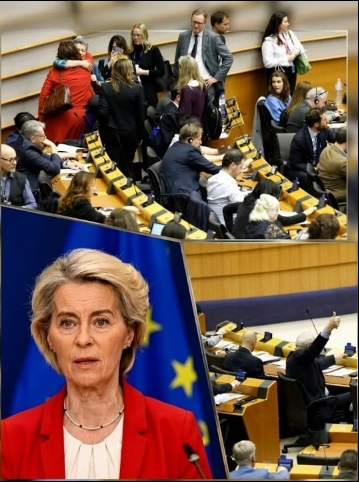
For several electrifying minutes, the European Parliament did not resemble the controlled, procedural heart of the European Union. It looked like the political fault line of an entire continent. When the result appeared—418 votes in favour, 218 against and 30 abstentions—supporters rose in applause. Some right-wing lawmakers began chanting “send them back.” From the opposite side of the chamber came an angry response: “shame on you.” The vote on June 17, 2026, approved Parliament’s first-reading position on the EU’s proposed Return Regulation, and the eruption in Strasbourg revealed that this was far more than another technical migration measure.
At its core, the legislation is intended to establish a common European system for returning third-country nationals who have no legal right to remain in an EU member state. European governments have long complained that national return procedures are inconsistent, slow and easily frustrated when a person ordered to leave one country travels to another. The regulation attempts to close those gaps through common procedures, closer cooperation between governments, a standardised European Return Order and stronger obligations on people facing removal. Supporters describe it as the enforcement mechanism without which the EU’s wider Migration and Asylum Pact could never become credible.
The most controversial provision is the possibility of establishing “return hubs” outside the European Union. Under the agreed framework, member states could negotiate arrangements with third countries to receive individuals who cannot be returned directly to their countries of origin. These facilities could serve as transfer centres for onward removal or, potentially, as longer-term destinations.
EU officials insist that agreements may be concluded only with countries that respect international human-rights standards and the principle of non-refoulement, which prohibits returning someone to a place where they face persecution, torture or serious harm. Unaccompanied minors would be excluded from such arrangements. However, the possibility of transferring families with children has intensified the political and moral battle surrounding the proposal.
The regulation also imposes new duties on people who have received return decisions. They may be required to cooperate with authorities, provide relevant information and follow instructions intended to facilitate their departure. Failure to cooperate could result in reduced benefits or allowances under national law, the loss of incentives offered for voluntary return and, where domestic legislation permits, criminal penalties.
Supporters argue that an official order to leave must carry consequences or it becomes little more than a piece of paper. Critics counter that the system could punish vulnerable people for circumstances beyond their control, including missing documentation, an uncooperative country of origin or legitimate fears about what will happen after removal.
Another significant change is the introduction of the European Return Order, a standardised record containing the essential details of a national return decision. The information would support recognition and enforcement across the bloc, making it more difficult for someone facing removal in one member state to restart the entire process simply by moving elsewhere in the EU.
Recognition of another country’s return decision will initially remain voluntary. However, the European Commission is expected to review the system within three years and could propose making recognition mandatory. To supporters state to restart the entire, this represents overdue coordination in a Europe where internal border controls have largely disappeared. To opponents, it raises the possibility that one government’s questionable decision could be enforced by another without an adequate
The proposed enforcement powers have proved equally explosive. Reporting on the adopted text indicates that authorities could be permitted to search a person’s residence or other relevant premises while attempting to locate someone subject to return proceedings. The framework also expands detention possibilities, with refugee-rights organisations warning that confinement could last as long as 30 months in certain circumstances.
Entry bans would become longer, while people considered security risks could face bans extending beyond the usual maximum or even indefinite exclusion. The framework would also change the relationship between deportation and legal appeals. Rather than automatically suspending removal in every case while a challenge is considered, courts could determine whether
For the centre-right and nationalist parties that pushed the measure through Parliament, the result represents a major political turning point. The European People’s Party joined conservative and far-right groups, along with some liberal lawmakers, to create an alternative majority to the centrist alliances that traditionally shaped EU legislation.
Their argument is direct: European governments cannot maintain public confidence in immigration and asylum systems unless final decisions are actually enforced. A system that grants protection to those who qualify but repeatedly fails to remove those whose claims have been rejected, supporters contend, will eventually lose democratic legitimacy. For them, the vote was not an attack on legal migration or genuine refugees. It was an overdue declaration that remaining in Europe without legal permission cannot become a pault.
Opponents see something much darker. Socialists, Greens, left-wing lawmakers, refugee organisations and human-rights advocates argue that the regulation normalises offshore detention, intrusive searches, prolonged deprivation of liberty and returns to countries with which deported individuals may have little connection.
The European Council on Refugees and Exiles says the final compromise goes beyond the European Commission’s original proposal in several important areas and risks weakening effective legal remedies. Critics also fear that safeguards written into EU legislation may prove fragile when implementation depends on governments outside the bloc, where monitoring, judicial accountability and access for independent
That is why the chanting inside Parliament mattered. It transformed an already divisive law into a symbol of Europe’s changing political climate. To supporters, the applause represented a democratic institution finally responding to years of frustration over irregular migration and unenforced removal orders. To opponents, celebrating deportation with slogans stripped a complicated legal process of its human reality—families, children, rejected asylum seekers and people whose cases may involve trauma, danger or legal uncertainty.
The confrontation showed that the argument is no longer merely about whether Europe should enforce immigration law. It is about what enforcement should look like, which safeguards must remain untouchable and how far democratic governments should be permitted to go in thetrol.
The parliamentary vote was decisive, but it was not the final procedural endpoint. As of August 5, 2026, the EU’s official EUR-Lex tracker continued to list the legislative procedure as “ongoing,” recording Parliament’s first-reading position while formal Council action remained outstanding. Once formally adopted and published in the EU’s Official Journal, several provisions are intended to apply immediately, while other parts of the regulation would become applicable 12 months later. Strasbourg approved the political architecture, but national governments, administrators and courts will ultimately determine how forcefully—
Europe has spent years attempting to balance open internal borders, humanitarian obligations, national sovereignty and growing public anxiety about irregular migration. The 418–218 vote did not resolve that struggle. It exposed it.
One side believes the European Union has finally equipped itself to make return decisions meaningful. The other believes Europe has crossed a line that will be extraordinarily difficult to reverse. Either way, the extraordinary scenes inside Parliament made one fact impossible to ignore: migration is no longer simply one policy area among many. It has become the arena in which Europe is deciding what kind of political union—and what kind of moralcommunity—it intends to be.