
The Night of Violence on Edgware Road: How One Evening of Disorder Has Reignited Britain’s National Debate on Policing, Public Safety, and Civil Order
An evening of disorder on London’s Edgware Road has become far more than a localized public order incident. What began as violent clashes requiring a significant police response has since evolved into a nationwide discussion touching on policing tactics, public confidence in law enforcement, freedom of assembly, criminal accountability, community relations, and the broader challenge of maintaining public order in one of Europe’s largest and most diverse cities. While investigators continue examining the circumstances surrounding the incident, political leaders, commentators, legal experts, and members of the public have begun interpreting the events through very different lenses, ensuring that the debate extends well beyond the streets where the confrontation took place.
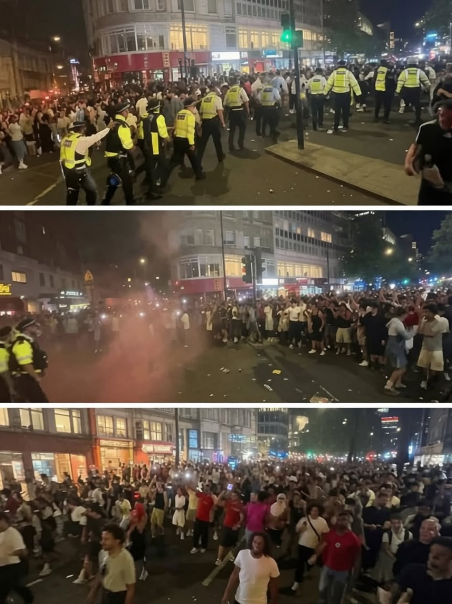
Although many details remain under official investigation, reports indicate that police officers were deployed after unrest developed in the area, resulting in confrontations between law enforcement personnel and individuals involved in the disturbance. Emergency responders were required to manage a rapidly changing situation in which public safety became a primary concem. Authorities have stated that evidence, including video recordings, witness statements, body-worn camera footage, and other investigative material, is being reviewed to establish a comprehensive understanding of what occurred throughout the evening.
One aspect of the incident that has attracted particular public attention involves reports that at least one police officer sustained injuries during the disorder. Police organizations have emphasized that assaults against officers performing their duties are treated as serious criminal offenses and that investigations will seek to identify anyone responsible for violence against emergency personnel. While the full circumstances surrounding individual injuries have not yet been established publicly. the reports have prompted renewed discussion about the risks officers increasingly face while policing large public disturbances.
At the same time, authorities have acknowledged that members of the public were also affected by the disruption. Businesses experienced interruptions, transportation was impacted, and residents in the surrounding area witnessed significant police activity as officers worked to restore order. For many local people, the immediate concern was not political but practical: ensuring that families, workers, visitors, and nearby communities remained safe while emergency services responded to a rapidly developing situation.
As footage and photographs from the evening began circulating online, public reaction quickly intensified. Social media platforms became filled with videos captured from different perspectives, each showing only portions of the broader events. Some clips appeared to emphasize violence directed toward police officers, while others focused on police tactics during crowd management. Because many recordings lack complete context, officials have cautioned against drawing definitive conclusions before investigations have been completed. Nevertheless, these images have played a significant role in shaping public perceptions and fueling broader political debate.
The incident has once again highlighted the increasingly important role that digital media plays during major public order events. Within minutes of disturbances occurring, videos can spread to millions of viewers worldwide, often before official statements are released. While this immediate visibility can improve transparency and assist investigators by generating additional evidence, it can also contribute to misinformation, selective editing, and polarized interpretations when isolated clips are presented without the surrounding context. Experts in public communication have repeatedly warned that early online narratives frequently become entrenched long before all available evidence has been examined.
The response of the Metropolitan Police has become a central focus of discussion. Senior officers have defended the necessity of maintaining public order while emphasizing that officers are expected to operate within established legal standards governing the use of force. British policing traditionally relies on principles emphasizing necessity, proportionality, accountability, and public consent. During major public disturbances, however, officers often face rapidly evolving situations in which decisions must be made within seconds while balancing the safety of officers, demonstrators, bystanders, and nearby communities.
Supporters of a stronger policing approach argue that incidents involving violence against officers demonstrate why law enforcement requires robust legal powers and sufficient operational resources. From this perspective, attacks on police undermine the rule of law and threaten public confidence in the state’s ability to maintain order. Those holding this view often contend that individuals engaging in violent disorder should face swift investigation and, where evidence supports prosecution, appropriate criminal penalties. They argue that firm enforcement protects both the public and the overwhelming majority of peaceful demonstrators who exercise their rights responsibly.
Others emphasize that public confidence depends not only on effective enforcement but also on transparent accountability. Civil liberties organizations frequently argue that maintaining trust requires careful scrutiny of police conduct during major operations, particularly where force is used or large numbers of arrests occur. They stress that independent oversight, thorough investigations, and clear public communication are essential components of democratic policing. According to this perspective, accountability strengthens rather than weakens public confidence by demonstrating that law enforcement remains subject to legal standards.
The incident has also renewed debate over the challenges of policing large gatherings in modern urban environments. London regularly hosts demonstrations, cultural events, religious celebrations, sporting occasions, and political protests involving thousands of participants. The overwhelming majority conclude peacefully. However, authorities acknowledge that isolated incidents can escalate rapidly when tensions increase, competing groups confront one another, or individuals engage in criminal behavior unrelated to the original purpose of a gathering. Managing these complex environments requires extensive planning, intelligence gathering, coordination among emergency services, and continuous risk assessment.
Questions surrounding public safety extend beyond policing alone. Urban planners, transport authorities, local businesses, and community organizations all play important roles in preparing for large-scale public events. Street design, emergency access routes, crowd management infrastructure, communication systems, and cooperation between agencies can significantly influence how effectively authorities respond when situations deteriorate unexpectedly. Following major incidents, operational reviews frequently examine not only police tactics but also broader coordination across public institutions.
Political reactions have reflected the wider divisions already present within British public discourse. Some elected representatives have described the disorder as evidence that stronger enforcement measures are necessary to deter future violence. Others have called for restraint until investigations establish a clear factual record, warning against politicizing incidents before evidence has been fully evaluated. These differing approaches illustrate how public order events increasingly become intertwined with broader national conversations about criminal justice, policing, immigration, community cohesion, and government policy.
Community leaders have meanwhile urged against allowing isolated acts of violence to define entire neighborhoods or populations. Edgware Road is known internationally as one of London’s most diverse commercial districts, attracting residents, tourists, businesses, and visitors from a wide variety of cultural and religious backgrounds. Many local organizations have emphasized that the overwhelming majority of people living and working in the area have no involvement in criminal disorder and should not be judged based on the actions of a small number of individuals. Such appeals reflect longstanding efforts to preserve community cohesion following highly publicized incidents.
The legal process now underway will likely determine many of the factual questions that remain unresolved. Police investigators are expected to review surveillance footage, body-worn camera recordings, mobile phone videos, forensic evidence, and witness testimony before determining whether criminal charges are appropriate in individual cases. Prosecutors, where applicable, must assess whether available evidence meets the legal threshold required for prosecution. Those charged are entitled to the presumption of innocence unless and until guilt is established in court, an important principle within the British justice system regardless of the public attention surrounding a case.
Legal experts note that public order investigations are often more complex than they initially appear. Multiple individuals may be involved, events unfold across different locations, and evidence frequently emerges over an extended period. Investigators must establish not only who participated but also the specific actions attributable to each individual. Courts subsequently consider individual responsibility rather than making collective judgments about everyone present during an incident. This process can require considerable time, particularly when large volumes of digital evidence must be analyzed.
The incident has also prompted renewed discussion about police recruitment, officer welfare, and operational readiness. Law enforcement organizations have increasingly highlighted the physical and psychological pressures associated with policing violent incidents. Officers responding to public disorder frequently face unpredictable situations involving projectiles, assaults, verbal abuse, and rapidly shifting threats while simultaneously attempting to protect the public. Police representatives argue that ensuring adequate staffing, equipment, training, and mental health support remains essential for maintaining an effective emergency response capability.
At the same time, academic researchers studying policing frequently emphasize that long-term public safety depends on more than enforcement alone. Preventing future disorder often requires sustained investment in community engagement, education, youth services, local partnerships, intelligence-led policing, and mechanisms that strengthen trust between authorities and residents. According to this perspective, enforcement addresses immediate incidents, while broader social policies may help reduce the likelihood of similar disturbances occurring in the future.
Media coverage has itself become part of the wider discussion. Different news organizations have emphasized different aspects of the incident, reflecting varying editorial priorities and audiences. Some reports have focused primarily on violence directed at police officers, while others have examined crowd dynamics, policing tactics, or broader social context. This diversity of coverage illustrates how complex public order events can generate multiple legitimate areas of inquiry, even when journalists are reporting on the same underlying incident.
Public confidence remains one of the most important issues emerging from the debate. Citizens generally expect that police will respond effectively when violence occurs while also respecting legal standards and civil liberties. Achieving both objectives simultaneously can be particularly challenging during rapidly evolving public disturbances. Every highly publicized incident therefore becomes an opportunity for both supporters and critics of existing policing strategies to argue that recent events either validate or undermine their respective positions.
The broader political conversation is unlikely to conclude once criminal investigations are completed. Parliamentary committees, local authorities, policing oversight bodies, and community organizations may all conduct reviews examining operational decisions, emergency response procedures, and lessons that could be applied to future incidents. Depending on the findings, discussions may include proposals relating to public order legislation, police resources, training, technology, intelligence gathering, or oversight mechanisms. Whether such proposals ultimately gain political support remains uncertain.
For residents of London, however, the immediate significance of the incident extends beyond national politics. Events that disrupt neighborhoods, threaten public safety, or result in injuries inevitably affect the daily lives of those living and working nearby. Restoring confidence therefore involves not only resolving criminal investigations but also reassuring communities that authorities, businesses, and local organizations are working together to maintain safe public spaces while respecting the rights of all individuals.
As official investigations continue, it remains important to distinguish between verified facts and claims that have not yet been confirmed. Many questions surrounding the precise sequence of events, the conduct of individual participants, and any potential legal consequences will ultimately be determined through evidence rather than speculation. What is already clear, however, is that one evening of unrest has evolved into a much broader national discussion about policing. accountability, public safety, civil order, and the complex responsibilities of democratic institutions when responding to major public disturbances. The conclusions reached through ongoing investigations and any subsequent legal proceedings may shape not only the outcome of this individual case but also future debates about how Britain balances effective law enforcement with the principles of transparency, proportionality, and the rule of law.