
UK Immigration Debate Rekindled After Parliamentary Exchange Between Rupert Lowe and a Muslim MP
A recent parliamentary exchange involving independent Member of Parliament Rupert Lowe and a Muslim MP has become the latest flashpoint in Britain’s long-running debate over immigration, integration, freedom of political expression, and national identity. Clips from the exchange have circulated widely across social media platforms, prompting extensive discussion among political commentators, journalists, advocacy organizations, and members of the public. While supporters of Lowe describe his intervention as a direct response to concerns shared by many voters, critics argue that the language used in the debate risks deepening divisions within an already polarized political environment.
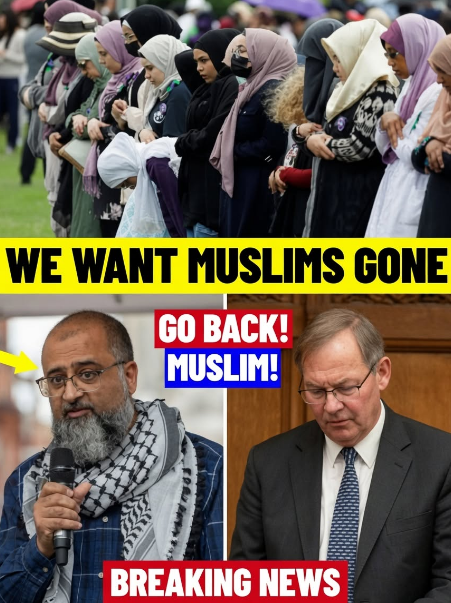
The incident comes at a time when immigration remains one of the most politically sensitive issues in the United Kingdom. Years after Brexit fundamentally reshaped discussions surrounding border control and national sovereignty, questions surrounding legal migration, asylum policy, integration, labor shortages, and social cohesion continue to dominate political discourse. Public opinion surveys have consistently shown immigration ranking among the issues that many voters consider most important, alongside the economy, healthcare, housing, and the cost of living.
Although the exchange itself lasted only a short time, it quickly became one of the most discussed political clips online. Numerous versions of the video were shared across multiple platforms, often accompanied by commentary supporting one side or criticizing the other. Some posts portrayed the encounter as evidence of growing frustration over immigration policy, while others argued that short excerpts removed important context from a more complex parliamentary discussion. As with many viral political videos, different audiences interpreted the same footage in very different ways.
According to publicly shared descriptions of the exchange, Rupert Lowe challenged aspects of Britain’s current immigration system while raising broader questions about integration and the government’s long-term strategy. Lowe has frequently argued that immigration policy should prioritize border security, effective enforcement of existing laws, and measures designed to strengthen social cohesion. Throughout his political career, he has repeatedly stated that the United Kingdom should exercise greater control over migration levels while ensuring that newcomers integrate successfully into British society.
The Muslim MP involved in the exchange reportedly responded by defending principles of equality, democratic participation, and religious freedom while emphasizing that immigration debates should avoid broad generalizations about particular communities. Such responses reflect positions frequently expressed by MPs across several political parties, many of whom argue that criticism of immigration policy should remain carefully separated from judgments about individual ethnic or religious groups. They maintain that political disagreements over migration should not undermine the rights of citizens who fully participate in British society regardless of their faith or background.
Although the specific wording exchanged during the debate has generated extensive commentary, the broader issues raised are far from new. Britain has spent decades balancing competing priorities: maintaining effective border controls while meeting labor market needs, honoring international legal obligations while responding to public concerns, and encouraging integration while protecting individual freedoms guaranteed under British law. Each of these objectives presents significant policy challenges, and governments led by different political parties have often struggled to satisfy competing expectations.
Supporters of Rupert Lowe argue that politicians should be willing to discuss immigration openly without fear of accusations of prejudice. They contend that concerns surrounding housing shortages, pressure on public services, illegal migration, wage competition in certain sectors, and community integration deserve honest public debate. From this perspective, avoiding difficult conversations risks further eroding public trust in political institutions and allowing frustrations to grow unchecked.
Those critical of Lowe’s remarks offer a different perspective. They argue that political leaders carry a responsibility to ensure discussions about immigration remain evidence-based and carefully framed. Critics warn that broad or highly charged rhetoric may unintentionally contribute to increased social tension, particularly when debates involve religion, ethnicity, or national identity. They emphasize that millions of British citizens from diverse backgrounds contribute positively to public life and should not be viewed through the lens of contentious immigration disputes.
The parliamentary exchange has also highlighted the growing influence of social media in shaping political narratives. Short video clips frequently receive millions of views within hours, often reaching audiences before longer recordings or official transcripts become widely available. As a result, public impressions are sometimes formed from isolated moments rather than complete debates. Analysts increasingly note that viral political content can amplify emotional reactions while reducing opportunities for nuanced discussion.
Immigration remains one of the defining political issues of modern Britain. Government statistics show that migration patterns have shifted considerably over recent decades, influenced by changing labor market demands, humanitarian crises, international conflicts, educational migration, and post- Brexit immigration reforms. Policymakers continue to debate how best to balance economic needs with public expectations regarding border management and community integration.
Questions surrounding integration have become particularly significant within these discussions. Some politicians argue that successful integration requires newcomers to develop strong English- language skills, participate actively in civic life, understand British legal and democratic traditions, and respect the country’s constitutional framework. Others emphasize that integration should be viewed as a two-way process in which both newcomers and established communities work together to build mutual understanding while respecting cultural diversity.
Religious freedom represents another important dimension of the wider debate. The United Kingdom has longstanding legal protections safeguarding freedom of religion, freedom of expression, and equal treatment under the law. Political discussions occasionally arise over how these principles interact with public policy concerning schools, local government, public demonstrations, and community practices. Courts, Parliament, and successive governments have frequently addressed these issues through legislation and judicial decisions intended to balance competing rights.
Political observers note that debates involving immigration often reflect broader questions about national identity rather than migration alone. Discussions may encompass citizenship, cultural traditions, economic opportunity, security, education, and the evolving character of British society. Because these issues touch upon personal experiences and deeply held values, public
conversations frequently become emotionally charged even when participants agree on many underlying principles.
The exchange involving Rupert Lowe has also drawn attention because it illustrates the increasingly fragmented nature of British politics. While the Conservative and Labour parties remain dominant, newer political movements and independent MPs have sought to capitalize on public dissatisfaction regarding immigration, economic pressures, and trust in government. Figures such as Lowe have attracted support from voters who believe mainstream parties have failed to address concerns they consider important, while opponents argue that simplified solutions cannot adequately address highly complex policy challenges.
Commentators across the political spectrum have offered differing interpretations of the confrontation. Some view it as evidence that immigration will remain central to future elections, regardless of which party forms government. Others believe the exchange demonstrates how political debate is increasingly shaped by viral moments rather than detailed policy discussions. Several analysts have also pointed out that parliamentary exchanges often become symbolic events that reflect larger ideological disagreements extending far beyond the specific conversation itself.
The role of media coverage has become another point of discussion. Traditional news organizations have generally sought to report the incident within the broader context of Britain’s ongoing immigration debate, while social media posts have often emphasized the most confrontational moments. Media researchers frequently observe that audiences today encounter political information through a mixture of journalism, commentary, personal opinion, and algorithm-driven recommendations, making it increasingly important to distinguish verified reporting from interpretation or advocacy.
Public opinion remains divided on many aspects of immigration policy. Surveys conducted over recent years have shown that many Britons support controlled legal immigration while expressing concern about irregular migration and the capacity of public services. Others emphasize the economic contributions made by migrants, including workers in healthcare, education, technology, construction, agriculture, hospitality, and numerous other sectors. These differing priorities help explain why immigration consistently generates vigorous political debate across the country.
Legal experts often remind observers that immigration policy operates within both domestic legislation and international agreements. Governments must consider obligations under refugee law, human rights legislation, border security requirements, and various international treaties when designing immigration systems. Consequently, proposed reforms frequently involve complex legal considerations rather than simple political choices.
Community organizations have likewise responded in different ways. Some groups advocate stronger immigration controls alongside enhanced integration initiatives, while others focus on protecting the rights of refugees, asylum seekers, and minority communities. Many local organizations emphasize practical cooperation at the community level, arguing that successful integration depends on education, employment opportunities, language support, and constructive dialogue between residents from different backgrounds.
Political debate over immigration is unlikely to diminish in the near future. Ongoing pressures associated with global migration, economic uncertainty, demographic change, international conflicts, and labor market demands suggest that questions surrounding border policy and integration will remain prominent across future elections. Parliamentary exchanges such as the one involving Rupert Lowe therefore resonate not only because of the individuals involved but also because they reflect broader national conversations that have evolved over many years.
As the widely shared video continues to circulate online, viewers encounter sharply contrasting interpretations depending on the sources they follow and the perspectives they bring to the discussion. Some regard the exchange as an example of elected representatives openly addressing concerns they believe many voters share. Others view it as a reminder of the need for careful language and responsible political leadership when discussing subjects capable of affecting social
cohesion.
Ultimately, the parliamentary confrontation has become another chapter in Britain’s continuing conversation about immigration, integration, democratic debate, and national identity. While opinions remain deeply divided, the exchange illustrates how these issues continue to shape political discourse across the United Kingdom. As with many highly publicized political moments, the lasting significance of the debate will likely depend less on a single viral clip than on the broader policy discussions, legislative decisions, and public conversations that follow.