
Violent Clashes During Manchester Demonstration Renew National Debate Over Public Order, Protest Rights and Community Tensions
A confrontation between opposing groups during a public demonstration in Manchester has renewed debate across the United Kingdom over public safety, freedom of assembly and the increasingly polarized atmosphere surrounding migration. Videos circulating on social media show tense moments in which demonstrators and counter-demonstrators came into conflict, prompting a rapid police response and widespread public discussion. However, many of the dramatic claims accompanying the footage-including descriptions of a nationwide “street war,” “pure bloodbath,” or assertions that “millions of people were left terrified-cannot be verified and should be regarded as rhetorical language rather than established fact. What is clear is that the incident has once again highlighted the challenges authorities face in managing highly charged public protests.
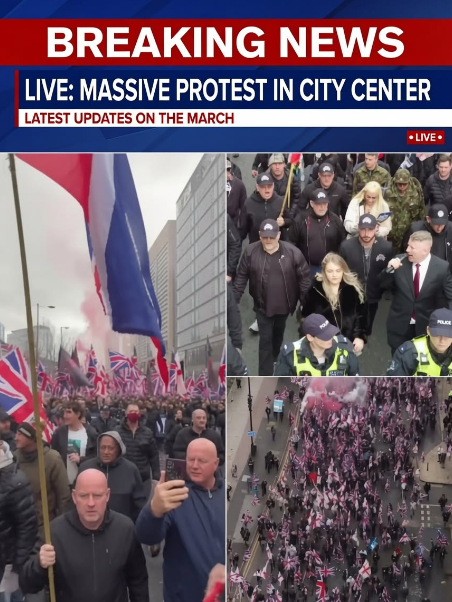
According to reports from the scene, demonstrators with differing political views gathered in central Manchester, where tensions escalated into physical confrontations involving punches, pushing and attempts by police officers to separate opposing groups. Emergency services responded to maintain public order while officers established barriers between rival demonstrations. Videos shared online captured isolated moments of disorder, though individual clips do not necessarily represent the entirety of the event or the behavior of all participants.
Greater Manchester Police have consistently emphasized that their operational priority during demonstrations is to facilitate lawful protest while intervening where criminal offences or threats to public safety occur.
Officers managing politically sensitive events are typically required to balance competing legal rights, including freedom of peaceful assembly, freedom of expression and the protection of public order. Police investigations following such incidents often rely on body-wom camera footage, CCTV recordings, witness statements and publicly submitted videos to identify individuals suspected of criminal offences.
The demonstration itself reflected broader national disagreements over immigration policy. Groups critical of current migration policies argued that Britain requires stronger border controls, more effective enforcement against illegal entry and greater action to address public concerns regarding housing, public services and community integration. Many participants maintained that they were exercising their democratic right to express dissatisfaction with government policy through peaceful protest.
Counter-demonstrators, however, argued that large anti-migration demonstrations risk increasing hostility toward minority communities and migrants who are lawfully living in Britain. They maintained that many of the slogans used during such protests oversimplify complex immigration issues and may contribute to social division. Organizers of counter-events often describe their objective as defending multiculturalism, opposing racism and supporting inclusive community relations rather than restricting legitimate political debate.
As with many politically sensitive demonstrations, the overwhelming majority of participants appeared to remain peaceful despite isolated outbreaks of violence. Police authorities frequently stress that most demonstrators cooperate with officers and exercise their rights responsibly. Nevertheless, relatively small groups engaging in disorder can quickly dominate public attention once dramatic footage begins circulating online. This dynamic often shapes public perceptions more strongly than the broader reality of the event.
The role of social media has become particularly significant in incidents of this nature. Within minutes of the confrontation, numerous videos were uploaded across multiple platforms, often accompanied by highly emotional captions describing Britain as descending into chaos or civil conflict. Communications researchers note that such descriptions frequently exaggerate localized events by presenting them as evidence of nationwide collapse. While individual confrontations deserve serious attention, they should not automatically be interpreted as representative of conditions across the country.
Political leaders from different parties have responded according to their respective priorities. Politicians advocating stricter immigration policies argue that repeated demonstrations reflect genuine public frustration regarding border security and government performance. They contend that dismissing these concerns risks further alienating voters who believe successive governments have failed to address irregular migration effectively. According to this perspective, public
demonstrations represent an expression of democratic dissatisfaction rather than the cause of broader social tensions.
Other political leaders have emphasized the importance of distinguishing between peaceful protest and criminal violence. They argue that democratic societies depend upon the right to demonstrate lawfully while rejecting intimidation, assaults and disorder regardless of the political views involved.
Many also caution against language that portrays entire communities as responsible for the actions of a small number of individuals participating in violent incidents.
Migration remains one of Britain’s most contested political issues. Small boat crossings across the English Channel, asylum processing delays, legal migration levels and border enforcement continue to generate extensive parliamentary debate and public discussion. Different political parties propose sharply contrasting solutions, ranging from expanded international cooperation and asylum reform to significantly stricter deportation policies and legal changes. These disagreements increasingly shape political demonstrations across the country.
Community leaders have urged restraint following the Manchester confrontation. Representatives from local organizations have encouraged residents not to allow isolated incidents of violence to damage relationships between different communities. Many have emphasized that disagreements over public policy should remain within democratic institutions and peaceful public debate rather than escalating into physical confrontation. Religious organizations, civic groups and local charities have similarly called for calm while encouraging constructive dialogue.
Experts studying political polarization observe that emotionally charged issues such as immigration, national identity and public security can increase the likelihood of confrontation during demonstrations. However, they caution against interpreting every violent protest as evidence of irreversible social breakdown.
Democratic societies have historically experienced periods of intense political disagreement while continuing to resolve disputes primarily through elections, parliamentary debate and legal institutions rather than sustained civil unrest.
The legal framework governing public demonstrations in Britain attempts to balance competing rights and responsibilities. Individuals generally possess the right to assemble peacefully and express political opinions, while police retain powers to impose conditions where necessary to prevent serious disorder, protect public safety or minimize significant disruption.
Where violence occurs, participants may face criminal investigation regardless of the cause they support. These principles apply equally to demonstrators and counter-demonstrators.
The widespread sharing of dramatic footage has also renewed discussion regarding responsible reporting during periods of heightened political tension. Journalists, researchers and fact-checking organizations frequently encourage viewers to examine complete sequences rather than relying exclusively on brief clips accompanied by sensational captions. A few seconds of video may accurately capture a violent incident while omitting the events preceding it, the police response or the fact that disorder involved only a limited number of participants within a much larger gathering.
For local residents and businesses, the immediate concern remains practical rather than ideological. Temporary road closures, transport disruption, increased police presence and uncertainty surrounding demonstrations can affect daily life regardless of individual political views. City authorities generally work alongside emergency services and community organizations to restore normal conditions as quickly as possible following significant public disturbances.
Ultimately, the Manchester confrontation illustrates the increasingly difficult task of maintaining peaceful democratic debate during periods of political polarization. Strong disagreements over migration, public policy and national identity are likely to remain central features of British politics. Whether these debates strengthen democratic participation or contribute to further confrontation will depend not only on government policy but also on the willingness of political leaders, demonstrators and the wider public to reject violence while protecting the legitimate right to peaceful protest. Although the language of a nationwide “street war” is not supported by verified evidence, the incident nevertheless serves as a reminder that maintaining civil discourse remains an important challenge for British society as contentious political issues continue to shape public life.