
“WE WILL NOT YIELD AN INCH”: GIORGIA MELONI’SWARNING AFTER THE CEUTA MIGRANT SURGEREIGNITES EUROPE’S BORDER DEBATE
Europe’s long-running debate over migration and border security has once again moved to the
center of political discussion following an extraordinary surge of migrants into the Spanish
autonomous city of Ceuta, a small but strategically significant territory located on the northern coast of Africa. The images emerging from the border have reignited concerns across the continent about migration management, border enforcement, international cooperation, humanitarian obligations, and the future of Europe’s asylum system.
Among the leaders responding most forcefully to the developments was Italian Prime Minister Giorgia Meloni, who declared that Italy “will not yield an inch” when it comes to protecting its national borders. Her remarks have once again placed Italy at the forefront of Europe’s migration debate while prompting renewed discussions about how the European Union should respond to increasingly complex migration pressures.
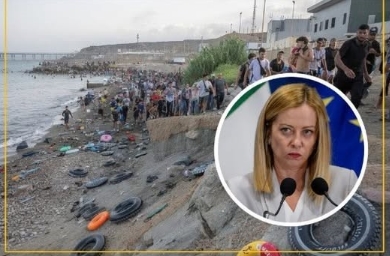
The developments in Ceuta attracted immediate international attention because the Spanish enclave occupies a unique geopolitical position. Ceuta, together with the nearby enclave of Melilla, represents one of the European Union’s only land borders with Africa. For decades these territories have served as focal points for migration attempts by people hoping to enter Europe. Although migration flows through Ceuta have fluctuated over time, sudden large-scale crossings have repeatedly tested the capacity of Spanish authorities and have often become symbolic moments in wider European political debates about border control. The latest surge once again highlighted how quickly local events can evolve into continent-wide discussions involving security, diplomacy, humanitarian policy, and domestic politics.
Spanish authorities responded by increasing security operations while coordinating with national agencies responsible for migration management. Officials worked to restore order, process arrivals, and assess the legal status of individuals entering the enclave. As in previous migration incidents, questions quickly emerged regarding asylum eligibility, humanitarian assistance, border procedures, and the responsibilities shared between Spain and the wider European Union. European institutions have consistently emphasized that member states must balance effective border management with their obligations under international refugee and human rights law, making each major migration event a complex legal as well as political challenge.
Against this backdrop, Giorgia Meloni issued one of the strongest political responses among European leaders. Declaring that Italy would not surrender control of its borders, she argued that governments have a primary responsibility to ensure national security while maintaining orderly immigration systems. According to public statements, Meloni indicated that Italy would be prepared to consider “extraordinary measures” if circumstances required additional action to safeguard the country’s frontiers and protect public safety. While the precise scope of such measures was not fully detailed, the remarks were widely interpreted as reinforcing her government’s longstanding commitment to strict border enforcement and tougher migration policies.
Meloni’s comments are consistent with the political platform that has characterized her administration since taking office. Her government has repeatedly argued that uncontrolled migration places significant pressure on national infrastructure, social services, public finances, and border authorities. Italian officials have maintained that preventing irregular migration is essential not only for national security but also for preserving the integrity of legal immigration systems. Supporters of this approach contend that governments cannot effectively manage asylum procedures or humanitarian programs unless irregular entry is significantly reduced.
Italy’s geographic position has made migration a particularly prominent political issue. Located in the central Mediterranean, the country has for years served as one of the principal arrival points for migrants crossing from North Africa. Thousands of people have attempted dangerous sea journeys aboard overcrowded and often unseaworthy vessels operated by sophisticated human smuggling networks. Italian coast guard personnel, humanitarian organizations, and naval authorities have conducted countless rescue operations over the years, while successive governments have struggled to balance humanitarian responsibilities with public demands for stronger migration control.
Supporters of Meloni’s approach argue that Europe has underestimated the scale of the migration challenge for too long. They contend that organized criminal smuggling networks continue to exploit weaknesses in border management while encouraging vulnerable individuals to undertake dangerous journeys across land and sea. From this perspective, stronger border enforcement is viewed not only as a security measure but also as a humanitarian strategy aimed at discouraging life-threatening migration routes and weakening criminal organizations that profit from illegal crossings.
Those who support stricter migration policies also point to concerns regarding public confidence in immigration systems. Opinion surveys conducted in several European countries over recent years have consistently shown migration ranking among the most important issues for many voters. Rising housing costs, strained healthcare systems, educational pressures, and concerns over integration have contributed to calls for governments to exercise greater control over migration flows. Advocates argue that maintaining secure borders strengthens public trust while allowing governments to continue accepting migrants and refugees through lawful and regulated channels.
Critics, however, caution against framing migration primarily as a security issue. Human rights organizations, refugee advocacy groups, and many legal experts emphasize that people arriving at European borders often include individuals fleeing war, persecution, political instability, or severe economic hardship. They argue that every individual deserves an assessment of their legal circumstances under international refugee law and that governments should avoid policies that may undermine humanitarian protections. Critics further warn that overly restrictive approaches could increase risks for vulnerable migrants by pushing them toward even more dangerous routes.
International law adds another layer of complexity to the debate. European states are bound by various international treaties governing asylum procedures, refugee protection, and human rights obligations. Governments therefore face the challenge of simultaneously enforcing border controls while ensuring that asylum seekers have access to fair legal processes. This balance has proven difficult in practice, particularly during periods of sudden mass arrivals that place enormous operational pressure on border authorities.
The events in Ceuta also underscored the importance of cooperation between Spain and Morocco. The relationship between the two neighboring countries has long influenced migration patterns around the Spanish enclaves. Diplomatic cooperation on border security, law enforcement, and migration management has historically played a significant role in reducing irregular crossings. At times, however, political disagreements between the two countries have coincided with increased migration pressures, highlighting the close connection between international diplomacy and migration management.
Within the European Union, the incident renewed discussion about burden sharing among member states. Countries located along the Mediterranean often argue that they shoulder a disproportionate share of migration responsibilities due to their geographic location. Italy, Greece, Spain, Malta, and Cyprus have repeatedly called for broader European solidarity, including more equitable relocation mechanisms, stronger external border protection, and increased financial support. Northern and eastern European member states have sometimes advocated different approaches, leading to prolonged negotiations over migration reform within EU institutions.
Meloni has consistently argued that migration should be addressed at its source rather than solely at Europe’s borders. Her government has promoted increased cooperation with countries of origin and transit, emphasizing investment, development partnerships, anti-smuggling initiatives, and strengthened border controls in North Africa. Supporters believe that reducing incentives for irregular migration while improving economic opportunities in migrants’ home countries represents a more sustainable long-term strategy than relying exclusively on border enforcement.
The broader European migration debate has increasingly reflected differing political philosophies regarding sovereignty, security, integration, and humanitarian responsibility. Conservative and center-right parties across several European countries have generally advocated stronger border controls, faster deportation procedures for individuals without legal permission to remain, and tighter asylum rules. Progressive parties have often emphasized humanitarian obligations, international legal commitments, and expanded pathways for legal migration while supporting reforms that preserve refugee protections.
The Ceuta developments occurred during a period when migration has remained one of Europe’s defining political issues. Elections across multiple countries have demonstrated that migration policy continues to influence voter behavior significantly. Governments of differing political orientations have faced pressure to respond to public concerns about border security while maintaining compliance with domestic constitutional requirements and international legal obligations. As a result, migration policy has become increasingly central to broader debates over national identity, economic sustainability, and European integration.
Experts note that migration is driven by multiple interconnected factors extending far beyond border policy alone. Armed conflict, political instability, climate change, demographic trends, economic inequality, and organized criminal networks all contribute to migration flows. Consequently, many analysts argue that no single policy can fully address migration pressures without broader international cooperation involving development assistance, conflict resolution, economic partnerships, and coordinated law enforcement efforts targeting human trafficking organizations.
Italy itself has experienced repeated migration crises over the past decade, shaping public opinion and influencing successive governments regardless of political orientation. Rescue operations in the Mediterranean, debates over NGO vessels, negotiations with neighboring countries, and discussions regarding relocation within the European Union have become recurring features of Italian domestic politics. Meloni’s administration inherited these longstanding challenges while promising a more assertive approach to border management and international negotiations concerning migration.
Spain likewise faces unique migration challenges because of its geographic position. In addition to Ceuta and Melilla, Spain also manages migration across the Mediterranean Sea and the Atlantic route to the Canary Islands. Spanish authorities have frequently cooperated with North African governments to reduce irregular migration while simultaneously maintaining humanitarian assistance for those arriving at European territory. The complexity of these operations illustrates the multiple dimensions of migration management involving diplomacy, policing, humanitarian aid, and judicial oversight.
The phrase “We will not yield an inch” resonated strongly because it reflected broader political messaging increasingly heard across Europe regarding national sovereignty and border protection. For supporters, such language demonstrates governmental determination to uphold the rule of law and preserve secure borders. Critics, meanwhile, caution that highly charged political rhetoric may intensify polarization surrounding migration debates and oversimplify an issue involving complex humanitarian, legal, and geopolitical considerations. As with many politically significant statements, public interpretation often depends upon broader ideological perspectives.
Media coverage of migration events has also become an important factor shaping public opinion. Dramatic images of crowded border crossings, rescue operations, and security responses often spread rapidly across television broadcasts and social media platforms. While visual reporting can raise awareness of important developments, experts frequently caution against drawing broad conclusions from isolated incidents without considering longer-term migration trends, official statistics, and verified information. Responsible reporting remains particularly important when early reports continue to develop and not all facts have yet been independently confirmed.
As European policymakers continue negotiations over reforms to migration and asylum systems, incidents such as the Ceuta surge are likely to remain influential. They serve as reminders of the operational challenges facing border authorities while also highlighting the continuing humanitarian responsibilities associated with international migration. Future policy decisions will likely involve ongoing efforts to strengthen external border management, improve asylum processing efficiency. enhance cooperation with neighboring countries, combat human smuggling networks, and develop legal migration pathways where appropriate.
Ultimately, the renewed attention surrounding Giorgia Meloni’s warning reflects a broader reality confronting Europe. Migration remains one of the continent’s most politically sensitive and strategically significant issues, with no simple solutions capable of satisfying every legal, humanitarian, economic, and security consideration simultaneously. The events in Ceuta have once again demonstrated how developments at a single border crossing can reverberate across the European Union, influencing political discourse far beyond the immediate region.
Whether governments prioritize stronger enforcement, expanded humanitarian protections, deeper international cooperation, or a combination of these approaches, the debate is likely to continue shaping European politics for years to come. As additional verified information emerges regarding both the Ceuta incident and any subsequent policy measures announced by European governments, public discussion will undoubtedly continue, reflecting the complexity of an issue that remains central to Europe’s future.