IRELAND IN TOTAL SHUTDOWN?” Mass Protest Claims Ignite Nationwide Debate as Questions Swirl Over Public Anger, Political Pressure, and the Country’s Future
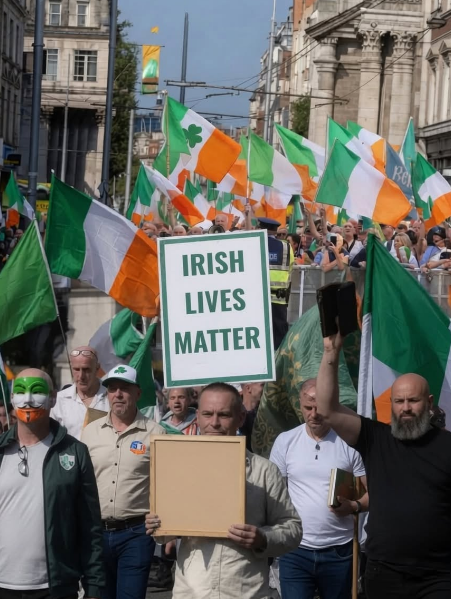
Ireland has once again become the focus of intense political discussion after dramatic claims circulating online alleged that as many as 200,000 people gathered outside Parliament during a nationwide protest, fueling speculation about growing dissatisfaction with the government. While images and videos shared across social media have generated enormous public attention, official figures and independent verification of crowd estimates have varied, highlighting the importance of distinguishing between confirmed facts and online narratives. Nevertheless, the demonstrations have renewed debate over immigration, housing, the cost of living, public services, and confidence in political leadership. Supporters describe the protests as a powerful expression of public frustration, while critics caution against exaggerating events or drawing premature conclusions about Ireland’s political future. Whatever the final assessment, the controversy has once again placed Ireland’s domestic politics under an international spotlight.
For several years, Ireland has experienced increasingly heated debates surrounding immigration policy, housing shortages, inflation, healthcare capacity, and broader concerns about the country’s rapid demographic and economic changes. Although the Irish economy has continued to perform strongly by many international measures, many households have simultaneously faced rising living costs and increasing pressure on essential services. These parallel realities have created a political environment in which economic success at the national level does not necessarily translate into public satisfaction at the individual level. As a result, demonstrations and political activism have become increasingly visible across different parts of the country. Many analysts argue that understanding the current mood requires looking beyond individual protests to the broader social trends that have developed over recent years.
The latest demonstrations reportedly attracted participants from a wide range of backgrounds, each bringing different priorities and motivations. Some attendees focused primarily on immigration and border policy, while others emphasized housing affordability, healthcare waiting lists, taxation, rural development, and government accountability. Protest organizers portrayed the gatherings as a grassroots movement reflecting widespread dissatisfaction, whereas government representatives
stressed that peaceful protest remains a fundamental democratic right but cautioned against interpreting any single event as representing the views of the entire population. Political observers noted that large demonstrations often combine multiple grievances rather than revolving around a single issue. That complexity has made it difficult to characterize the movement using simple political labels.
Among the most widely discussed claims circulating online was the suggestion that approximately 200,000 people had assembled near Ireland’s Parliament. Crowd estimates at major public demonstrations are frequently contested, however, with organizers, police, media outlets, and independent observers often reporting significantly different figures. Estimating attendance in large urban gatherings is inherently difficult, particularly when crowds move throughout the day and occupy multiple locations. Experts generally recommend caution when relying on early estimates until additional evidence becomes available. Consequently, while the scale of public participation has attracted considerable attention, precise attendance figures remain an important point of discussion rather than an established fact.
The protests have unfolded against the backdrop of ongoing political debates over Ireland’s immigration system. Government officials have argued that Ireland must balance humanitarian responsibilities with effective border management, while opposition voices have questioned whether existing policies adequately address growing public concerns regarding infrastructure, integration, and public services. Supporters of stricter immigration controls believe reforms are necessary to maintain public confidence, whereas advocates for refugee protection emphasize Ireland’s legal and humanitarian obligations under international agreements. These competing perspectives have produced one of the country’s most challenging political conversations in recent years. The demonstrations have therefore become part of a broader national discussion rather than an isolated event.
Housing has emerged as one of the central themes underlying public frustration. Ireland has experienced persistent shortages in available housing, rising rental prices, and increasing pressure on first-time homebuyers. Many families have struggled to secure affordable accommodation despite broader economic growth, creating concerns that the benefits of prosperity have not been evenly distributed. Protest participants have frequently linked housing pressures with broader questions regarding infrastructure planning, population growth, and long-term government strategy. Officials, meanwhile, have pointed to ongoing construction programs and housing initiatives intended to increase supply over time.
The cost-of-living crisis has also contributed significantly to the current political atmosphere. Inflation, energy prices, grocery costs, and mortgage payments have affected households across income levels, leading many citizens to express concerns about financial security. Although inflation
has moderated compared with previous peaks, many consumers continue to feel the cumulative impact of higher prices established during recent years. Public frustration over everyday expenses has become intertwined with wider political debates concerning taxation, public spending, and economic priorities. Demonstrations often reflect this broader economic anxiety alongside more specific policy concerns.
Healthcare remains another recurring issue in Irish political debate. Long waiting lists, staffing shortages, and increasing demand have placed pressure on hospitals and healthcare professionals. Critics argue that sustained investment and structural reform are necessary to improve patient outcomes, while government officials point to increased funding and ongoing modernization efforts. Protesters have cited healthcare as one example of broader concerns regarding the capacity of public services to meet growing demand. The discussion illustrates how multiple policy challenges can reinforce one another within public discourse.
Political analysts caution against interpreting large demonstrations as definitive evidence of imminent governmental instability. Democracies regularly experience substantial public protests without resulting in constitutional crises or government collapse. While visible demonstrations can influence public debate, legislative outcomes ultimately depend upon parliamentary arithmetic, political negotiations, elections, and constitutional processes. Ireland possesses established democratic institutions designed to manage periods of political disagreement. Consequently, speculation about governmental collapse should be distinguished from confirmed political developments.
Social media has played a significant role in shaping perceptions of the protests. Images, short videos, livestreams, and commentary have spread rapidly across multiple platforms, enabling millions of viewers both inside and outside Ireland to observe developments in real time. However, viral content frequently emphasizes the most dramatic moments, potentially creating impressions that differ from the broader reality on the ground. Fact-checkers and media analysts have repeatedly encouraged audiences to verify the origin, timing, and context of widely shared footage before drawing firm conclusions. Digital platforms have therefore become both powerful sources of information and potential sources of misunderstanding.
Government representatives have responded by acknowledging public concern while emphasizing their commitment to democratic dialogue. Officials have defended existing policies in some areas while indicating willingness to continue reviewing others through parliamentary processes. They have also urged citizens to rely upon verified information rather than speculation circulating online. Public statements have generally focused on maintaining public order, protecting the right to peaceful assembly, and continuing normal governmental operations. Such responses reflect the balancing act faced by democratic governments during periods of heightened political tension.
Opposition parties have interpreted the demonstrations through differing political lenses. Some argue that the protests reveal growing dissatisfaction with government performance and demonstrate the need for significant policy changes. Others emphasize that individual
demonstrations should not automatically be viewed as representative of nationwide public opinion. Political leaders across the spectrum have sought to frame the events in ways consistent with their broader policy agendas. As a result, the demonstrations have become an important feature of Ireland’s wider political conversation.
International observers have also monitored developments closely, particularly given similar debates occurring across Europe concerning migration, economic pressures, housing availability, and public trust in institutions. Several European countries have experienced demonstrations addressing related concerns, although each national context differs substantially. Analysts note that Ireland’s experience should therefore be understood within its own constitutional, economic, and historical framework rather than assumed to mirror developments elsewhere. Comparative analysis can provide useful perspective while recognizing important national differences.
One recurring theme throughout public discussion has been confidence in democratic institutions. Even among citizens who disagree sharply on specific policies, many emphasize the importance of resolving disputes through peaceful protest, elections, parliamentary debate, and lawful civic participation. Ireland’s constitutional framework provides mechanisms for political change through democratic means, including general elections, legislative reform, and judicial review. These institutions have historically demonstrated resilience during periods of significant public
disagreement. Maintaining public confidence in those processes remains an important objective for political leaders.
Economic considerations continue to influence public attitudes. Ireland has attracted substantial international investment and achieved strong macroeconomic indicators over many years, yet concerns remain regarding affordability, regional inequality, infrastructure capacity, and access to public services. Economists often distinguish between national economic performance and individual household experiences, noting that both perspectives can simultaneously contain elements of truth. Political debates frequently emerge where these differing experiences intersect. The demonstrations have highlighted that complexity.
Media coverage itself has become part of the story. Different outlets have emphasized different aspects of the demonstrations, including attendance, political messaging, policing, economic grievances, or constitutional implications. This diversity of coverage reflects broader differences in editorial priorities rather than necessarily indicating factual disagreement on every issue. Readers are therefore encouraged to consult multiple reputable sources when evaluating rapidly developing
political events. Balanced reporting remains particularly important during periods of heightened public emotion.
Experts in public policy suggest that the underlying issues raised by demonstrators are unlikely to disappear quickly. Housing supply, healthcare capacity, infrastructure investment, immigration management, and affordability represent long-term challenges requiring sustained policy responses. Regardless of the size of any individual demonstration, these topics are expected to remain central features of Irish political debate in the years ahead. Policymakers from across the political spectrum will likely continue proposing differing approaches to address them. Public engagement is therefore expected to remain high.
At the same time, constitutional experts caution against dramatic predictions unsupported by evidence. Headlines suggesting immediate governmental collapse often attract substantial attention online, but constitutional change generally follows clearly defined legal and political processes. Governments may face criticism, declining popularity, or electoral setbacks without necessarily approaching institutional breakdown. Distinguishing between political pressure and constitutional crisis remains essential for accurate reporting. Precision in language helps preserve public understanding during fast-moving events.
The coming weeks and months may provide a clearer picture of the demonstrations’ lasting political significance. Future opinion polls, parliamentary debates, policy announcements, and electoral developments will offer additional evidence regarding public sentiment and governmental stability. Whether the protests represent a temporary surge of public frustration or the beginning of a broader political realignment remains an open question. Analysts will continue examining both immediate reactions and longer-term trends before drawing definitive conclusions.
For now, Ireland finds itself at the center of another highly visible national debate-one shaped by passionate public opinion, competing political narratives, and complex policy challenges. While dramatic headlines have fueled widespread international attention, many of the most important questions remain unresolved. What is clear is that issues such as housing, immigration, affordability, healthcare, and public confidence in government will continue to influence Irish politics well beyond the latest demonstrations. As additional verified information emerges, the full significance of these events will become easier to assess through evidence rather than speculation.